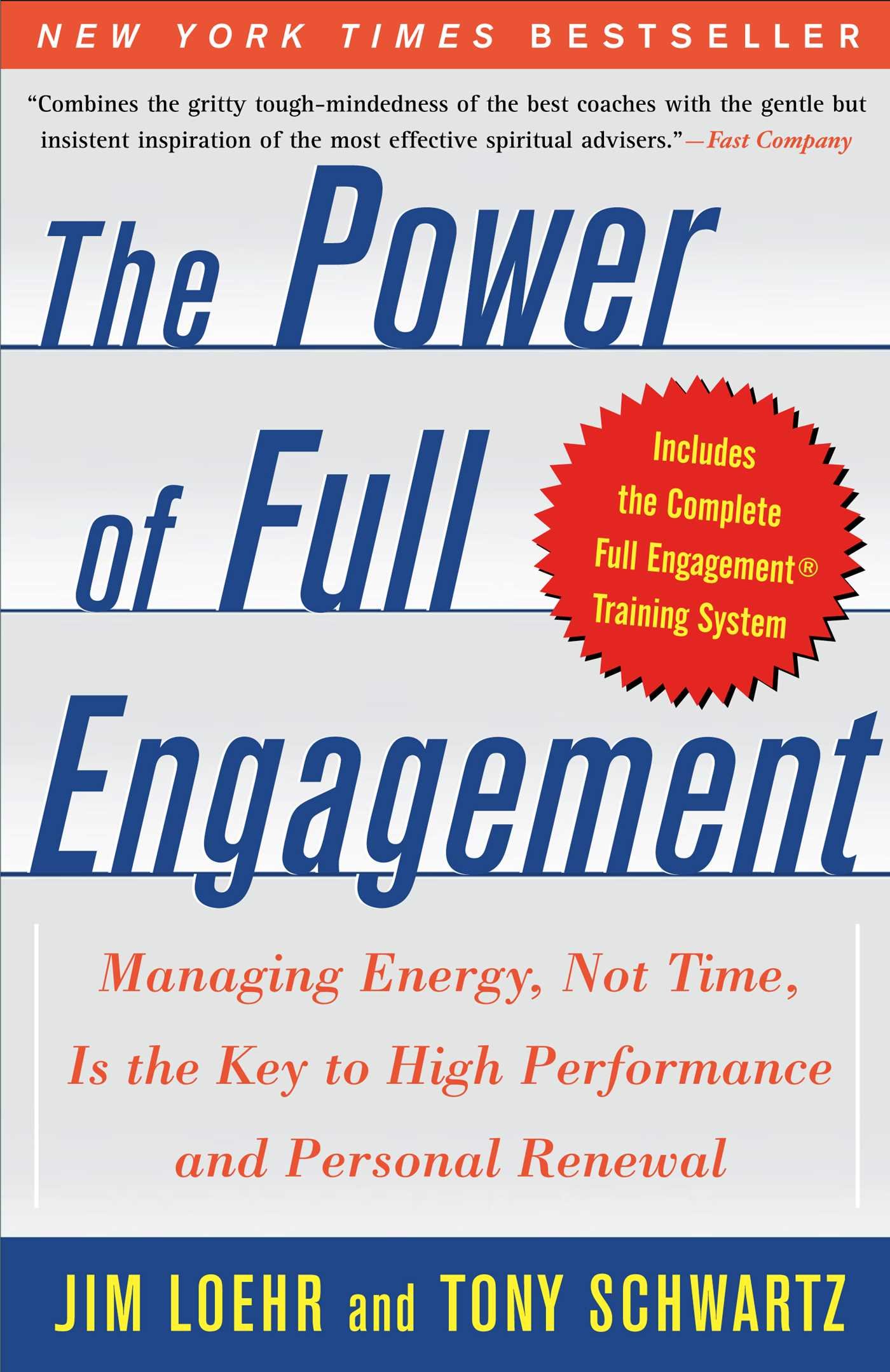
The Power of Full Engagement: Managing Energy, Not Time, is the Key to High Performance and Personal Renewal
About This Book
The Power of Full Engagement argues that energy, not time, is the fundamental currency of high performance. Drawing on their work training elite athletes and executives, Jim Loehr and Tony Schwartz contend that managing energy skillfully is the foundation of performance, health, and happiness.
The book rests on four core principles:
- Full engagement requires drawing on four related sources of energy: physical, emotional, mental, and spiritual.
- Because energy diminishes with both overuse and underuse, we must balance expenditure with intermittent renewal — a rhythmic wave the authors call oscillation.
- To build capacity, we must push beyond normal limits and train systematically, just as athletes do; stress is not the enemy but the key to growth.
- Positive energy rituals — highly specific routines — are the key to sustained high performance, because conscious will and discipline are far more limited than we realize.
Much of the book is grounded in physiology: ultradian rhythms that cycle every 90 to 120 minutes, the costs of chronic stress hormones, the importance of breathing, eating, sleep, and interval training. The authors warn against the linear, 24/7 culture that celebrates overwork and ignores recovery, citing phenomena like karoshi (death from overwork).
Lasting change follows a three-step process: Define Purpose, Face the Truth, and Take Action. Readers are urged to connect with their deepest values, honestly assess how they currently spend energy, and build personal-development plans grounded in precise rituals. The recurring metaphor — that emotional, mental, and spiritual "muscles" grow exactly like physical ones, through stress followed by recovery — ties the framework together into a practical, repeatable system for personal renewal.
Key Takeaways
- 1.Energy, not time, is the fundamental currency of high performance, health, and happiness.
- 2.Full engagement requires being physically energized, emotionally connected, mentally focused, and spiritually aligned with a purpose beyond self-interest.
- 3.Energy diminishes with both overuse and underuse, so life works best as a series of sprints — full engagement followed by full recovery, a rhythm called oscillation.
- 4.Capacity in every dimension grows like a muscle: by pushing past comfort zones and then recovering, since stress plus recovery produces growth.
- 5.Positive rituals beat willpower, because conscious discipline is a limited resource that depletes with every act of self-control.
- 6.Lasting change follows three steps: Define Purpose, Face the Truth, and Take Action — all necessary, none sufficient alone.
- 7.The 24/7 culture that celebrates overwork ignores recovery, leading to burnout, breakdown, and even death (karoshi).
Top Highlights
Because energy capacity diminishes both with overuse and with underuse, we must balance energy expenditure with intermittent energy renewal.
Highlighted by 4 people
To build capacity, we must push beyond our normal limits, training in the same systematic way that elite athletes do.
Highlighted by 4 people
To be fully engaged, we must be physically energized, emotionally connected, mentally focused and spiritually aligned with a purpose beyond our immediate self-interest.
Highlighted by 3 people
Full engagement requires drawing on four separate but related sources of energy: physical, emotional, mental and spiritual.
Highlighted by 3 people
Physical energy capacity is measured in terms of quantity (low to high) and emotional capacity in quality (negative to positive).
Highlighted by 3 people
To maintain a powerful pulse in our lives, we must learn how to rhythmically spend and renew energy.
Highlighted by 3 people
is the key to growth.
Highlighted by 3 people
Positive energy rituals—highly specific routines for managing energy—are the
Highlighted by 3 people
A positive ritual is a behavior that becomes automatic over time—fueled by some deeply held value.
Highlighted by 3 people
energy as possible where it is not absolutely necessary, leaving us free to strategically focus the energy available to us in creative, enriching ways.
Highlighted by 3 people
AI Review
Across 12 readers' highlights, Glasp's analysis finds strong consensus around the book's central thesis and its four energy-management principles, which are quoted and re-highlighted repeatedly.
Pros
- +Clear, memorable central thesis: manage energy, not time
- +Actionable framework built on positive rituals rather than willpower
- +Strong grounding in physiology (ultradian rhythms, recovery, nutrition, sleep)
- +Practical three-step change process: Purpose, Truth, Action
- +Versatile muscle metaphor applied across physical, emotional, mental, and spiritual dimensions
Cons
- −Frequent references to the authors' proprietary assessment and website can feel promotional
- −Some readers note the ideas overlap heavily with other works (e.g., Flow, NLP) and repeat across chapters
Glasp AI analysis based on highlights from 12 readers.
Who Should Read This
This book is for busy professionals, executives, and leaders who feel chronically overworked yet under-renewed, and who want a science-grounded system for sustaining performance. It suits anyone facing burnout, struggling with work-life balance, or seeking to build lasting habits through ritual rather than willpower. Coaches, athletes, and high achievers will recognize the training metaphors. No prior knowledge is required, though readers open to self-assessment and behavior change will gain the most.
Frequently Asked Questions
What is The Power of Full Engagement about?
Who is the book for?
What are the key lessons?
Is it worth reading?
Why do the authors say managing energy is better than managing time?
What are positive energy rituals and why do they matter?
How often should I take recovery breaks according to the book?
How to Apply What You Read
- 1.Schedule a deliberate recovery break every 90 to 120 minutes to honor your body's natural ultradian rhythm.
- 2.Define your deepest values and write a vision statement answering how you want to spend your energy.
- 3.Build one precise positive ritual at a time — specifying when, where, and how — and hold yourself accountable each day.
- 4.Audit how you currently manage energy physically, emotionally, mentally, and spiritually, gathering honest feedback from people close to you.
- 5.Adopt physical foundations: eat smaller frequent meals, drink water, sleep seven to eight hours, and use interval-style exercise.
Discussion Questions
- Q1.In which dimensions of your life are you overtraining (spending without recovery), and in which are you undertraining (not spending enough)?
- Q2.How would treating life as a series of sprints rather than a marathon change your daily habits?
- Q3.What deeply held values could fuel new rituals in your life, and which current habits work against them?
- Q4.Why do you think our culture rewards overwork and views recovery as weakness, and how might you resist that pressure?
- Q5.Where do you get your best ideas, and what does that reveal about the role of disengagement in your creativity?
- Q6.Which single ritual, built first, would most improve your energy management — and what makes it the right starting point?
- Q7.How does connecting to a purpose beyond self-interest change the energy you bring to challenges?
Recommended Books




Revisit Your Highlights, Deepen Your Understanding
Import your Kindle highlights to review, organize, and share the ideas that matter most to you.
Get the free browser extension