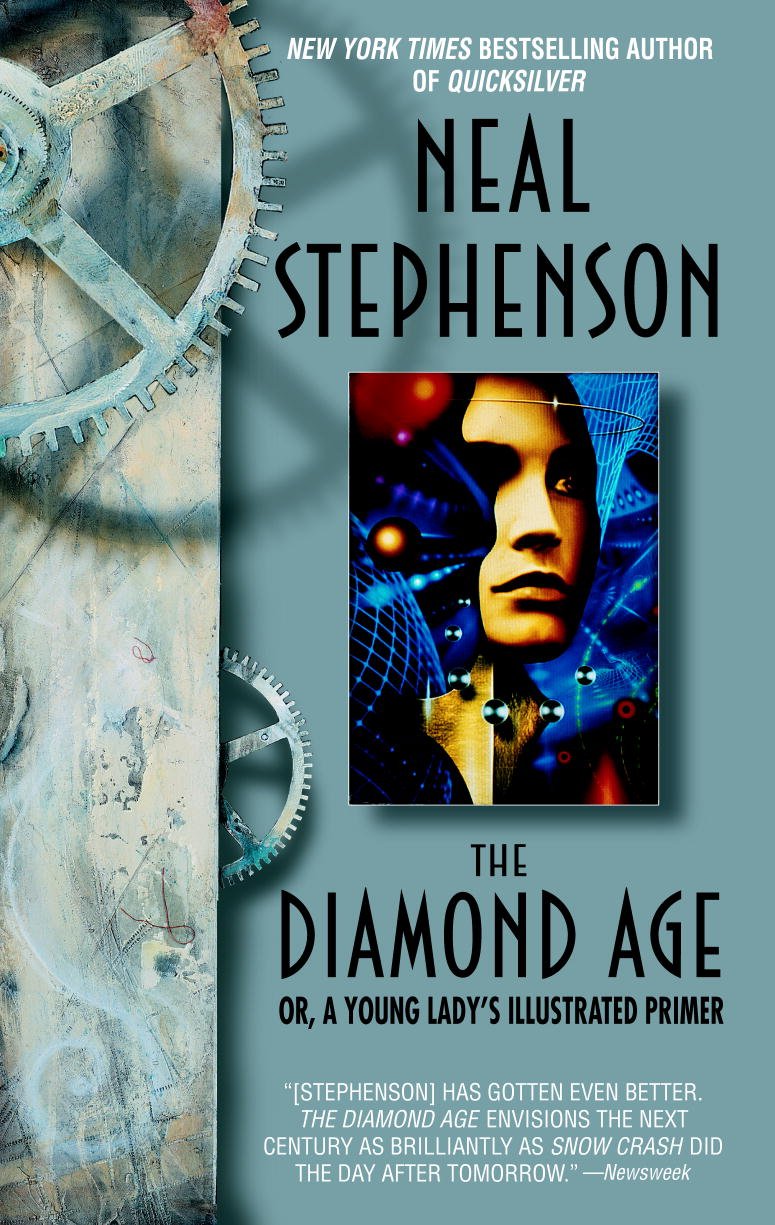
The Diamond Age: Or, a Young Lady's Illustrated Primer (Bantam Spectra Book)
About This Book
Neal Stephenson's The Diamond Age imagines a future transformed by nanotechnology, where matter compilers fed by Feeds can assemble nearly anything from raw atoms — making the central question no longer what technology can do, but what cultures should do with it. In this world the nation-state has dissolved into phyles: tribes bound not by geography but by shared values, the greatest of which is the neo-Victorian New Atlantis.
The novel follows the fate of a single device, A Young Lady's Illustrated Primer — an interactive, adaptive book engineered to educate and cultivate a privileged child, but which falls into the hands of Nell, a girl from the lowest rungs of society. Through the Primer, powered by distributed human performers called ractors, Nell teaches herself to read, reason, and ultimately to think for herself.
Across the highlights, several themes dominate:
- The conviction that some cultures thrive and others fail, and that moral qualities — not technology — are the true foundation of a society.
- The nature of real education: not the accumulation of facts, but the capacity to handle subtlety, ambiguity, and contradiction.
- The tension between the free flow of information and the discipline of a moral code.
Stephenson weaves Confucian philosophy (the cultivation of the person as the root of everything), Victorian social commentary, and sharp satire of media culture — where focus groups reduce entertainment to "tits, tires, and explosions." The Primer itself dramatizes how learning works: mapping universal archetypes onto one child's unique psychological terrain. The result is a dense, idea-rich saga about education, class, identity, and the moral scaffolding required when material scarcity vanishes.
Key Takeaways
- 1.In a post-scarcity world, the real question shifts from what technology can do to what a culture decides it should do.
- 2.A society is ultimately founded on moral qualities; prosperity and technology mean little without that foundation.
- 3.The difference between stupid and intelligent people is the ability to handle subtlety, ambiguity, and contradiction.
- 4.Genuine education cultivates a thinking person rather than merely transferring facts; being ignorant versus educated is not the same as being stupid versus intelligent.
- 5.Cultures that fail to propagate their values risk being swallowed up, forgotten, and scattered to the wind.
- 6.Treating information as a quasi-mystical force with no moral code confuses inevitability with what is right.
- 7.People are culturally, not genetically, divided; personality, not native intelligence, separates the classes in this world.
Top Highlights
suppositions,
Highlighted by 2 people
prevarication,
Highlighted by 2 people
“as most of our prospective customers do not share your diligent attention to detail insofar as that aspect of the arrangement is concerned.
Highlighted by 2 people
AI Review
Based on highlights from 3 readers, this is a richly conceptual novel whose most-saved passages cluster around culture, morality, and education rather than plot. Its ideas resonate strongly, though its density and vocabulary demand commitment.
Pros
- +A provocative meditation on culture and morality as the true foundation of society
- +The Illustrated Primer is a compelling vision of adaptive, personalized education
- +Imaginative nanotechnology world-building, including matter compilers and the Feed
- +Memorable aphorisms about intelligence, subtlety, and ambiguity
- +Sharp satire of media, class, and the economics of post-scarcity
Cons
- −Extremely dense vocabulary and allusion can slow or alienate readers
- −Ideas and world-building often outweigh narrative momentum and characterization
Glasp AI analysis based on highlights from 3 readers.
Who Should Read This
Readers who love idea-dense science fiction and cyberpunk will find this rewarding, especially those interested in nanotechnology, education, and the philosophy of culture. It suits fans of Stephenson's maximalist style who enjoy ornate vocabulary and dense world-building. Educators, technologists, and parents thinking about how children learn will connect with the Primer's adaptive-teaching premise. Expect a demanding read: it rewards patience, tolerance for ambiguity, and interest in moral and sociological questions as much as plot.
Frequently Asked Questions
What is The Diamond Age about?
Who is it for?
What are the key lessons?
Is it worth reading?
What is the Illustrated Primer?
What are phyles in the novel?
Why is the vocabulary so difficult?
How to Apply What You Read
- 1.Reflect on which values define your own community or "phyle," and how they are passed to the next generation.
- 2.Reconsider what education means in your life — prioritize the capacity to handle ambiguity over the memorization of facts.
- 3.Examine how you distinguish inevitability from rightness when adopting new technologies.
- 4.Keep a vocabulary list while reading and look up the ornate words to deepen comprehension.
- 5.Discuss the Primer's model of personalized learning with educators or parents and consider its real-world parallels.
Discussion Questions
- Q1.Does the novel convincingly argue that some cultures are "simply better" than others, or is that a troubling value judgment?
- Q2.How does the Primer's success with Nell challenge or reinforce ideas about class and opportunity?
- Q3.Is the claim that moral qualities are the foundation of society persuasive in a world of material abundance?
- Q4.What is the difference the book draws between being clever and being part of a tribe that remembers your contributions?
- Q5.How does Stephenson's satire of media ("tits, tires, and explosions") reflect concerns about entertainment today?
- Q6.Do you agree that intelligence is best measured by comfort with ambiguity and contradiction?
- Q7.What does the "Lesson of the Screwdriver" — learning from sources beyond your magic book — mean for how we rely on technology?
Recommended Books

Revisit Your Highlights, Deepen Your Understanding
Import your Kindle highlights to review, organize, and share the ideas that matter most to you.
Get the free browser extension