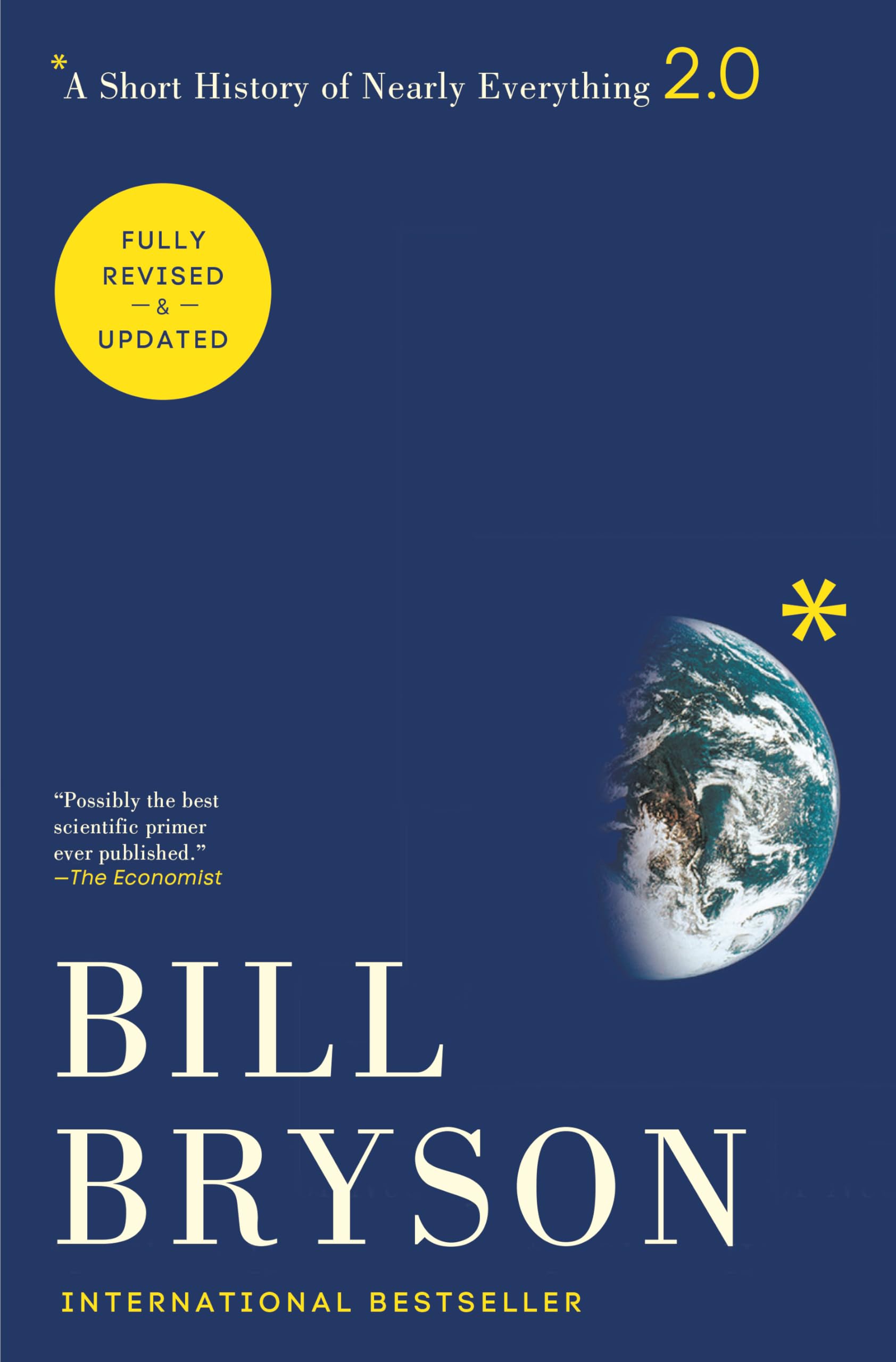
A Short History of Nearly Everything: 2.0
About This Book
A Short History of Nearly Everything: 2.0 is Bill Bryson's sweeping tour through the sciences — cosmology, astronomy, physics, chemistry, geology, and biology — written for the curious non-specialist. Rather than teaching formulas, Bryson conveys scale, wonder, and the sheer improbability of our existence, grounding abstract science in memorable, concrete images.
The highlights cluster around a few recurring themes. First, the staggering vastness of space: a to-scale model would place Earth as a pea and Pluto 1.6 miles away and no bigger than a bacterium, while Voyager 1 — hurtling outward for half a century — remains nowhere near the solar system's edge. The light we see from stars is ancient history; the North Star we admire may have burned out centuries ago.
Second, the origin and strangeness of the universe: from a dimensionless singularity, 98 percent of all matter formed in the first three minutes of the Big Bang, whose faint remnant still flickers as static on an untuned television. Relativity reveals that space and time bend with motion, and quantum reality means you never quite touch your chair — you levitate one angstrom above it on mutually repelling electrons.
Third, the fragility and luck of life: of all species that have ever existed, 99.99 percent are extinct. Earth is very good at promoting life but even better at extinguishing it. The fine-tuned constants that allow our existence hint at the anthropic principle — perhaps we simply inhabit the universe whose numbers happen to work.
Bryson closes on a humbling note: we live in a cosmos whose age we can't quite compute, filled with matter we can't identify, governed by laws we don't fully understand. The book's genius is making that uncertainty feel exhilarating rather than frightening.
Key Takeaways
- 1.The solar system is enormous — to-scale, Pluto would be a mile and a half away and invisibly tiny, and no human will ever reach its edge.
- 2.Nearly all life is fleeting: 99.99% of species that ever existed are extinct, and Earth both promotes and extinguishes life with ease.
- 3.Looking at the night sky is looking into the past — starlight shows stars as they were, and some may have already burned out.
- 4.Relativity means space and time are relative to the observer, and nothing can be accelerated to the speed of light.
- 5.At the quantum level you never truly touch anything — you levitate one angstrom above your chair on mutually repelling electrons.
- 6.The Big Bang's remnant is still observable as roughly 1 percent of the static on an untuned television.
- 7.We inhabit a universe fine-tuned for life, yet science still can't fully explain its age, its matter, or its governing laws.
AI Review
Based on highlights from 3 readers, this edition resonates most for its vivid, quotable explanations of cosmic scale and the improbability of life. Reader interest clusters tightly around its most memorable analogies.
Pros
- +Makes vast scales tangible through unforgettable analogies like the pea-sized Earth
- +Conveys the improbability of life — 99.99% of species extinct — with genuine awe
- +Explains dense ideas like relativity and quantum behavior in plain language
- +Memorable hooks such as Big Bang static on an untuned television
- +Honest about the limits of knowledge, making uncertainty feel exciting
Cons
- −Breadth over depth means specialists may find topics simplified
- −Some figures and estimates (e.g., Oort Cloud distances) remain speculative by nature
Glasp AI analysis based on highlights from 3 readers.
Who Should Read This
Ideal for curious general readers who find textbooks intimidating but love big questions about the universe, Earth, and life. Perfect for students seeking an engaging science overview, adults wanting to fill gaps in their science education, and anyone who enjoys wit paired with wonder. No prior scientific background is required — Bryson assumes none. Science enthusiasts who want fresh, quotable analogies and a sense of humility about what we still don't know will also find much to enjoy.
Frequently Asked Questions
What is the book about?
Who is it for?
What are the key lessons?
Is it worth reading?
How does the book convey the scale of space?
What does it say about the origins of the universe?
What is the book's overall message about human knowledge?
How to Apply What You Read
- 1.Visualize cosmic scale by building or sketching a to-scale solar system model to grasp just how empty space really is.
- 2.Observe the night sky with the knowledge that you are seeing ancient history, not the present.
- 3.Tune a television or radio to an empty channel and recognize part of that static as the echo of the Big Bang.
- 4.Reflect on the improbability of your own existence given that 99.99% of species have vanished.
- 5.Explore a specific topic Bryson touches — relativity, quantum behavior, or extinction — in greater depth to build on the overview.
Discussion Questions
- Q1.Which analogy from the book most changed how you picture the universe, and why?
- Q2.How does learning that 99.99% of species are extinct affect your view of life on Earth?
- Q3.If no human will ever reach the solar system's edge, what does that mean for our place in the cosmos?
- Q4.Does the anthropic principle — that we exist in the one universe with the right numbers — satisfy you as an explanation, or feel like a dodge?
- Q5.How comfortable are you with Bryson's conclusion that science still can't explain the universe's age, matter, or laws?
- Q6.What responsibility, if any, comes with understanding how rare and fragile life appears to be?
- Q7.Did the book make science feel more approachable to you? What topic would you now want to learn more about?
Recommended Books
Revisit Your Highlights, Deepen Your Understanding
Import your Kindle highlights to review, organize, and share the ideas that matter most to you.
Get the free browser extension