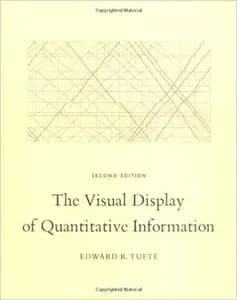
The Visual Display of Quantitative Information: Second Edition PAPERBACK
by Edward Tufte
Recommended byBrianne Kimmel
About This Book
"The Visual Display of Quantitative Information" is a highly regarded book written by Edward Tufte. In this enlightening and comprehensive work, Tufte explores the principles and practices of visualizing numerical data. Through meticulous analysis of various graphics, charts, and diagrams, he critically assesses their effectiveness in conveying information accurately and efficiently.
Tufte highlights the importance of clarity, simplicity, and precision in visual displays, emphasizing the essential goal of providing insightful and honest portrayals of quantitative information. Drawing on examples from diverse fields such as science, economics, and statistics, he demonstrates how effective data visualization can tremendously enhance understanding and decision-making.
The book delves into the subtleties of design elements, including graphical integrity, data-ink ratio, and the use of multiple dimensions. Tufte provides practical advice on how to improve the visual displays of information, advising readers on effective chart types, labeling techniques, and the selection of appropriate scales and orientations.
Moreover, Tufte investigates the potential pitfalls of misrepresenting data and presents a critical analysis of common graphical misrepresentations and distortions. By investigating notorious examples of deceptive visualizations and explaining the underlying principles that render them uninformative or biased, Tufte equips readers with the tools to identify and avoid such missteps.
"The Visual Display of Quantitative Information" is an essential reference for anyone involved in presenting data, whether in academia, business, or journalism. It challenges conventional practices, encouraging readers to think critically about how to best represent quantitative information visually, with an ultimate emphasis on fostering accurate understanding and insightful analysis.
Tufte highlights the importance of clarity, simplicity, and precision in visual displays, emphasizing the essential goal of providing insightful and honest portrayals of quantitative information. Drawing on examples from diverse fields such as science, economics, and statistics, he demonstrates how effective data visualization can tremendously enhance understanding and decision-making.
The book delves into the subtleties of design elements, including graphical integrity, data-ink ratio, and the use of multiple dimensions. Tufte provides practical advice on how to improve the visual displays of information, advising readers on effective chart types, labeling techniques, and the selection of appropriate scales and orientations.
Moreover, Tufte investigates the potential pitfalls of misrepresenting data and presents a critical analysis of common graphical misrepresentations and distortions. By investigating notorious examples of deceptive visualizations and explaining the underlying principles that render them uninformative or biased, Tufte equips readers with the tools to identify and avoid such missteps.
"The Visual Display of Quantitative Information" is an essential reference for anyone involved in presenting data, whether in academia, business, or journalism. It challenges conventional practices, encouraging readers to think critically about how to best represent quantitative information visually, with an ultimate emphasis on fostering accurate understanding and insightful analysis.
What People Are Saying
“Highly recommend Edward Tufte’s books for inspiration on ways to present information — charts, diagrams, dashboards”
Revisit Your Highlights, Deepen Your Understanding
Import your Kindle highlights to review, organize, and share the ideas that matter most to you.
Get the free browser extension
Share This Book
More Books in Creativity
View More
The Creative Act
Rick Rubin
The $12 Million Stuffed Shark
Don Thompson

The Artist's Way
Julia Cameron

The Elements of Style
William Strunk Jr.

A Technique for Producing Ideas
James Webb Young

Andy Goldsworthy
Andy Goldsworthy
Creative Selection
Ken Kocienda
Creativity
Mihaly Csikszentmihalyi

Deiter Rams
Sophie Lovell
How To Shoot Video That Doesn't Suck
Steve Stockman

Impro
Keith Johnstone

James Turrell
Michael Govan
Lateral Thinking
Edward de Bono
Leonardo Da Vinci
Frank Zollner

Lost Ocean
Johanna Basford

Nobody Wants To Read Your Sh*t
Steven Pressfield
Powers of Two
Joshua Wolf Shenk

Schulz and Peanuts
David Michaelis
Shortcut
John Pollack

Six Thinking Hats
Edward de Bono
Steal Like an Artist
Austin Kleon

The Act of Creation
Arthur Koestler

The Art of Possibility
Rosamund Stone Zander

The Belly Art Project
Sara Blakely

The Creative Society
Lars Tvede

The Gift
Lewis Hyde

This Is Your Brain on Music
Daniel Levitin
Popular Books Recommended by Great Minds 📚

Sapiens
Yuval Noah Harari

The Hard Thing About Hard Things
Ben Horowitz
Zero to One
Peter Thiel

High Output Management
Andrew Grove

Principles
Ray Dalio

Shoe Dog
Phil Knight

Snow Crash
Neal Stephenson

Meditations
Marcus Aurelius
Originals
Adam Grant

Poor Charlie's Almanack
Charlie Munger

The Innovators Dilemma
Clayton Christensen

The Lean Startup
Eric Reis

The Sovereign Individual
James Dale Davidson & William Rees-Mogg
High Growth Handbook
Elad Gil
Influence
Robert Cialdini

Principles for Dealing With The Changing World Order
Ray Dalio

Rework
Jason Fried

Surely You're Joking Mr. Feynman
Richard Feynman

The Ride of a Lifetime
Bob Iger

The Three Body Problem
Cixin Liu
Thinking, Fast and Slow
Daniel Kahneman

7 Powers
Hamilton Helmer

Antifragile
Nassim Nicholas Taleb

Atlas Shrugged
Ayn Rand

Blitzscaling
Reid Hoffman

Dune
Frank Herbert

Foundation
Isaac Asimov
Good To Great
Jim Collins

Hopping Over The Rabbit Hole
Anthony Scaramucci

Man's Search for Meaning
Viktor Frankl