Entrepreneurial Roots
I'm Kazuki, co-founder of Glasp. Thank you for being interested in our story.
My grandfather came back from Manchuria after the end of the war and founded a construction company all by himself. He employed many foreigners living in Japan at a time when few others would, and his steady, honest work earned him recognition from the government. My father went on to found an electronics company. I grew up watching them build things from nothing, and even as a young kid, I remember thinking that I wanted to be of use to the world through a steady way of life like my grandfather's.
That feeling stayed with me. It was not a detailed plan or a career ambition. It was something simpler: a quiet conviction that I should try to leave the world a little better than I found it.
I had no idea how that conviction would be tested.
Twenty Years Old, on the Edge of Death
At 20, I was diagnosed with a subdural hematoma. The left side of my body went numb without warning, and my doctor told me that I could go into cardiopulmonary arrest at any moment.
I managed to survive through emergency surgery. But lying in the hospital, confronted with the possibility that I might disappear from this world, I felt something I had never experienced before: a raw, overwhelming fear that my existence might leave no trace at all. And alongside the fear came an urge I could not ignore. I wanted to prove that I had been here. I wanted to leave something useful behind for others while I still could.
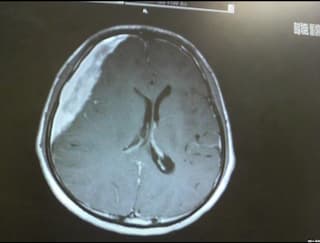 CT scan of my brain at that time. The white part is blood.
That experience changed the course of my life. The childhood feeling of wanting to contribute became something far more urgent: a need to build something that would outlast me, something that would be genuinely useful to people I might never meet.
What 100 Books Taught Me
Six or seven years after the surgery, I hit another wall. The first startup I cofounded fell apart due to a conflict with my co-founder. I was kicked out of the company I had helped build, and I could not continue with the idea I loved. I was in despair.
Not knowing what to do next, I turned to the people I thought might have answers: the great minds of human history. I read over 100 books, from ancient philosophy to modern science, looking for something to hold onto.
What I found surprised me. While so much changes over time, one thing remains constant. Human beings want to leave something good behind for future generations. It is one of the deepest drives of our nature. Otherwise, there is no way that books and traditions from over 2,000 years ago would have survived to the present day.

But I also realized something troubling. These messages from our ancestors come from a very limited number of people. Of the tens of billions of human beings who have ever existed, only a handful have survived in the form of books and traditions. The rest, their insights, their hard-won lessons, their unique ways of seeing the world, all of it was lost.
I kept thinking: how different would the world be if the rest of us had the power to preserve our learning and experiences for future generations?
Why Can't We Learn from Others' Experiences?
That question led to another. Why can't we learn effectively from the experiences of others?
If everyone's accumulated knowledge were accessible in a shared repository, I thought, we could always draw on what others have learned and apply it to our own work and lives. Instead, most of us start from scratch, reinventing lessons that someone else already paid a high price to learn.
As Bismarck said, "Only a fool learns from his own mistakes. The wise man learns from the mistakes of others." If we keep building without using the wisdom of those who came before us, the odds of wasting our effort grow enormously. Imagine placing an infinite number of monkeys in front of typewriters, hoping one will produce Shakespeare's "King Lear" by chance. The probability is vanishingly small compared to the success rate of humans who have acquired and shared language and knowledge.
It is often said, "Think outside the box." But if you don't know anything, there is no box to think outside of. Unless you absorb what others have learned, you cannot be anything more than what you have been exposed to and experienced on your own. Breaking through that limit takes extraordinary energy and extraordinary luck.
This is especially true today. In an age of information overload, we are constantly exposed to noise that feeds attention and fear rather than genuine understanding. The truly valuable signal, the trajectory of experience that someone has followed throughout their life, gets buried. If those trajectories could be inherited and built upon by the next person walking the same path, the impact would be enormous. Not just for one generation, but for every generation that follows.
Of course, humanity may eventually disappear in the timeline of the universe. But as long as that light exists, I will continue to see the possibilities and bet on them.
"The two most important days in your life are the day you are born and the day you find out why." -- Mark Twain
Glasp: Greatest Legacy Accumulated as Shared Proof
My answer to these questions became my life's work.
"Creating a system that allows everyone to share and develop their learnings as their legacy in a natural way." This is what I want to accomplish with the rest of my life, and it is the meaning of my life. This mission will never change.
That system is Glasp. The name stands for Greatest Legacy Accumulated as Shared Proof. It captures exactly what I believe in: that the learning each person accumulates throughout their life is a legacy worth sharing, and that making it visible is proof that their journey mattered.
The way I see it, Google democratized access to information. Twitter democratized access to what people are thinking and what is happening in the world. Pinterest democratized access to people's inspirations through visual collections. Through Glasp and my life, I want to democratize access to other people's learning and experiences that they have collected throughout their lives as a utilitarian legacy.
I could not have built this alone. Kei has been building Glasp with me from the very beginning, and his dedication to this mission has been essential to making it real. Together, we designed Glasp around a simple but powerful idea: take highlights out of the silos of personal note-taking apps and bring them into the open. When you highlight something on the web, it should not disappear into a private notebook that no one ever sees. It should become part of a shared layer of knowledge that others can discover, learn from, and build upon.
What Your Highlights Reveal
As we built Glasp, we discovered something we had not expected. What people highlight and engage with is a reflection of who they are and who they aspire to become. Your highlights are not just bookmarks. They are a map of your intellectual journey, your curiosities, your evolving understanding of the world.
This insight changed how we thought about Glasp's future. If highlights reveal so much about a person's learning path, what if Glasp could do more than store them? What if it could help you learn, connecting dots you had not seen, surfacing patterns in your own thinking, and recommending ideas that push you further?
That is where AI comes in. By leveraging your highlights, notes, and reading patterns, Glasp is becoming a personalized learning assistant that deeply understands your knowledge journey. It is not a generic recommendation engine. It is an AI that grows with you, shaped by the unique trail of knowledge you leave behind.
And you are not doing this alone. The incredible community of lifelong learners, educators, and knowledge seekers who use Glasp have turned it into something far bigger than a tool. Every highlight, every note, every shared insight contributes to a collective intelligence that benefits everyone. You are not just consuming information. You are shaping the future of knowledge.
Where Glasp Is Headed
I believe the future of learning is social and AI-assisted. We are building toward a world where knowledge is not lost but accumulated, where learning is not isolated but shared. A world where the insights of billions of people, not just a privileged few, are preserved and accessible to those who come after them.
Mahatma Gandhi said, "My life is my message." I believe that deeply. The things you read, the ideas you highlight, the knowledge you build throughout your life, that is your message. Glasp exists to make that message visible and accessible to others.
This is why we are building Glasp. Let's leave something good for future generations, together.
Keep highlighting,
Kazuki