Specific heat, heat of fusion and vaporization example | Chemistry | Khan Academy
TL;DR
The video explains the energy changes that occur during phase changes in water and calculates the amount of heat required for each change.
Transcript
A couple of videos ago, we learned that if we started with solid water or ice at a reasonably low temperature-- maybe this temperature right here is minus 10 degrees Celsius. And we can deal with Celsius when we're dealing with these phase changes, because we really just care about the difference in temperature, and not necessarily the absolute tem... Read More
Key Insights
- 🥵 The temperature of ice increases as heat energy is added until it reaches the melting point, at which point the added heat is used to convert ice into water.
- 🥵 The heat of fusion is the amount of heat required to convert a substance from a solid to a liquid state, and the heat of vaporization is the amount of heat required to convert a substance from a liquid to a vapor state.
- 🍧 The specific heat of water varies depending on its state, with ice having the lowest specific heat, liquid water having a higher specific heat, and water vapor having a similar specific heat to ice.
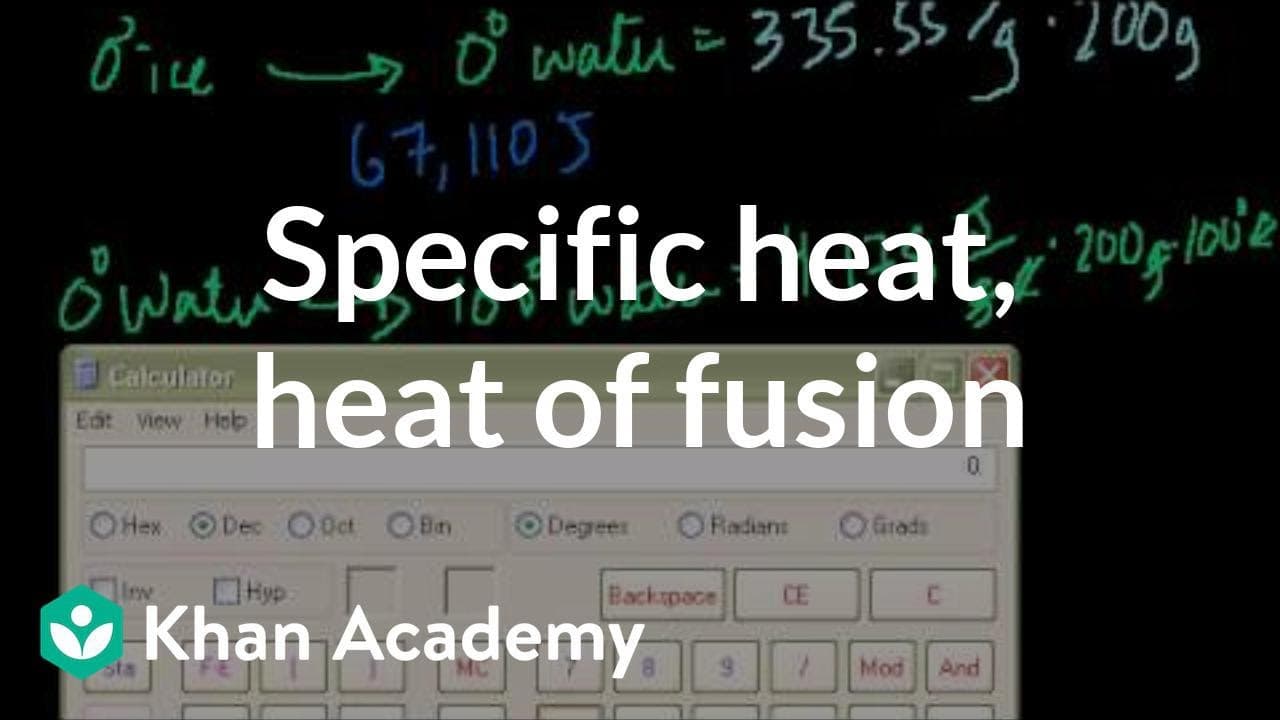
- 💦 Calculating the total amount of heat required to go from minus 10 degrees Celsius ice to 110 degrees Celsius water vapor for 200 grams of water gives a value of 609,950 joules or 609 kilojoules.
Install to Summarize YouTube Videos and Get Transcripts
Explore YouTube Video Summarizer or Get YouTube Transcript Extractor
Questions & Answers
Q: What happens to the temperature of ice when heat is added beyond the melting point?
Beyond the melting point, adding heat to ice does not increase its temperature but instead breaks the lattice structure and converts it into water.
Q: How is potential energy added during phase changes in water?
During phase changes, such as melting or vaporization, heat energy is used to break intermolecular bonds and separate water molecules, adding potential energy to the system.
Q: What is the difference between the heat of fusion and heat of vaporization?
The heat of fusion is the amount of heat required to convert a substance from a solid to a liquid state, while the heat of vaporization is the amount of heat required to convert a substance from a liquid to a vapor state.
Q: How much heat is required to warm up a gram of ice by one degree Celsius?
It takes 2 joules of energy to warm up 1 gram of ice by one degree Celsius or Kelvin.
Q: What is the specific heat of water in its solid, liquid, and vapor states?
The specific heat of water is approximately 2 joules per gram Celsius for ice, 4 joules per gram Celsius for liquid water, and 1.89 joules per gram Celsius for water vapor.
Summary & Key Takeaways
-
Water molecules in ice vibrate with increased kinetic energy as they are heated until they reach the melting point at zero degrees Celsius.
-
At the melting point, heat energy is used to break the lattice structure of ice and convert it into water.
-
Adding more heat to the water increases its temperature until it reaches the boiling point at 100 degrees Celsius, where heat energy is used to convert water into water vapor.
Read in Other Languages (beta)
Share This Summary 📚
Summarize YouTube Videos and Get Video Transcripts with 1-Click
Try YouTube Summary with ChatGPT & Claude or YouTube Transcript Generator
Explore More Summaries from Khan Academy 📚



Summarize YouTube Videos and Get Video Transcripts with 1-Click
Try YouTube Summary with ChatGPT & Claude or YouTube Transcript Generator