Related Rates - The Baseball Diamond Problem
TL;DR
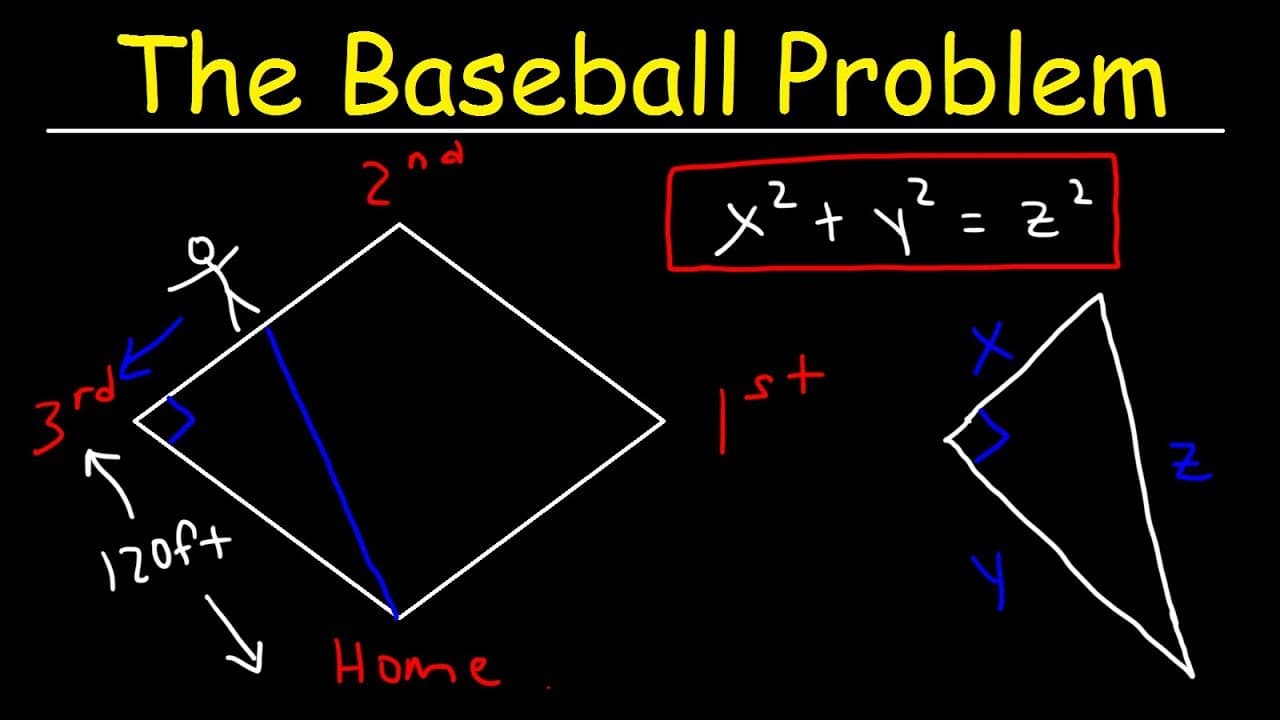
Determine the rate at which the distance between a baseball player and the home plate is changing as he runs from second to third base.
Transcript
in this video we're going to go over the baseball diamond problem so we have a baseball player running from second base to third base at a speed of 20 feet per second he is currently 50 feet away from the third base and the baseball diamond field it has the shape of a square where all the side lamps are 120 feet so we need to determine the rate at ... Read More
Key Insights
- ☠️ The problem involves determining the rate of change for the distance in a right triangle.
- 🙃 The triangle's sides represent the distances between the player and the home plate.
- 🤪 Using the Pythagorean theorem, the value of z is found to be 130 feet.
- ☠️ By taking the derivative of the equation and plugging in known values, the rate of change (dz/dt) is calculated to be approximately -7.69 feet per second.
- 🤘 The negative sign indicates that the distance between the player and the home plate is decreasing.
- 💱 The rate of change is influenced by the x-coordinate, which represents the distance between the player and third base.
- 👪 The y-coordinate, representing the distance between third base and home plate, remains constant during this specific movement.
Install to Summarize YouTube Videos and Get Transcripts
Explore YouTube Video Summarizer or Get YouTube Transcript Extractor
Questions & Answers
Q: What is the problem stated in the video?
The problem involves determining the rate at which the distance between a baseball player and the home plate is changing as the player runs from second to third base.
Q: What are the given values in the problem?
The player's speed is 20 feet per second, and the player is initially 50 feet away from third base. The side length of the baseball diamond field is 120 feet.
Q: How is the problem solved mathematically?
By setting up a right triangle with known values of x, y, and z, the equation z² = x² + y² is established. Using this equation, the rate of change (dz/dt) can be determined by taking the derivative and solving for dz/dt.
Q: What is the final answer?
The rate at which the distance between the player and the home plate is changing is approximately -7.69 feet per second.
Summary & Key Takeaways
-
A baseball player is running from second base to third base at a speed of 20 feet per second, with a distance of 50 feet from third base.
-
The baseball diamond field is a square with side lengths of 120 feet.
-
By calculating the derivative of the equation, the rate of change of the distance between the player and the home plate is found to be approximately -7.69 feet per second.
Read in Other Languages (beta)
Share This Summary 📚
Summarize YouTube Videos and Get Video Transcripts with 1-Click
Try YouTube Summary with ChatGPT & Claude or YouTube Transcript Generator
Explore More Summaries from The Organic Chemistry Tutor 📚




Summarize YouTube Videos and Get Video Transcripts with 1-Click
Try YouTube Summary with ChatGPT & Claude or YouTube Transcript Generator