Numerical Based on Demultiplexer Type 3 (Example 2) | Number System and Code | Digital Electronics
TL;DR
Learn how to implement a 1:16 demultiplexer using OR gates for given functions F1 and F2.
Transcript
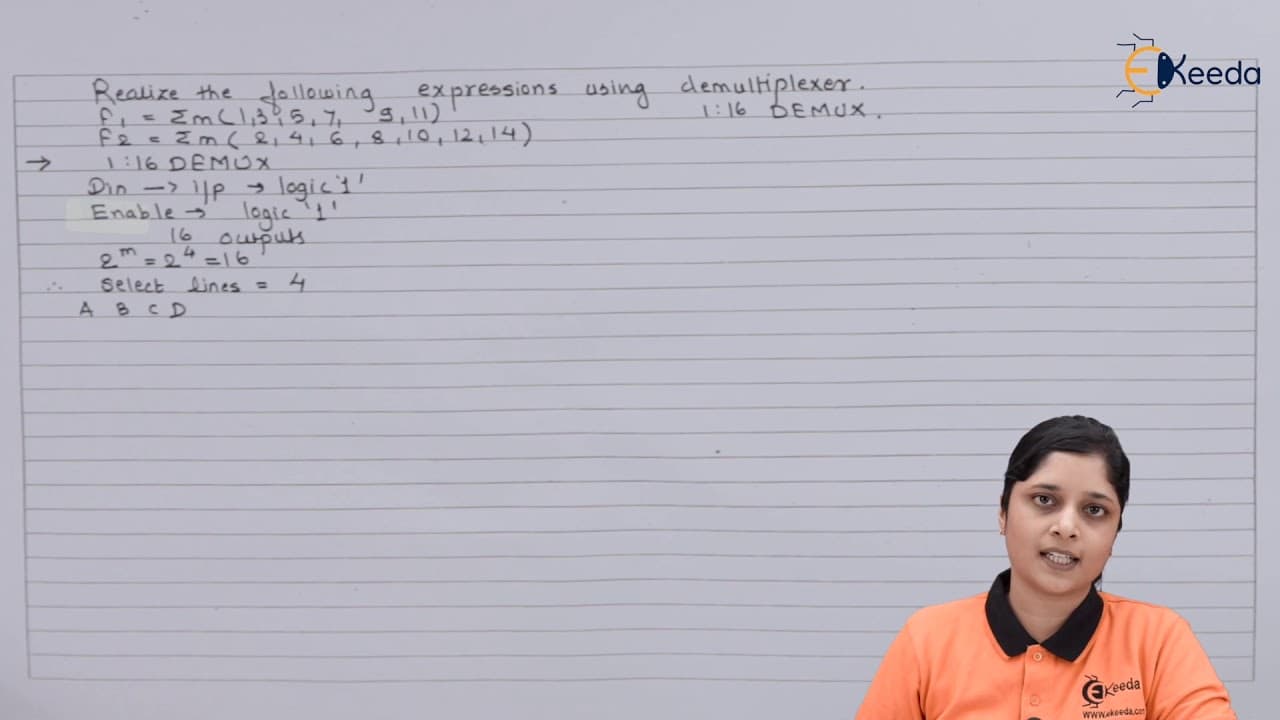
click the bell icon to get latest videos from akira hello friends now we are going to discuss the numerical best or demultiplexer let's start with the numerical your caution is realize the following expressions using the multiplexer and your expressions are f1 equal to summation M 1 3 5 7 9 11 after that you have f2 equal to summation M 2 4 6 8 and... Read More
Key Insights
- ❓ Understanding the concept of a 1:16 demultiplexer for processing multiple outputs efficiently.
- 🔠 Connection of input and enable terminals to logic one ensures proper functioning of the demultiplexer.
- 🍉 The design of OR gates for each function's main terms is crucial for accurate output selection.
- 🫥 The importance of determining the number of select lines in a demultiplexer setup.
- 🔬 Utilization of OR gates for logical processing in a demultiplexer configuration.
- 🔠 Significance of following proper diagramming and input connections in a demultiplexer implementation.
- 🍉 Explanation of how main terms like 11 and 14 influence the selection of outputs in a demultiplexer.
Install to Summarize YouTube Videos and Get Transcripts
Explore YouTube Video Summarizer or Get YouTube Transcript Extractor
Questions & Answers
Q: How do you define the main terms for the given expressions in a 1:16 demultiplexer setup?
The main terms, like 11 and 14, dictate the selection of outputs in the demultiplexer. These terms determine the inputs for the OR gates handling functions F1 and F2.
Q: What are the key steps in configuring a 1:16 demultiplexer?
Essential steps include connecting the input and enable terminals to logic one, determining the number of select lines, and designing OR gates for each function's main terms in the demultiplexer layout.
Q: Why is it important to use OR gates for processing functions in a demultiplexer?
OR gates are crucial in a demultiplexer setup as they handle the logical connections of main terms in functions like F1 and F2, ensuring the correct output selection based on the input signals.
Summary & Key Takeaways
-
Explanation of using a 1:16 demultiplexer with specific expressions F1 and F2.
-
Important points include connecting input and enable terminals to logic one, 16 outputs, and 4 select lines.
-
Designing OR gates for each function's main terms in the demultiplexer setup.
Read in Other Languages (beta)
Share This Summary 📚
Summarize YouTube Videos and Get Video Transcripts with 1-Click
Try YouTube Summary with ChatGPT & Claude or YouTube Transcript Generator
Explore More Summaries from Ekeeda 📚





Summarize YouTube Videos and Get Video Transcripts with 1-Click
Try YouTube Summary with ChatGPT & Claude or YouTube Transcript Generator