Multiway Search Tree Part 2 | Data Structure Using C
TL;DR
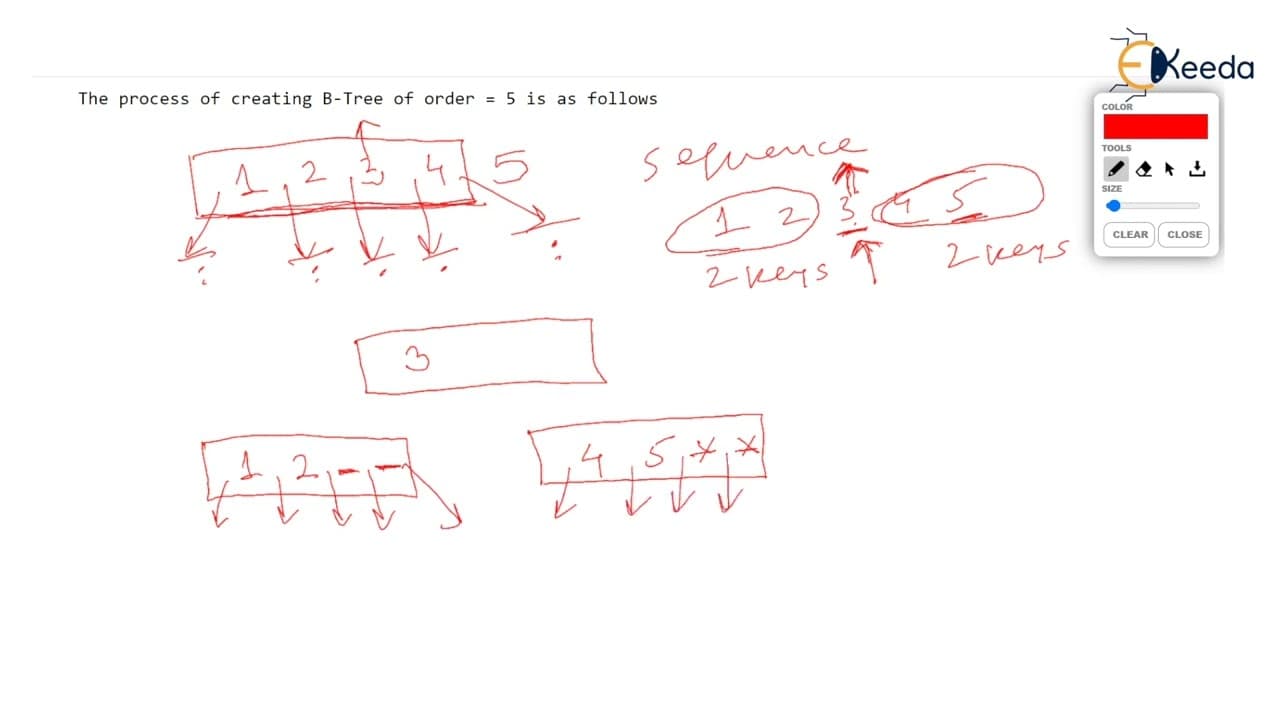
Learn how to construct a B-Tree of order five using split and propagate techniques.
Transcript
hello dear students i am samir velankar i welcome all of you to this next video on b3 in the previous video we saw what are the rules for creating b3 or how a b tree appears and in this video we are going to learn or rather in the previous video we also saw what do you mean by order of b3 and how the distribution of keys are present and the rule of... Read More
Key Insights
- 🏗️ B-Tree construction involves managing node capacities, following split and propagate techniques for maintaining balance.
- 🤩 Root node exceptions to capacity rules in a B-Tree allow for more flexibility in storing keys.
- 👨🔬 The importance of keeping leaf nodes at the same level in a B-Tree for optimal search performance.
- 🤩 Splitting full nodes ensures efficient key insertion and distribution, vital for maintaining balance.
- 👨🔬 Understanding the process of propagating median values in a B-Tree helps in optimizing storage and search operations.
- 🔙 Observing the pattern of pointers in a B-Tree provides insights into the organization and hierarchy of nodes.
- 🤾 Capacity constraints in B-Tree nodes play a crucial role in ensuring balanced storage and efficient retrieval processes.
Install to Summarize YouTube Videos and Get Transcripts
Explore YouTube Video Summarizer or Get YouTube Transcript Extractor
Questions & Answers
Q: What is the significance of the order of a B-Tree in construction?
The order of a B-Tree determines the maximum number of children each node can have, leading to the capacity of keys a node can store, essential for balanced tree structure.
Q: How does split and propagate help maintain the balance of a B-Tree?
Split and propagate ensures that new keys are inserted in leaf nodes first, splitting full nodes to propagate median values up the tree, maintaining balance and adherence to capacity rules.
Q: Why is it crucial to have leaf nodes at the same level in a B-Tree?
Having leaf nodes at the same level in a B-Tree ensures balanced search operations, optimizing retrieval speed and storage efficiency.
Q: How does the split and propagate process address the issue of node capacity constraints?
Split and propagate ensures that when a node reaches full capacity, it is split into two nodes with equal keys, propagating the median value up the tree to maintain balance.
Summary & Key Takeaways
-
Samir Velankar explains how to construct a B-Tree of order five, emphasizing the process of split and propagate.
-
The video demonstrates the insertion of keys in a sorted order and handling node capacity constraints effectively.
-
The importance of maintaining balance in a B-Tree by following split and propagate rules is highlighted.
Read in Other Languages (beta)
Share This Summary 📚
Summarize YouTube Videos and Get Video Transcripts with 1-Click
Try YouTube Summary with ChatGPT & Claude or YouTube Transcript Generator
Explore More Summaries from Ekeeda 📚






Summarize YouTube Videos and Get Video Transcripts with 1-Click
Try YouTube Summary with ChatGPT & Claude or YouTube Transcript Generator