Concurrency Control In Distributed Databases Part I - System Architecture - DBMS
TL;DR
Exploring locking protocols and consistency levels in distributed databases.
Transcript
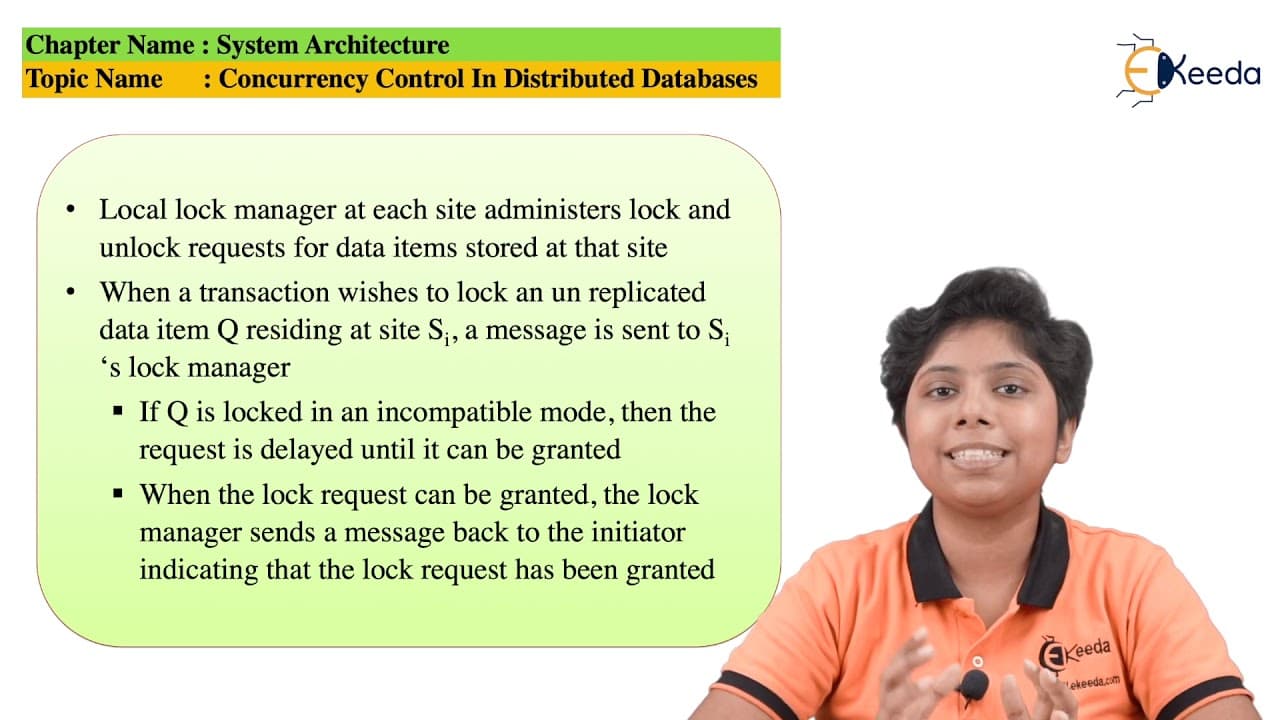
click the Bell icon to get latest videos from akira hello friends today we will discuss about the concurrency control in distributed databases we will first discuss today about the locking protocol and difference type of locking like the single side locking distributed side locking majority locking biased locking primary copy of pages and finally w... Read More
Key Insights
- ©️ Locking protocols include single site, distributed, primary copy, and majority copy.
- ⏰ Centralizing lock management offers simplicity but can create bottlenecks.
- ⏰ Multiple sites administering locks in distributed systems improve concurrency but complicate write operations.
- ©️ Majority copy protocols enhance data consistency at the cost of increased message overhead.
- 🫠 Bias protocols prioritize read operations, optimizing concurrency for read-heavy systems.
- 🫠 Consensus protocols allocate weights to sites for read and write operations, balancing locking permissions.
- 🔄 Master-slave replication ensures consistency by updating the master before syncing with slave sites.
Install to Summarize YouTube Videos and Get Transcripts
Explore YouTube Video Summarizer or Get YouTube Transcript Extractor
Questions & Answers
Q: What are the advantages of the single site locking protocol in distributed databases?
The single site locking protocol simplifies implementation and deadlock handling by centralizing lock management. However, it introduces bottlenecks and vulnerability due to the reliance on one site for all locking operations.
Q: How does the distributed lock mechanism protocol differ from the single site locking protocol?
The distributed lock mechanism involves multiple sites in lock granting, reducing bottlenecks but increasing vulnerability to write operations across replicas. Deadlock handling becomes more complex due to the involvement of multiple sites.
Q: What is the primary copy protocol in concurrency control?
In the primary copy protocol, one replica is designated as the primary copy responsible for granting locks on data items. It ensures that write operations are only permitted on the primary copy, maintaining data consistency across replicas.
Q: How does the majority copy protocol improve upon the primary copy protocol?
The majority copy protocol requires permission from a majority of replicas before granting write access. This enhances data consistency and reduces deadlock issues but complicates implementation and increases message overhead.
Summary & Key Takeaways
-
Discusses locking protocols in distributed databases.
-
Explains different types of locking mechanisms - single site locking, distributed lock, majority locking, biased locking.
-
Details the concept of primary copy and majority copy protocols in concurrency control.
Read in Other Languages (beta)
Share This Summary 📚
Summarize YouTube Videos and Get Video Transcripts with 1-Click
Try YouTube Summary with ChatGPT & Claude or YouTube Transcript Generator
Explore More Summaries from Ekeeda 📚






Summarize YouTube Videos and Get Video Transcripts with 1-Click
Try YouTube Summary with ChatGPT & Claude or YouTube Transcript Generator