What Is Voltage and How Is It Related to Electric Potential?
TL;DR
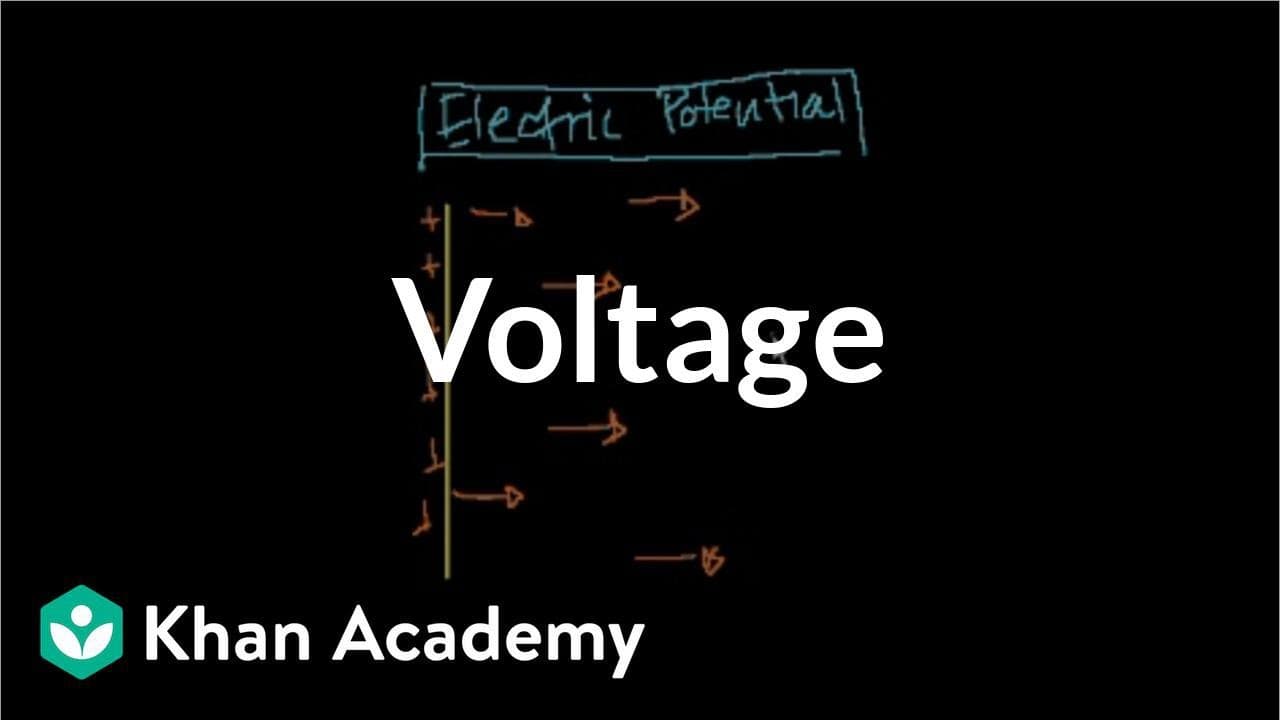
Voltage, or electric potential, is the amount of work needed per unit charge to move a charge from one position to another, measured in volts. It indicates the potential energy difference between two points in space, independent of the charge size. Understanding voltage helps compare electric potential energy across different locations in an electric field.
Transcript
Before we move on, I want to clarify something that I've inadvertently done. I think I was not exact with some of the terminology I used. So I want to highlight the difference between two things that I've used almost interchangeably up to this point, but now that we are about to embark on learning what voltage is, I think it's important that I high... Read More
Key Insights
- 👾 Electrical potential energy is associated with charged particles, while electric potential is related to positions in space.
- 🔌 Electric potential can be calculated by dividing the electric potential energy by the charge of the particle.
- 👻 Voltage is a measure of electric potential and allows for comparison of potential energy differences.
- 🧘 Electric potential is independent of the charge size and depends only on the position.
- ⚡ The unit for voltage is volts, equal to joules per coulomb.
- 🔌 Gravitational potential energy is analogous to electric potential energy, but for the force of gravity instead of electromagnetism.
- 👻 Electric potential allows us to determine the potential energy difference between two positions in space.
Install to Summarize YouTube Videos and Get Transcripts
Explore YouTube Video Summarizer or Get YouTube Transcript Extractor
Questions & Answers
Q: What is the difference between electrical potential energy and electric potential?
Electrical potential energy is related to a charged particle and represents the amount of energy it possesses. Electric potential, on the other hand, is associated with a position and describes how much work is needed per unit charge to move it between two points.
Q: How can electric potential energy be calculated?
Electric potential energy can be calculated by multiplying the electric potential at a point by the charge of the particle. It represents the difference in energy between two points in space.
Q: What is the significance of voltage?
Voltage is another term for electric potential and is measured in volts. It allows us to compare the potential energy differences between two points in space, regardless of the size or sign of the charge involved.
Q: How is electric potential different from gravitational potential energy?
Electric potential is similar to gravitational potential energy, but it is per unit charge instead of per mass. It represents the amount of work needed to move a charge per unit charge between two positions, while gravitational potential energy is the energy associated with an object's position relative to the Earth's surface.
Summary & Key Takeaways
-
Electrical potential energy is the amount of energy associated with a charged particle.
-
Electric potential is the amount of work required per unit charge to move it from one position to another.
-
Voltage is another term for electric potential, measured in volts.
Read in Other Languages (beta)
Share This Summary 📚
Summarize YouTube Videos and Get Video Transcripts with 1-Click
Try YouTube Summary with ChatGPT & Claude or YouTube Transcript Generator
Explore More Summaries from Khan Academy 📚



Summarize YouTube Videos and Get Video Transcripts with 1-Click
Try YouTube Summary with ChatGPT & Claude or YouTube Transcript Generator