Linear Equations in Point Slope Form
TL;DR
This video explains how to write the equation of a line in point-slope form, which is an alternative to the slope-intercept form.
Transcript
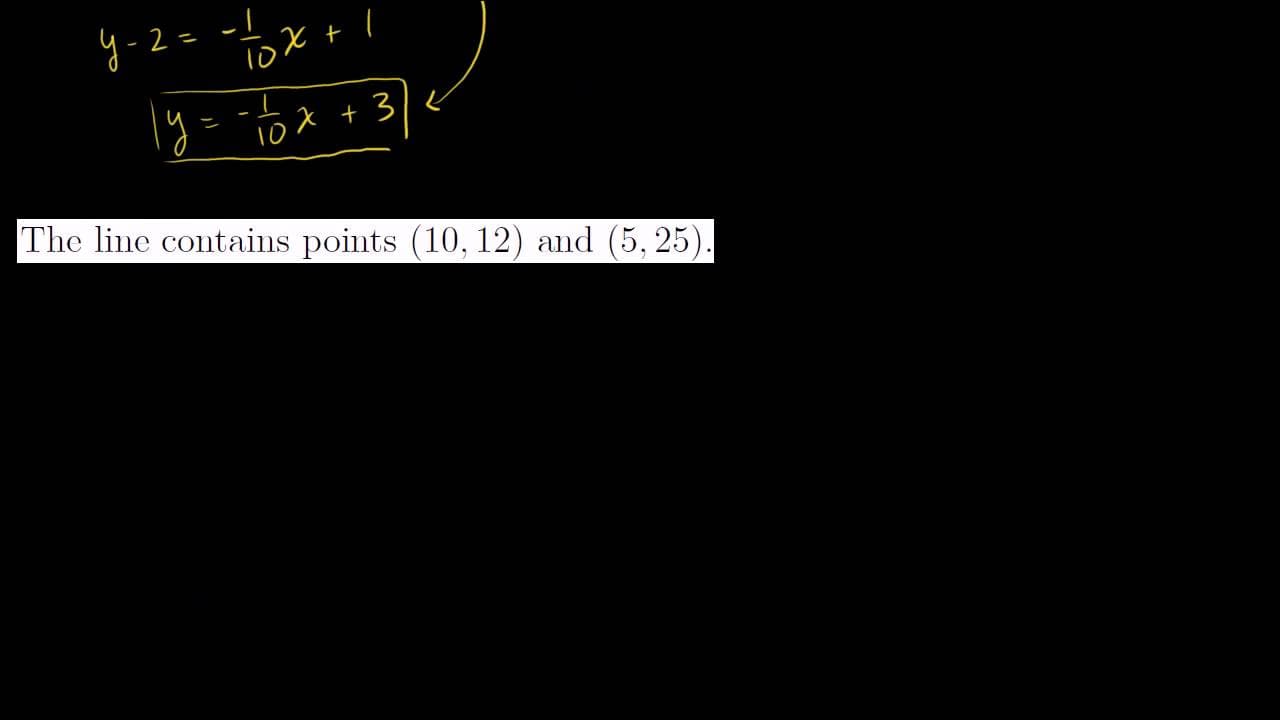
Let's do some equations of lines in point-slope form. And this is different from y or from slope-intercept form. But they really are just two different ways of writing the same equation. We'll see that with a couple of examples. And you might remember that slope-intercept form were equations of the form, y is equal to mx plus b-- we did this in the... Read More
Key Insights
- 💁 Point-slope form and slope-intercept form are equivalent and can be converted into each other algebraically.
- 💁♂️ Point-slope form uses a specific point on the line and the slope to represent the equation, while slope-intercept form uses the slope and the y-intercept.
- 🫥 The slope of a line can be calculated using the coordinates of two points on the line.
Install to Summarize YouTube Videos and Get Transcripts
Explore YouTube Video Summarizer or Get YouTube Transcript Extractor
Questions & Answers
Q: How does point-slope form differ from slope-intercept form?
Point-slope form, y - y1 = m(x - x1), represents a line using a specific point on the line and the slope. Slope-intercept form, y = mx + b, uses the slope and the y-intercept. Both forms can be converted into each other algebraically.
Q: How do you determine the slope of a line using point-slope form?
The slope, m, can be calculated by finding the change in y (y2 – y1) divided by the change in x (x2 – x1) between two points on the line represented by (x1, y1) and (x2, y2).
Q: Can any point on the line be used to write the equation in point-slope form?
Yes, any point on the line can be used to write the equation in point-slope form. The choice of point does not affect the equation or the slope.
Q: How can point-slope form be converted into slope-intercept form?
To convert point-slope form into slope-intercept form, you can algebraically manipulate the equation by distributing and simplifying to isolate the y variable on one side of the equation.
Summary & Key Takeaways
-
The point-slope form of an equation of a line is y - y1 = m(x - x1), where (x1, y1) is a point on the line and m is the slope.
-
Point-slope form and slope-intercept form are two different ways of representing the same equation.
-
Point-slope form allows for the direct calculation of the slope of a line using the coordinates of two points on the line.
Read in Other Languages (beta)
Share This Summary 📚
Summarize YouTube Videos and Get Video Transcripts with 1-Click
Try YouTube Summary with ChatGPT & Claude or YouTube Transcript Generator
Explore More Summaries from Khan Academy 📚



Summarize YouTube Videos and Get Video Transcripts with 1-Click
Try YouTube Summary with ChatGPT & Claude or YouTube Transcript Generator