Do you see a face? You’re actually hallucinating - Susan G. Wardle
TL;DR
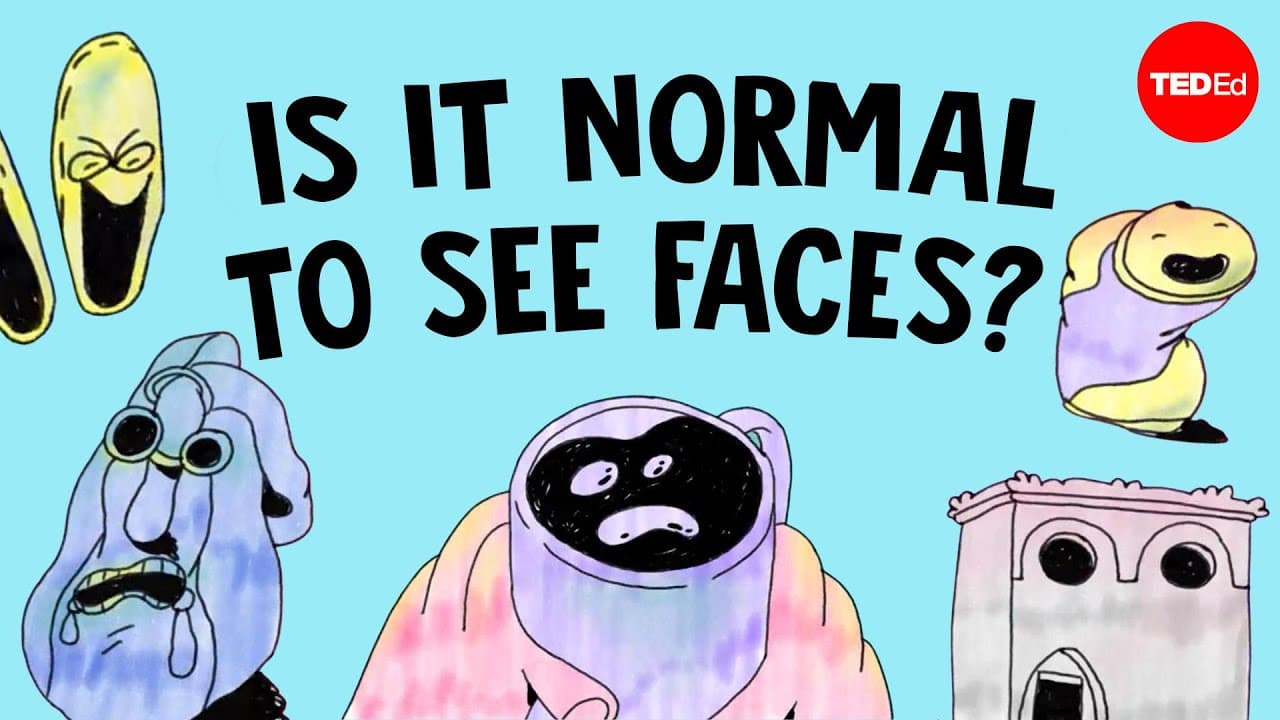
Our brains see faces where they don't exist due to face pareidolia, a phenomenon aiding in social cognition.
Transcript
Imagine opening a bag of chips only to find Santa Claus looking back at you. Or turning the corner to see a smile as wide as a building. Humans see faces in all kinds of mundane objects, but these faces aren’t real— they’re illusions due to a phenomenon known as face pareidolia. So why exactly does this happen, and how far can this distortion of re... Read More
Key Insights
- 😀 Face pareidolia is a phenomenon where humans see faces in inanimate objects, driven by social adaptation.
- 😀 Humans evolved to be hypersensitive to identifying faces quickly, with the brain detecting faces in just a tenth of a second.
- 🧠 Brain imaging studies reveal that our brains may be too sensitive, perceiving illusory faces in objects where none exist.
- 😀 Brain stimulation can impact our ability to differentiate between real faces and illusions.
- 🫢 Features as minimal as three dots can be enough for our brains to perceive eyes and a mouth in an object.
- 😃 Pareidolia is not unique to humans, as rhesus macaque monkeys display similar eye movements when observing pareidolia-inducing objects.
- 😀 Cultural and individual history may impact how we perceive illusory faces.
Install to Summarize YouTube Videos and Get Transcripts
Explore YouTube Video Summarizer or Get YouTube Transcript Extractor
Questions & Answers
Q: Why do humans see faces in inanimate objects?
Humans see faces in objects due to face pareidolia, an evolutionary adaptation aiding in social cognition by allowing us to quickly identify and process faces for social interaction.
Q: How quickly can our brains differentiate between a real face and an illusory one?
Research using magnetoencephalography shows that our brains generally recognize an illusory face within a quarter of a second, similar to the time it takes to identify other non-face visual stimuli.
Q: How can brain stimulation impact our ability to differentiate between real faces and illusions?
Studies have shown that stimulating the fusiform face area in the brain can create perceived facial distortions even when looking at non-face objects, indicating the importance of certain features in face detection.
Q: Is face pareidolia unique to humans?
No, studies on rhesus macaque monkeys show similar eye movements when observing pareidolia-inducing objects, suggesting that this phenomenon is deeply rooted in social primate brains.
Summary & Key Takeaways
-
Humans see faces in everyday objects due to face pareidolia, a social adaptation.
-
Our brains evolved to prioritize identifying faces over other visual stimuli.
-
Brain imaging studies reveal that our brains can detect illusory faces within a quarter of a second.
Read in Other Languages (beta)
Share This Summary 📚
Summarize YouTube Videos and Get Video Transcripts with 1-Click
Try YouTube Summary with ChatGPT & Claude or YouTube Transcript Generator
Explore More Summaries from TED-Ed 📚





Summarize YouTube Videos and Get Video Transcripts with 1-Click
Try YouTube Summary with ChatGPT & Claude or YouTube Transcript Generator