Myosin and actin | Circulatory system physiology | NCLEX-RN | Khan Academy
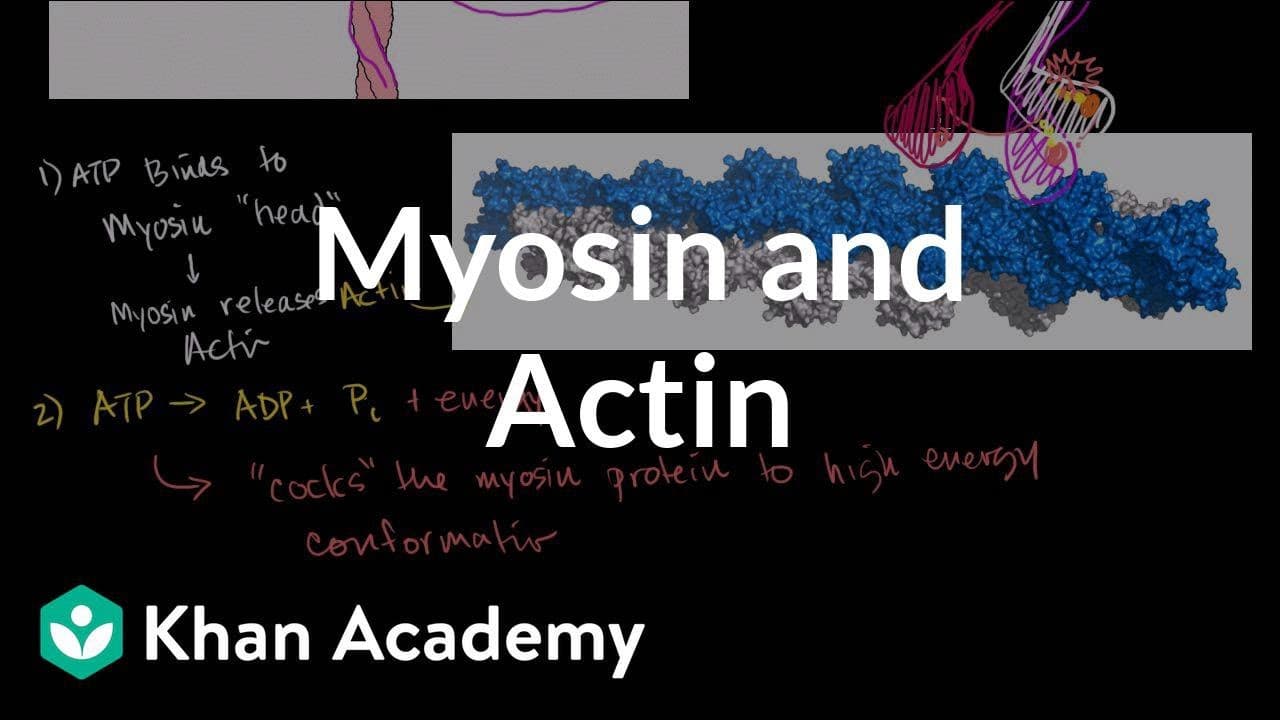
TL;DR
ATP and protein interactions in muscle cells allow for mechanical motion and muscle contraction.
Transcript
What I want to do in this video is try to understand how two proteins can interact with each other in conjunction with ATP to actually produce mechanical motion. And the reason why I want to do this-- one, it occurs outside of muscle cells as well, but this is really going to be the first video on really how muscles work. And then we'll talk about ... Read More
Key Insights
- 💪 Myosin, an ATPase enzyme, binds to ATP and releases actin, initiating muscle contraction.
- ✋ Hydrolysis of ATP provides the energy to cock myosin into a high-energy state ready for the power stroke.
- ✊ The release of phosphate from myosin during hydrolysis triggers the power stroke, resulting in the contraction of muscles.
- 👻 Proteins change shape based on what is bonded to them, allowing for the conversion of ATP energy into mechanical energy.
- 💪 ATP and protein interactions are fundamental to understanding muscle function and the conversion of chemical energy into mechanical energy.
- 💪 This video serves as an introduction to the mechanics of muscle contraction, setting the stage for future discussions on muscle function and nerve stimulation.
- 💪 Myosin and actin interactions form the basis of muscle action and mechanical energy production.
Install to Summarize YouTube Videos and Get Transcripts
Explore YouTube Video Summarizer or Get YouTube Transcript Extractor
Questions & Answers
Q: How do ATP and proteins interact to produce mechanical motion in muscles?
ATP binds to myosin heads, causing them to release actin. Hydrolysis of ATP then provides energy for myosin to move into a high-energy state, enabling it to attach to actin and push on it during the power stroke.
Q: What is the significance of the release of phosphate in muscle contraction?
The release of phosphate from myosin triggers the power stroke, where myosin pushes on actin to generate mechanical energy. This release of phosphate allows the myosin protein to release its stored energy and produce movement.
Q: How do proteins change shape during muscle contraction?
Proteins, like myosin, change shape based on what is bonded to them and what is not. When ATP binds to myosin, it changes its conformation, allowing it to attach to actin and produce mechanical energy. The release of phosphate further alters the shape of myosin for muscle contraction.
Q: Why is understanding ATP and protein interactions important for understanding muscle function?
ATP and protein interactions are essential for muscle contraction. By understanding how ATP is used to produce mechanical motion, we can gain insights into how muscles work and how nerves stimulate muscles to function.
Summary & Key Takeaways
-
ATP binds to myosin heads and causes myosin to release actin, initiating muscle contraction.
-
Hydrolysis of ATP releases energy, enabling myosin to move into a high-energy state.
-
The release of phosphate from myosin triggers the power stroke, where myosin pushes on actin to create mechanical energy.
Read in Other Languages (beta)
Share This Summary 📚
Summarize YouTube Videos and Get Video Transcripts with 1-Click
Try YouTube Summary with ChatGPT & Claude or YouTube Transcript Generator
Explore More Summaries from Khan Academy 📚



Summarize YouTube Videos and Get Video Transcripts with 1-Click
Try YouTube Summary with ChatGPT & Claude or YouTube Transcript Generator