Products
Features
YouTube Video Summarizer
Summarize YouTube videos
Web & PDF Highlighter
Highlight web pages & PDFs
Chat with PDF
Ask any PDF questions with AI
Ask AI Clone
Chat with your highlights & memories
Audio Transcriber
Transcribe audio files to text
Glasp Reader
Read and highlight articles
Kindle Highlight Export
Export your Kindle highlights
Idea Hatch
Hatch ideas from your highlights
Integrations
Obsidian Plugin
Notion Integration
Pocket Integration
Instapaper Integration
Medium Integration
Readwise Integration
Snipd Integration
Hypothesis Integration
Apps & Extensions
Chrome Extension
Safari Extension
Edge Add-ons
Firefox Add-ons
iOS App
Android App
Discover
Discover
Ideas
Discover new ideas and insights
Articles
Curated articles and insights
Books
Book recommendations by great minds
Posts
Essays and notes from readers
Quotes
Inspiring quotes collection
Videos
Curated videos and summaries
Explore Glasp
Glasp Newsletter
Weekly insights and updates
Glasp Talk
Interview series with great minds
Glasp Blog
Latest news and articles
Glasp Use Cases
Learn how others use Glasp
Build & Support
Glasp API
Access Glasp's API for developers
MCP Connector
Connect Glasp to Claude & ChatGPT
Community
Glasp Reddit Community
Students
Student discount and benefits
FAQs
Frequently Asked Questions
AboutPricing
DashboardLog inSign up

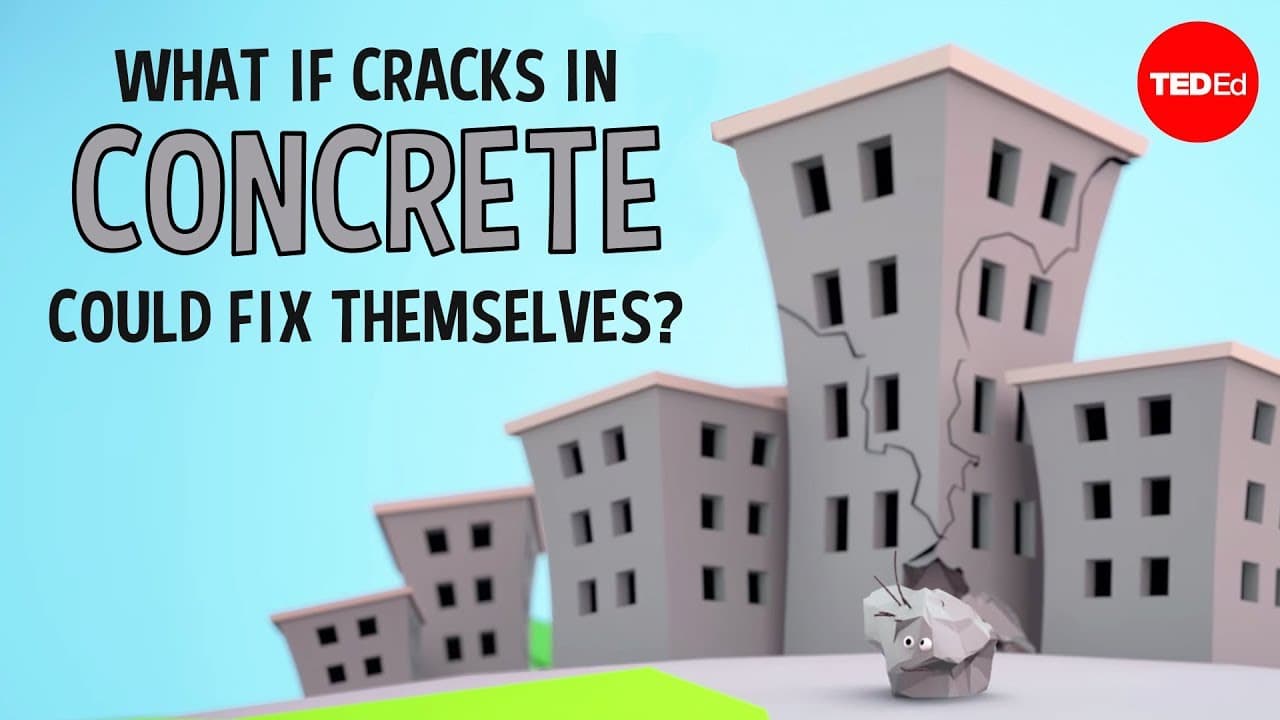
What if cracks in concrete could fix themselves? - Congrui Jin
1.4M views
•
October 16, 2018
by
TED-Ed
YouTube video player
What if cracks in concrete could fix themselves? - Congrui Jin

TL;DR

Concrete can self-heal using bacteria and fungi, reducing repair costs and increasing longevity.

Transcript

Concrete is the most widely used construction material in the world. It can be found in swathes of city pavements, bridges that span vast rivers, and the tallest skyscrapers on earth. But this sturdy substance does have a weakness: it’s prone to catastrophic cracking that costs tens of billions of dollars to repair each year. But what if we could a... Read More

Key Insights

  • 🥺 Concrete is widely used but prone to cracking, leading to costly repairs.
  • 😒 Self-healing concrete uses bacteria, fungi, and adhesive-filled fibers to fill cracks.
  • 🇨🇷 This innovation can make concrete structures more resilient and reduce maintenance costs.
  • 🤳 Self-healing concrete mimics natural processes to repair cracks.
  • 🤳 Certain bacteria and fungi in concrete can produce minerals for self-healing.
  • 🤳 Incorporating self-healing technologies can increase the longevity of concrete structures.
  • 🤳 Self-healing concrete may reshape the construction industry by reducing maintenance needs.

Install to Summarize YouTube Videos and Get Transcripts

Explore YouTube Video Summarizer or Get YouTube Transcript Extractor

Questions & Answers

Q: What are the main causes of concrete cracking?

Concrete can crack due to natural processes like shrinkage, freezing and thawing, and heavy loads that weaken the material over time, potentially leading to catastrophic failures.

Q: How does self-healing concrete work?

Self-healing concrete utilizes bacteria, fungi, and adhesive-filled fibers to fill and seal cracks when they form, mimicking natural processes and helping to prolong the lifespan of concrete structures.

Q: What are the benefits of self-healing concrete?

Self-healing concrete reduces the need for costly repairs and maintenance, increases the longevity of concrete structures, and ultimately helps to make infrastructure more resilient and sustainable.

Q: How can self-healing concrete impact the future of construction?

By incorporating self-healing technologies into concrete production, we can create more durable and long-lasting structures that require less maintenance, leading to significant cost savings and environmental benefits in the construction industry.

Summary & Key Takeaways

  • Concrete is widely used in construction but prone to cracking, leading to costly repairs.

  • Self-healing concrete uses bacteria, fungi, and adhesive-filled fibers to fill and seal cracks.

  • This innovative approach could make concrete structures more resilient and long-lasting, reducing environmental and financial costs.


Read in Other Languages (beta)

English

Share This Summary 📚

Summarize YouTube Videos and Get Video Transcripts with 1-Click

Download browser extensions on:

Try YouTube Summary with ChatGPT & Claude or YouTube Transcript Generator

Explore More Summaries from TED-Ed 📚

What Do Global Greetings Reveal About Peace? thumbnail
What Do Global Greetings Reveal About Peace?
TED-Ed
How sugar affects the brain - Nicole Avena thumbnail
How sugar affects the brain - Nicole Avena
TED-Ed
Why do we dream? - Amy Adkins thumbnail
Why do we dream? - Amy Adkins
TED-Ed
The loathsome, lethal mosquito - Rose Eveleth thumbnail
The loathsome, lethal mosquito - Rose Eveleth
TED-Ed
The rise and fall of the Berlin Wall - Konrad H. Jarausch thumbnail
The rise and fall of the Berlin Wall - Konrad H. Jarausch
TED-Ed
How do cigarettes affect the body? - Krishna Sudhir thumbnail
How do cigarettes affect the body? - Krishna Sudhir
TED-Ed

Summarize YouTube Videos and Get Video Transcripts with 1-Click

Download browser extensions on:

Try YouTube Summary with ChatGPT & Claude or YouTube Transcript Generator

Apps & Extensions

  • Chrome Extension
  • Safari Extension
  • Edge Add-ons
  • Firefox Add-ons
  • iOS App
  • Android App

Key Features

  • YouTube Video Summarizer
  • Web & PDF Summarizer
  • Web & PDF Highlighter
  • Chat with PDF
  • Ask AI Clone
  • Audio Transcriber
  • Glasp Reader
  • Kindle Highlight Export
  • Idea Hatch

Integrations

  • Obsidian Plugin
  • Notion Integration
  • Pocket Integration
  • Instapaper Integration
  • Medium Integration
  • Readwise Integration
  • Snipd Integration
  • Hypothesis Integration

More Features

  • APIs
  • MCP Connector
  • Blog & Post
  • Embed Links
  • Image Highlight
  • Personality Test
  • Quote Shots

Company

  • About us
  • Blog
  • Community
  • FAQs
  • Job Board
  • Newsletter
  • Pricing
Terms

•

Privacy

•

Guidelines

© 2026 Glasp Inc. All rights reserved.