What Is Cell Theory and Who Discovered It?
TL;DR
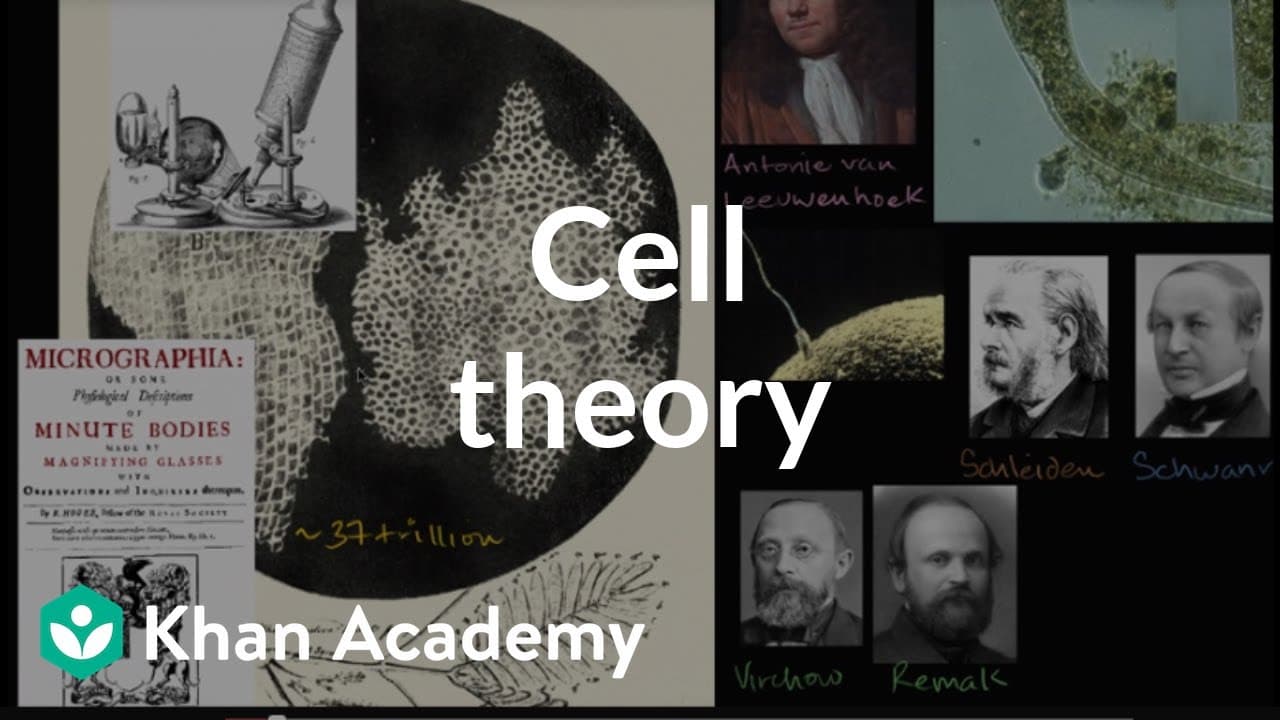
Cell theory states that all living things are made up of cells, which are the basic units of life. Key contributors include Robert Hooke, who coined the term 'cell' in 1665 after observing cork, and Antonie van Leeuwenhoek, who first observed living cells. Modern cell theory was further established by Schleiden and Schwann in the 1830s, who proposed that all cells arise from pre-existing cells.
Transcript
To us modern folk, we tend to take for granted the existence of cells and the idea that all living things are made up of cells that we as human beings, as living organisms, we are made up of many, many, many cells the estimates of the cells, of the human body, are around the order of 37 trillion cells! But, if we were to rewind, even 400 years ago ... Read More
Key Insights
- 🥺 Robert Hooke's observations with a primitive microscope led to the discovery of cells and the term "cell".
- 👻 Antonie van Leeuwenhoek's improved microscopes allowed for direct observation of living cells and unicellular organisms.
- 🫒 Matthias Schleiden and Theodor Schwann established the foundation of modern cell theory by proposing that all living things are composed of cells.
- 😑 The development of modern cell theory challenged the idea of spontaneous generation, suggesting that all cells come from pre-existing cells.
- 🫤 The specific origin of the first cells, or "proto-cells", is still uncertain but likely occurred approximately 3.5 billion years ago.
- 😃 The formation of phospholipid bi-layers and self-replicating RNA or proteins are theories on how the first cells may have emerged.
Install to Summarize YouTube Videos and Get Transcripts
Explore YouTube Video Summarizer or Get YouTube Transcript Extractor
Questions & Answers
Q: How did Robert Hooke use his primitive microscope to contribute to the understanding of cells?
Robert Hooke used his microscope to observe various organisms, including lice, fleas, and cork cells. He noticed the structure of cork cells and compared them to the cells in which monks lived, thus coining the term "cell".
Q: What were the limitations of Robert Hooke's observations?
Robert Hooke only observed dead tissue and the remnants of cell walls, not living cells. He couldn't deduce that cells were the building blocks of life or that cells reproduced.
Q: How did Antonie van Leeuwenhoek contribute to the development of cell theory?
Antonie van Leeuwenhoek improved microscopes and directly observed living cells and unicellular organisms. He observed sperm and called unicellular organisms "animalcules", suggesting that life exists at a small scale.
Q: Who laid the foundation for modern cell theory?
Matthias Schleiden and Theodor Schwann, in the 1830s, proposed that all living things are composed of one or more cells, establishing the basis of modern cell theory.
Summary & Key Takeaways
-
400 years ago, people lacked the tools to directly observe cells and didn't know that unicellular organisms existed.
-
Robert Hooke used a primitive microscope to observe cells in 1665 and coined the term "cell" in his book "Micrographia".
-
Antonie van Leeuwenhoek improved microscopes, allowing him to directly observe living cells and unicellular organisms.
Read in Other Languages (beta)
Share This Summary 📚
Summarize YouTube Videos and Get Video Transcripts with 1-Click
Try YouTube Summary with ChatGPT & Claude or YouTube Transcript Generator
Explore More Summaries from Khan Academy 📚



Summarize YouTube Videos and Get Video Transcripts with 1-Click
Try YouTube Summary with ChatGPT & Claude or YouTube Transcript Generator