Harvard Food+ Research Symposium: Michael Kremer
TL;DR
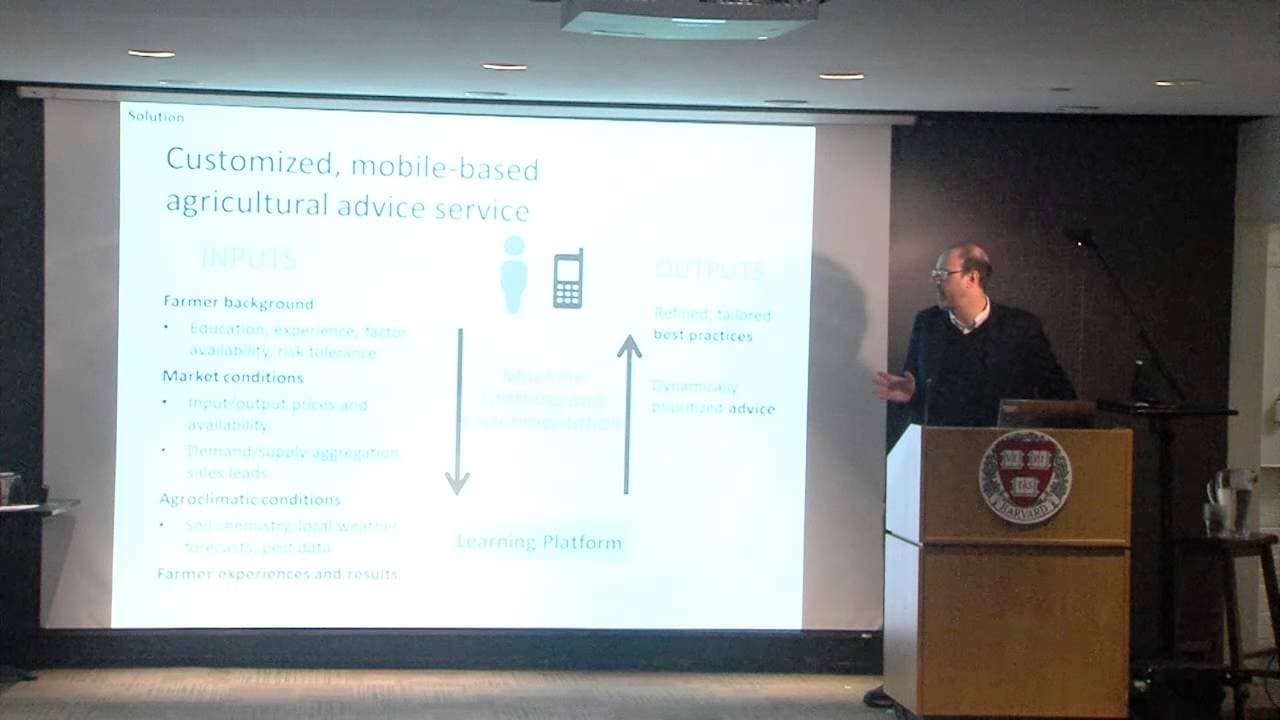
The potential for mobile phone technology to improve agricultural extension services and increase productivity in developing countries is explored.
Transcript
thank you very much um i'd like to discuss some ideas that i've been working on or thinking about with uh sean cole at harvard business school dan bjorker green who's uh was a grad student in economics but is uh and has a tech background and is now at brown university uh risa fabregas who's a um a student at the kennedy school a phd student there a... Read More
Key Insights
- 🧑🌾 The productivity of smallholder farms in developing countries is not fully optimized.
- 💁 Traditional government extension services often fail to provide effective agricultural information to farmers.
- 😀 Private agricultural extension services face market failures and scalability challenges.
- 📱 Mobile phone technology can offer low-cost and tailored information delivery to farmers.
- 📱 Increased agricultural extension through mobile phones can lead to significant improvements in productivity, climate adaptation, and environmental benefits.
- 🐕🦺 Alternative financing models, such as contract farming organizations or advertising, can support the sustainability of mobile-based agricultural extension services.
Install to Summarize YouTube Videos and Get Transcripts
Explore YouTube Video Summarizer or Get YouTube Transcript Extractor
Questions & Answers
Q: What are the challenges of traditional government agricultural extension services?
Traditional government extension services often face organizational inefficiencies, spatial constraints, limited accountability, and temporal limitations. This leads to ineffective and infrequent farmer interactions with extension agents.
Q: How do input dealers contribute to farmers' access to information?
Farmers often rely on input dealers for information, but they may have a financial interest in promoting specific products. This can lead to biased advice and cases of selling unnecessary or harmful products.
Q: What market failures hinder the growth of private agricultural extension services?
Private agricultural extension services face information sharing challenges, as farmers can pass on acquired information to others. Additionally, farmers find it difficult to determine the value of advice, hindering the adoption of subscription-based models.
Q: How can mobile phone technology contribute to improving agricultural extension?
Mobile phones offer the potential to deliver tailored information to farmers based on their spatial location and the time of year. This includes advice on soil composition, weather forecasts, market information, fertilizer recommendations, and more. Continuous learning and feedback systems can improve the quality of information over time.
Summary & Key Takeaways
-
The productivity of smallholder farms in developing countries is below potential, and there is a need for improved agricultural extension services.
-
Traditional government extension services are often ineffective due to organizational, spatial, and temporal constraints, leaving farmers with limited sources of agricultural information.
-
Private agricultural extension services face market failures, such as information sharing and uncertainty about the value of advice, making it challenging to provide scalable and effective services.
Read in Other Languages (beta)
Share This Summary 📚
Summarize YouTube Videos and Get Video Transcripts with 1-Click
Try YouTube Summary with ChatGPT & Claude or YouTube Transcript Generator
Explore More Summaries from Harvard University 📚





Summarize YouTube Videos and Get Video Transcripts with 1-Click
Try YouTube Summary with ChatGPT & Claude or YouTube Transcript Generator