What Really Happened to Arabia After World War I?
TL;DR
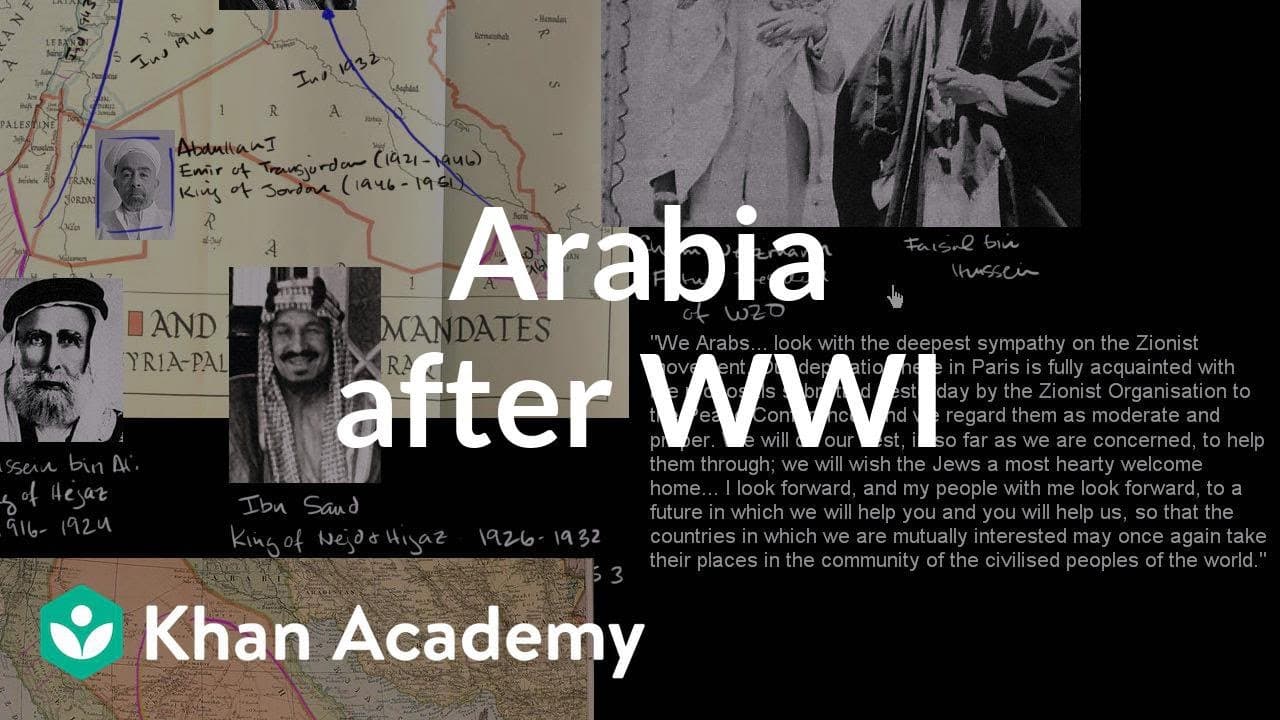
After World War I, the British and French reneged on promises of Arab independence, leading to disillusionment and uprisings. The Sykes-Picot Agreement laid out plans to divide the Ottoman territories, while Faisal bin Hussein became King of Iraq under British influence. Ultimately, Lebanon, Syria, and Jordan achieved independence post-war, but tensions remained high in the region.
Transcript
Narrator: As we entered in to World war I the British already had a presence in the Middle East. Egypt was already a British protectorate and it formalized this as we entered in to World War I and they don't get their independence until 1922. The British don't just hand it to them, they fight for this, they have a revolt against the British rule an... Read More
Key Insights
- 🥺 The British controlled Egypt and Kuwait before World War I, and their promises of independence to the Arabs led to the Arab revolt against the Ottomans.
- 🇮🇴 The Sykes-Picot Agreement and the Balfour Declaration revealed conflicting promises and intentions of the British, causing distrust among the Arabs.
- 🧑🦯 Faisal bin Hussein's attempt to collaborate with the Zionists at the Paris Peace Conference shows the complexity and shifting alliances in the region.
- 🥺 The Treaty of Sev divided the region according to the Sykes-Picot Agreement, leading to uprisings and revolts against British and French control.
Install to Summarize YouTube Videos and Get Transcripts
Explore YouTube Video Summarizer or Get YouTube Transcript Extractor
Questions & Answers
Q: How did the British gain control over Egypt and Kuwait?
The British established Egypt as a protectorate before World War I, formalizing their control. Kuwait, on the other hand, had been a British protectorate since the 1800s, and it gained independence in 1961.
Q: Why did the British try to convince Hussein bin Ali to revolt against the Ottomans?
The British needed Arab support to fight against the Ottomans in the Sinai, Palestine, and Mesopotamia fronts. They promised Hussein bin Ali an independent Arab state, excluding a small region, in exchange for his cooperation.
Q: What agreements undermined the Arab's hopes for an independent state?
The Sykes-Picot Agreement, revealed in 1917, divided the Middle East between the British and the French, undermining the idea of independent Arab states. The Balfour Declaration pledged British support for a Jewish homeland, causing further unease among the Arabs.
Q: How did Faisal bin Hussein try to form alliances at the Paris Peace Conference?
Faisal bin Hussein reached out to the World Zionist Organization, hoping to establish an independent Arab state in collaboration with the Jewish homeland advocated by the Zionists. However, his support was conditional on receiving an independent Arab state.
Summary & Key Takeaways
-
The British had control over Egypt and Kuwait as protectorates before World War I. During the war, they promised Hussein bin Ali an independent Arab state if he helped them fight against the Ottomans.
-
After the war, the Sykes-Picot Agreement and Balfour Declaration disheartened the Arabs as it revealed conflicting promises by the British. The Treaty of Sev divided the region according to the Sykes-Picot Agreement, leading to uprisings and revolts.
-
Faisal bin Hussein became King of Iraq under British influence, while Abdullah became King of Trans Jordan. Independence for Lebanon, Syria, and Jordan came after World War II.
Read in Other Languages (beta)
Share This Summary 📚
Summarize YouTube Videos and Get Video Transcripts with 1-Click
Try YouTube Summary with ChatGPT & Claude or YouTube Transcript Generator
Explore More Summaries from Khan Academy 📚



Summarize YouTube Videos and Get Video Transcripts with 1-Click
Try YouTube Summary with ChatGPT & Claude or YouTube Transcript Generator