Ionic solids | Intermolecular forces and properties | AP Chemistry | Khan Academy
TL;DR
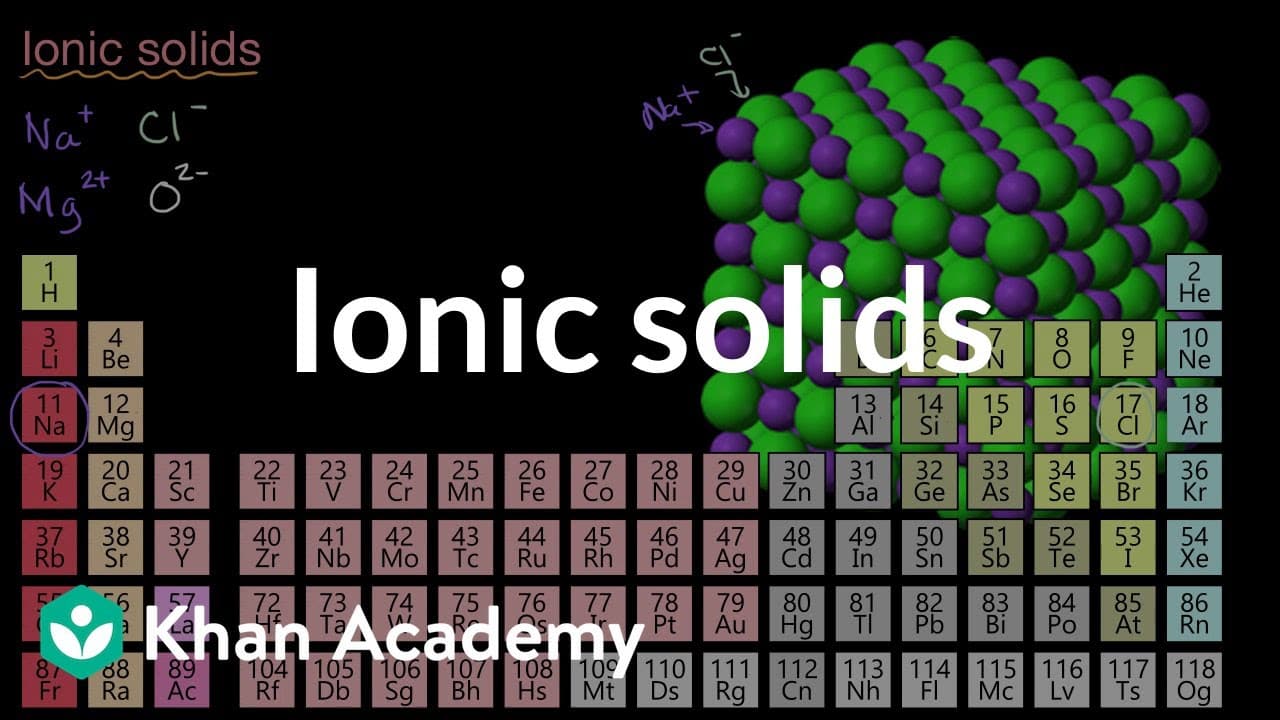
Ionic solids are formed by ions, with metals losing electrons and nonmetals gaining electrons, resulting in a lattice structure with strong electrostatic attraction. They have high melting points, are brittle, and do not conduct electricity in their solid form.
Transcript
- [Instructor] Let's talk a little bit about ionic solids, which you can imagine are solids formed by ions. So, let's think a little bit about these ions. So, for example, we could look at group one elements here, especially things like lithium, or sodium, or potassium. And in many other videos we have talked about these elements wanting maybe not ... Read More
Key Insights
- 😚 Ionic solids are formed by the reaction between metals (losing electrons) and nonmetals (gaining electrons).
- 🫠 The stronger the electrostatic attraction between ions, the higher the melting point of the ionic solid.
- 🍳 Ionic solids are brittle and break rather than bend under pressure.
- 🫠 They do not conduct electricity in their solid form but can do so when dissolved in a solution or melted.
Install to Summarize YouTube Videos and Get Transcripts
Explore YouTube Video Summarizer or Get YouTube Transcript Extractor
Questions & Answers
Q: How are ionic solids formed?
Ionic solids are formed through the reaction between metals and nonmetals, where the metals lose electrons and become positively charged ions (cations), while the nonmetals gain electrons and become negatively charged ions (anions).
Q: What determines the melting points of ionic solids?
The melting points of ionic solids depend on the magnitude of the charge and the radius of the ions forming the lattice structure. Higher charge and smaller ions result in stronger electrostatic attraction and higher melting points.
Q: Are ionic solids flexible or brittle?
Ionic solids are generally brittle. When enough force is applied to break the lattice structure, the negatively charged ions will be next to each other, and the positively charged ions will be next to each other, causing the solid to break rather than bend.
Q: Can ionic solids conduct electricity?
Ionic solids do not conduct electricity in their solid form because the ions are not able to move. However, they can conduct electricity when dissolved in a solution or melted, allowing the ions to move and carry the electric charge.
Summary & Key Takeaways
-
Ionic solids are formed by the reaction between metals (that lose electrons) and nonmetals (that gain electrons), resulting in positively charged ions (cations) and negatively charged ions (anions).
-
These ions are attracted to each other due to electrostatic forces and form a lattice structure, such as sodium chloride (table salt) or magnesium oxide.
-
Ionic solids have high melting points due to the strong electrostatic attraction between ions, can be brittle and break rather than bend, and do not conduct electricity in their solid form but can do so when dissolved in a solution or melted.
Read in Other Languages (beta)
Share This Summary 📚
Summarize YouTube Videos and Get Video Transcripts with 1-Click
Try YouTube Summary with ChatGPT & Claude or YouTube Transcript Generator
Explore More Summaries from Khan Academy 📚



Summarize YouTube Videos and Get Video Transcripts with 1-Click
Try YouTube Summary with ChatGPT & Claude or YouTube Transcript Generator