Limits from tables for oscillating functions
TL;DR
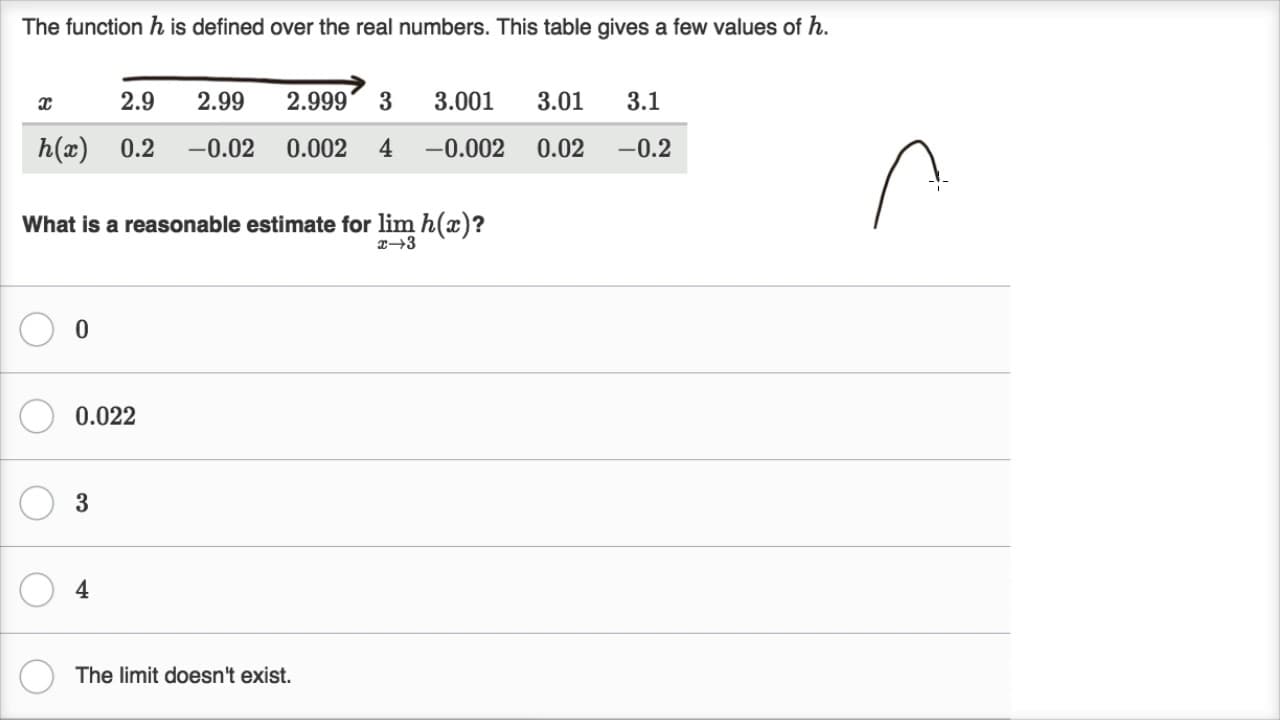
When a function exhibits oscillations as it approaches a certain value, the limit may not exist. However, if the oscillations decrease in magnitude, it is reasonable to estimate that the function is approaching that value.
Transcript
- [Instructor] The function h is defined over the real numbers. This table gives a few values of h, so they give us for different x values, What is the value of h of x? What is a reasonable estimate for the limit of h of x as x approaches one? So with the table we can estimate the limit. We won't know 100% for sure, but it's a good way to estimate ... Read More
Key Insights
- ⛩️ Observing oscillations in a function as it approaches a certain value can provide hints about the existence of a limit.
- 😚 Oscillations becoming more wild as we get closer to a value often indicates that the limit does not exist.
- ⛔ If the magnitude of oscillations decreases as we approach a value, it is reasonable to estimate that the limit exists.
- ⛔ The behavior of a function as it approaches a value can be different from the value that the function is defined at, emphasizing the purpose of studying limits.
Install to Summarize YouTube Videos and Get Transcripts
Explore YouTube Video Summarizer or Get YouTube Transcript Extractor
Questions & Answers
Q: How can we estimate the limit of a function using a table of values?
By analyzing the behavior of the function as we approach a specific value, we can make an estimate of the limit. This involves observing how the function changes for different x values that are getting closer to the target value.
Q: What is the significance of oscillations in determining the existence of a limit?
Oscillations alone do not indicate that a limit does not exist. However, if the oscillations become more significant or wilder as we approach a value, it is likely that the limit does not exist. On the other hand, if the oscillations decrease in magnitude, it is reasonable to estimate that the limit exists.
Q: Can the limit of a function be approached even if the function is defined at a different value?
Yes, the concept of limits allows us to study what a function approaches, even if the function is defined at a different value. In fact, the limit can approach a value that is different from the value at which the function is defined, as seen in the example where the limit is zero while the function is defined as four.
Q: Is it always possible to mathematically prove the existence or non-existence of a limit?
In many cases, it is not possible to mathematically prove the existence or non-existence of a limit. Estimating the limit based on the behavior of the function is often the best approach.
Summary & Key Takeaways
-
The first example shows oscillations that become more significant on both sides as x approaches one, indicating that the limit does not exist.
-
In the second example, the oscillations become less wild on both sides as x approaches three, suggesting that the limit is likely zero.
-
The table highlights the importance of considering the behavior of a function as it approaches a value in order to estimate the limit.
Read in Other Languages (beta)
Share This Summary 📚
Summarize YouTube Videos and Get Video Transcripts with 1-Click
Try YouTube Summary with ChatGPT & Claude or YouTube Transcript Generator
Explore More Summaries from Khan Academy 📚



Summarize YouTube Videos and Get Video Transcripts with 1-Click
Try YouTube Summary with ChatGPT & Claude or YouTube Transcript Generator