How Can White Nationalism be Prevented?
TL;DR
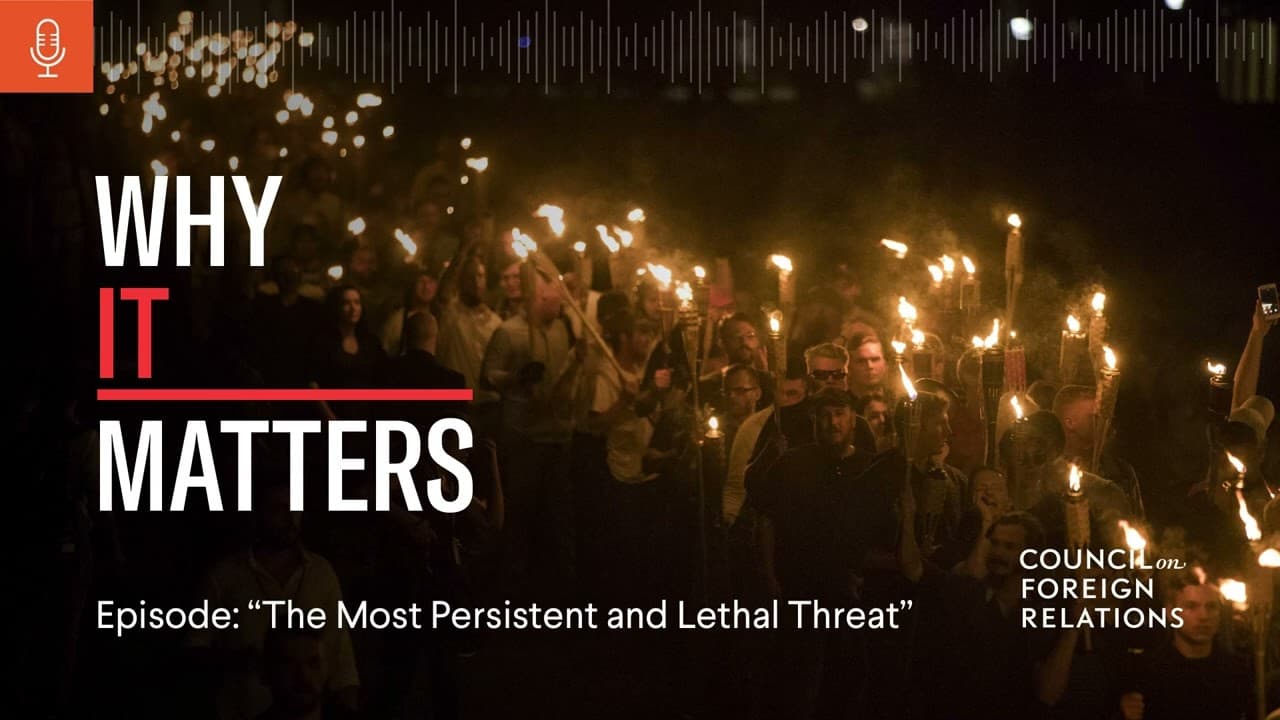
This podcast episode delves into the pressing issue of white nationalism and white supremacist extremism, highlighting its evolution and current status as a significant threat to U.S. national security. Experts Bruce Hoffman and Cynthia Miller-Idriss discuss the roots, transnational nature, and the challenges of combating these ideologies in the digital age, emphasizing the need for focused resources and policy changes.
Transcript
HOFFMAN: Foreigners coming to America to kill Americans - we immediately condemn it, and we see it as offensive, wrong, illegal, and we've waged a 20-year war on terrorism against this kind of threat. Somehow when it occurs in the United States, it's something we ignore, we don't want to come to grips with. And in part, that's because of constituti... Read More
Key Insights
- White nationalism and white supremacist extremism have become significant threats, surpassing Islamist extremism in the U.S., requiring urgent attention and resources.
- The digital age has amplified the reach and impact of these ideologies, with social media playing a crucial role in radicalization and recruitment.
- White nationalism is not a new phenomenon but has evolved over centuries, with roots tracing back to the early history of the United States.
- The decentralized nature of modern extremist groups makes them difficult to track and counter, complicating efforts for law enforcement and policy makers.
- The Capitol riots highlighted the urgent need to address domestic terrorism, prompting discussions on new legislation and policies.
- There are significant parallels between white supremacist groups and Islamist extremists, both seeking to restore perceived past glories by targeting 'the other.'
- Social media platforms have become powerful tools for extremists, facilitating communication, recruitment, and the live broadcasting of attacks.
- A comprehensive approach, including new laws, education, and a shift in national security focus, is essential to effectively combat these threats.
Install to Summarize YouTube Videos and Get Transcripts
Explore YouTube Video Summarizer or Get YouTube Transcript Extractor
Questions & Answers
Q: What role does social media play in the spread of white nationalist ideologies?
Social media plays a critical role in spreading white nationalist ideologies by facilitating radicalization, recruitment, and communication among extremists. It allows these groups to reach a global audience, coordinate attacks, and broadcast them live, as seen in events like the Christchurch attack. The anonymity and reach of social media platforms make it a powerful tool for extremism.
Q: How have white nationalist groups evolved over time?
White nationalist groups have evolved from organized entities into decentralized networks, making them harder to track and dismantle. Historically rooted in early U.S. history, these groups have adapted to modern challenges, leveraging digital platforms for recruitment and propaganda. Their evolution reflects broader societal changes and technological advancements, complicating efforts to counter their influence.
Q: What are the parallels between white nationalist and Islamist extremist groups?
Both white nationalist and Islamist extremist groups share similar goals of restoring perceived past glories by targeting 'the other.' They use similar tactics, such as leveraging digital platforms for radicalization and recruitment, and share an 'us versus them' mentality. These parallels highlight the transnational nature of extremist ideologies and the need for comprehensive counterterrorism strategies.
Q: Why is new legislation needed to address domestic terrorism?
New legislation is needed to address domestic terrorism because existing laws are often inadequate to prosecute individuals for extremist activities. A domestic terrorism statute would provide law enforcement with the necessary tools to charge individuals appropriately, ensuring that the legal system can effectively address the unique challenges posed by domestic extremist groups.
Q: What challenges do law enforcement agencies face in combating white nationalism?
Law enforcement agencies face several challenges in combating white nationalism, including the decentralized and anonymous nature of extremist networks, biases within law enforcement ranks, and inadequate resources. Additionally, the lack of comprehensive data on domestic extremism hinders efforts to understand and address the scope of the threat effectively.
Q: How has the threat of white nationalism changed in recent years?
The threat of white nationalism has intensified in recent years, becoming more diffuse and widespread due to the rise of digital communication platforms. This shift has made it challenging to track and counter these groups, prompting a reevaluation of national security priorities and the need for new policies to address the evolving nature of domestic extremism.
Q: What historical factors have contributed to the rise of white nationalism in the U.S.?
Historical factors contributing to the rise of white nationalism in the U.S. include longstanding racial tensions, economic instability, and disillusionment with government. These elements have fostered an environment where extremist ideologies can thrive, drawing on a narrative of restoring a perceived lost past and targeting minority groups as scapegoats for societal issues.
Q: What steps are being proposed to combat white nationalist extremism effectively?
Proposed steps to combat white nationalist extremism include enacting new legislation to address domestic terrorism, reallocating resources to focus on domestic threats, and enhancing education on the history of racial issues in the U.S. Additionally, there is a call for greater regulation of social media platforms to curb the spread of extremist content and improve data collection on domestic extremism.
Summary & Key Takeaways
-
The podcast explores the rise of white nationalism and white supremacist extremism as major threats to U.S. security, surpassing Islamist extremism. Experts discuss the historical roots, digital evolution, and the challenges of addressing these ideologies.
-
Social media has significantly amplified the reach of white supremacist ideologies, enabling radicalization and recruitment on a global scale. Experts emphasize the need for new policies and resources to combat these threats effectively.
-
The decentralized nature of modern extremist groups complicates efforts to counter them. The Capitol riots underscore the urgent need for a comprehensive approach, including legislation and education, to address domestic terrorism.
Read in Other Languages (beta)
Share This Summary 📚
Summarize YouTube Videos and Get Video Transcripts with 1-Click
Try YouTube Summary with ChatGPT & Claude or YouTube Transcript Generator
Explore More Summaries from Council on Foreign Relations 📚


Summarize YouTube Videos and Get Video Transcripts with 1-Click
Try YouTube Summary with ChatGPT & Claude or YouTube Transcript Generator