Quadratic Regression
TL;DR
This video demonstrates how to use a graphing calculator to model the trajectory of a golf ball hit down a fairway using quadratic regression.
Transcript
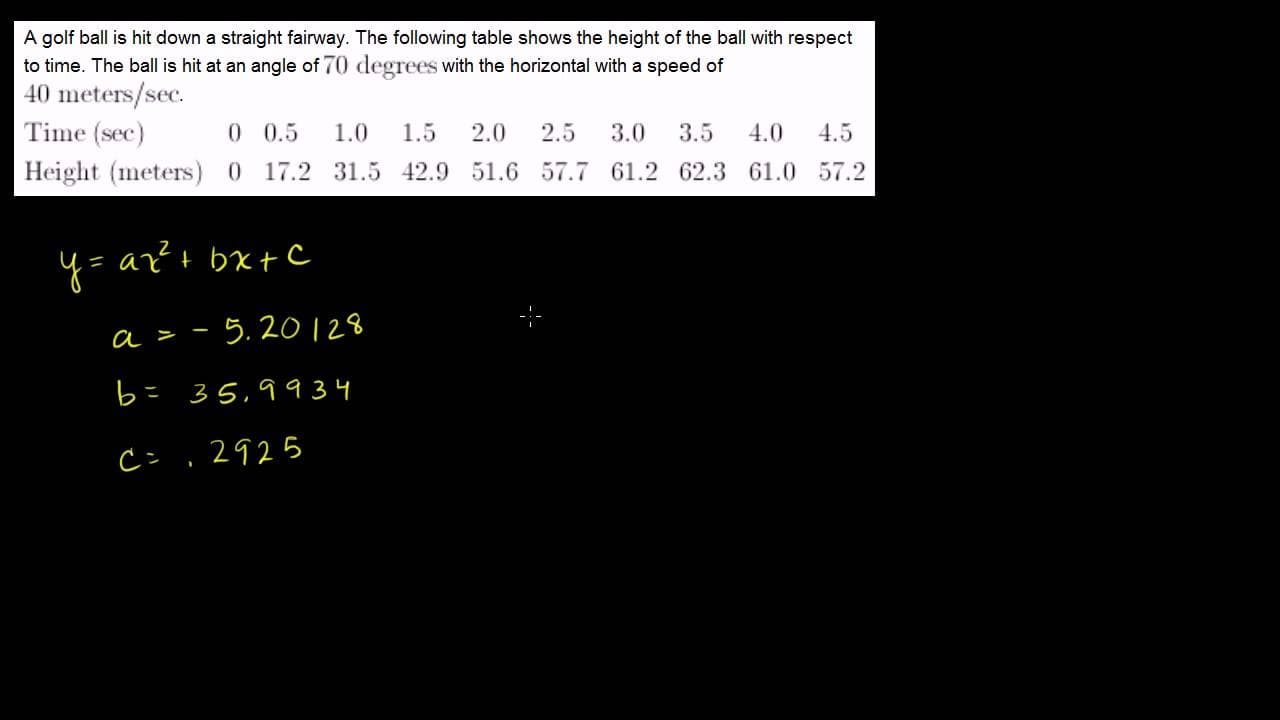
I have some data here. It says a golf ball is hit down a fairway. The following table shows the height of the ball with respect to time. The ball is hit at an angle of 70 degrees with the horizontal with a speed of 40 meters per second. And then they give us a bunch of, essentially data samples. At time 0, we're at 0 meters. At time 0.5 seconds, we... Read More
Key Insights
- 😫 Quadratic regression is a useful tool for modeling complex data sets and finding the best-fit quadratic function.
- 👨🦳 The data used in this video is collected from a golf ball hit in air, which complicates the physics of the trajectory.
- 😥 By inputting the data points into a graphing calculator and using regression analysis, a quadratic function that closely matches the data can be obtained.
- 💬 The coefficients of the quadratic function can be used to calculate the height of the golf ball at specific time intervals.
- 💨 Graphing calculators provide a convenient way to visualize and analyze data, making complex calculations and modeling tasks easier.
- 👱 Actual data may differ from ideal theoretical models due to factors like air resistance.
Install to Summarize YouTube Videos and Get Transcripts
Explore YouTube Video Summarizer or Get YouTube Transcript Extractor
Questions & Answers
Q: What is the purpose of using quadratic regression in modeling the golf ball trajectory?
Quadratic regression is used to find a quadratic function that closely matches the data points, allowing for accurate modeling of the golf ball's height with respect to time.
Q: How is the data inputted into the graphing calculator?
The video shows how to input the data points into the calculator by using the stat and edit functions. Each data point consists of a time interval and the corresponding height of the golf ball.
Q: Why is the data modeling in this video more complicated than using an equation for a vacuum environment?
The data being used in this video is collected from a golf ball hit in air, which introduces air resistance and makes the physics more complex. Therefore, modeling the trajectory using actual data requires more sophisticated methods like quadratic regression.
Q: What are the coefficients of the quadratic function that best fits the data points?
The coefficients of the quadratic function obtained through regression analysis are approximately -5.20128, 35.9934, and 0.2925. These coefficients determine the shape and position of the quadratic curve.
Summary & Key Takeaways
-
The video demonstrates how to use a graphing calculator to model the height of a golf ball with respect to time.
-
The data samples provided include the height of the ball at different time intervals after it has been hit.
-
By using quadratic regression, the video shows how to find a quadratic function that best fits the data points.
Read in Other Languages (beta)
Share This Summary 📚
Summarize YouTube Videos and Get Video Transcripts with 1-Click
Try YouTube Summary with ChatGPT & Claude or YouTube Transcript Generator
Explore More Summaries from Khan Academy 📚



Summarize YouTube Videos and Get Video Transcripts with 1-Click
Try YouTube Summary with ChatGPT & Claude or YouTube Transcript Generator