Primaries and caucuses | American civics | US History | Khan Academy
TL;DR
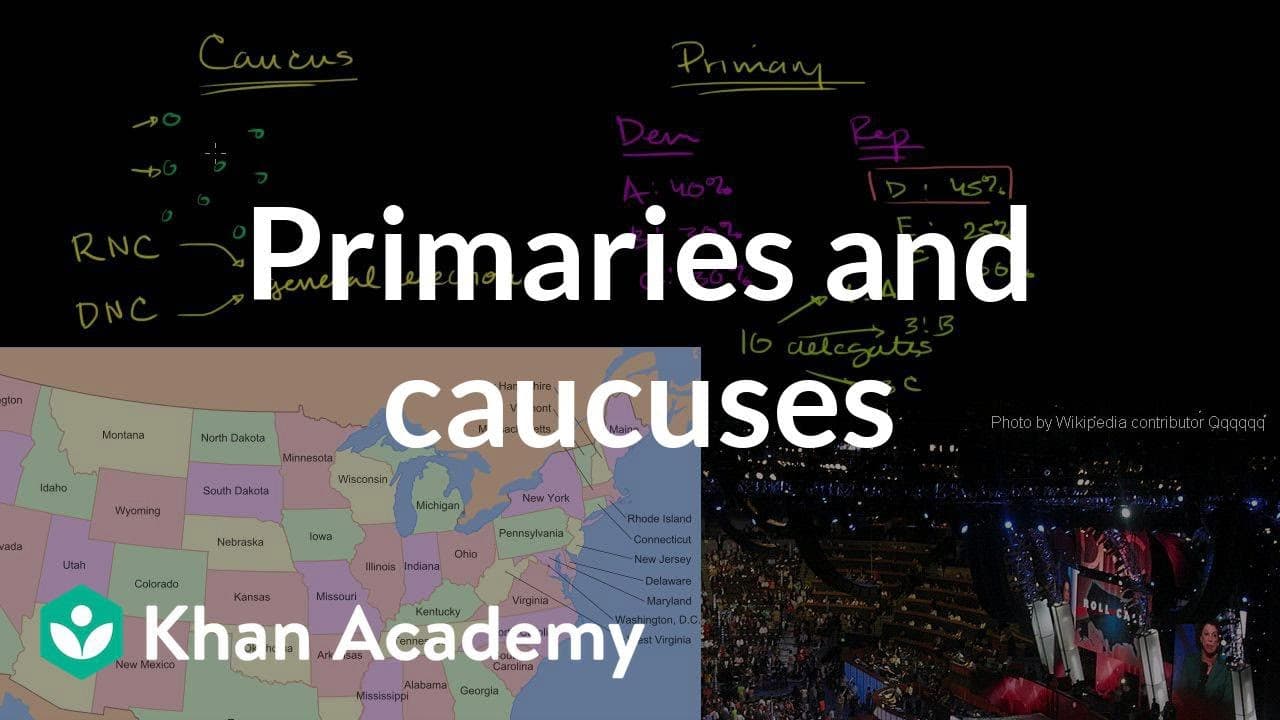
US political parties hold national conventions in the summer where they choose their official candidates for the general election. These candidates are selected through primaries or caucuses held in each state.
Transcript
Both of the major parties -- and we're talking about the United States here -- hold a national convention during the summer before the actual general election. So the Republicans will hold their Republican national convention, and the Democrats will hold their Democratic national convention. And it's there that they will choose their official candi... Read More
Key Insights
- 🥳 US political parties hold national conventions to choose their official candidates for the general election.
- ❓ The selection of delegates for the conventions can be done through primaries or caucuses, which vary in their processes and delegate allocation methods.
- 👻 Primaries distribute delegates proportionally based on the candidate's vote share, while some states allow winner-takes-all allocation.
- 🍗 Caucuses involve precinct meetings where supporters try to influence each other's choices until delegates are selected gradually through a series of conventions.
- 🥹 The Iowa caucus and New Hampshire primary hold significance as they are the early events in the primary season and often shape candidate perception and fundraising.
- 🥳 National conventions serve as a platform for party supporters to rally behind their candidate and generate excitement for the general election.
- 🥳 Primary elections and caucuses allow the parties to gauge support for their candidates among voters and identify front runners.
Install to Summarize YouTube Videos and Get Transcripts
Explore YouTube Video Summarizer or Get YouTube Transcript Extractor
Questions & Answers
Q: What is the purpose of the national party conventions in the US?
The national party conventions are held to choose the official candidates who will run in the general election for each political party.
Q: How do the states select delegates for the national conventions?
States use either primaries or caucuses to select delegates. Primaries are like elections, while caucuses involve precincts where supporters of different candidates try to influence each other's choices.
Q: How are the delegates proportionally represented in the national convention?
In a primary, candidates receive delegates proportionate to their votes. For example, if a candidate receives 40% of the votes, they will have 40% of the state's delegates.
Q: What is the difference between a primary and a caucus?
In a primary, voters cast their ballots to select a candidate. In a caucus, supporters gather at precincts and try to convince others to support their candidate through a series of meetings.
Summary & Key Takeaways
-
US political parties hold national conventions to select their official candidates for the general election.
-
The selection process involves primaries or caucuses in each state, where delegates are chosen to represent different candidates proportionally or through a winner-takes-all system.
-
The Iowa caucus and New Hampshire primary are important because they happen early in the primary season and can influence fundraising and candidate perception.
Read in Other Languages (beta)
Share This Summary 📚
Summarize YouTube Videos and Get Video Transcripts with 1-Click
Try YouTube Summary with ChatGPT & Claude or YouTube Transcript Generator
Explore More Summaries from Khan Academy 📚



Summarize YouTube Videos and Get Video Transcripts with 1-Click
Try YouTube Summary with ChatGPT & Claude or YouTube Transcript Generator