Is Spin Angular Momentum afterall? ('What is Spin?' follow up)
TL;DR
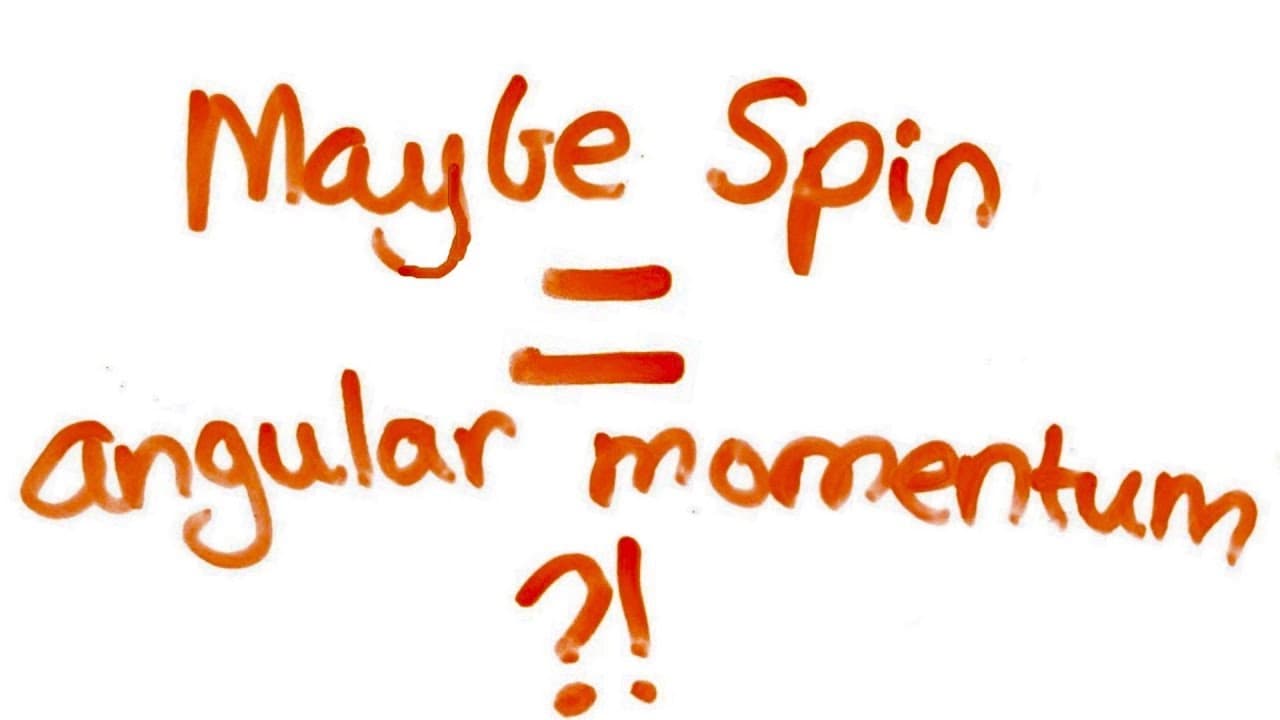
Spin, considered intrinsic angular momentum, is not the same as physical rotation and has a crucial role in understanding particles' behavior in magnetic fields.
Transcript
Angular momentum measures how much something is rotating. For a very brief time, a few of physicists thought that Spin was a type of angular momentum that came from the electrons spinning on their own axis. These days we are pretty sure that isn’t the case, electrons aren’t actually spinning, BUT spin is still thought of as a type of angular moment... Read More
Key Insights
- 📐 Spin is considered intrinsic angular momentum, independent of physical rotation.
- 🦾 The idea of spin as angular momentum is supported by an equation in quantum mechanics and the behavior observed in the Stern-Gerlach experiment.
- 🤢 The Stern-Gerlach machine accurately measures the orientation of particles with angular momentum but not bar magnets.
- 🏑 Angular momentum resists twisting in a magnetic field, resulting in circular motion known as Larmor precession.
- 🦾 Larmor precession occurs in quantum mechanics, where particles require multiple rotations to return to their original state.
- 🦾 Sources on spin and quantum mechanics can be advanced and confusing, posing challenges for research comprehension.
- 👨🔬 Further research on spin and exploration of other physics concepts is encouraged.
Install to Summarize YouTube Videos and Get Transcripts
Explore YouTube Video Summarizer or Get YouTube Transcript Extractor
Questions & Answers
Q: Why was the idea of spin being a form of angular momentum initially considered, even though electrons do not physically rotate?
The idea emerged from the similarities between spin and angular momentum, as spin followed a key equation in quantum mechanics. This equation was believed to define angular momentum and justified spin as a type of intrinsic angular momentum.
Q: How does the Stern-Gerlach experiment support the notion of spin as angular momentum?
The Stern-Gerlach experiment showed that particles with spin, like magnets with angular momentum, exhibit magnetism. This led to the conclusion that particles with spin possess intrinsic angular momentum.
Q: Why does the Stern-Gerlach machine work for charged particles with angular momentum but not for bar magnets?
The Stern-Gerlach machine's pointy shape creates a stronger pulling force on the magnet's south pole, leading to deflection. In contrast, the twisting effect experienced by bar magnets in the machine prevents accurate measurement of their orientation.
Q: Does Larmor precession occur in quantum mechanics, and why is it significant?
Yes, Larmor precession also occurs in quantum mechanics. In the case of electrons, for example, it takes two complete rotations for them to return to their original state. This phenomenon highlights the unique behavior of particles with spin and deepens our understanding of quantum mechanics.
Summary & Key Takeaways
-
Spin is initially thought to be a type of angular momentum generated by the rotation of electrons, but it is now understood as intrinsic angular momentum.
-
Previous arguments for spin as angular momentum based on quantum mechanics equations and the Stern-Gerlach experiment are debunked.
-
The Stern-Gerlach machine, acting like a magnet, measures the orientation of a charged particle, but it does not work for bar magnets. However, it does work for particles with angular momentum.
-
Angular momentum resists twisting in a magnetic field, resulting in Larmor precession, which is observed in particles with spin.
Read in Other Languages (beta)
Share This Summary 📚
Summarize YouTube Videos and Get Video Transcripts with 1-Click
Try YouTube Summary with ChatGPT & Claude or YouTube Transcript Generator
Explore More Summaries from Looking Glass Universe 📚




Summarize YouTube Videos and Get Video Transcripts with 1-Click
Try YouTube Summary with ChatGPT & Claude or YouTube Transcript Generator