Preimage of a set | Matrix transformations | Linear Algebra | Khan Academy
TL;DR
Transformations in mathematics involve mapping elements from one set to another, while pre-images represent the set of vectors in the domain that map to a specific subset in the codomain.
Transcript
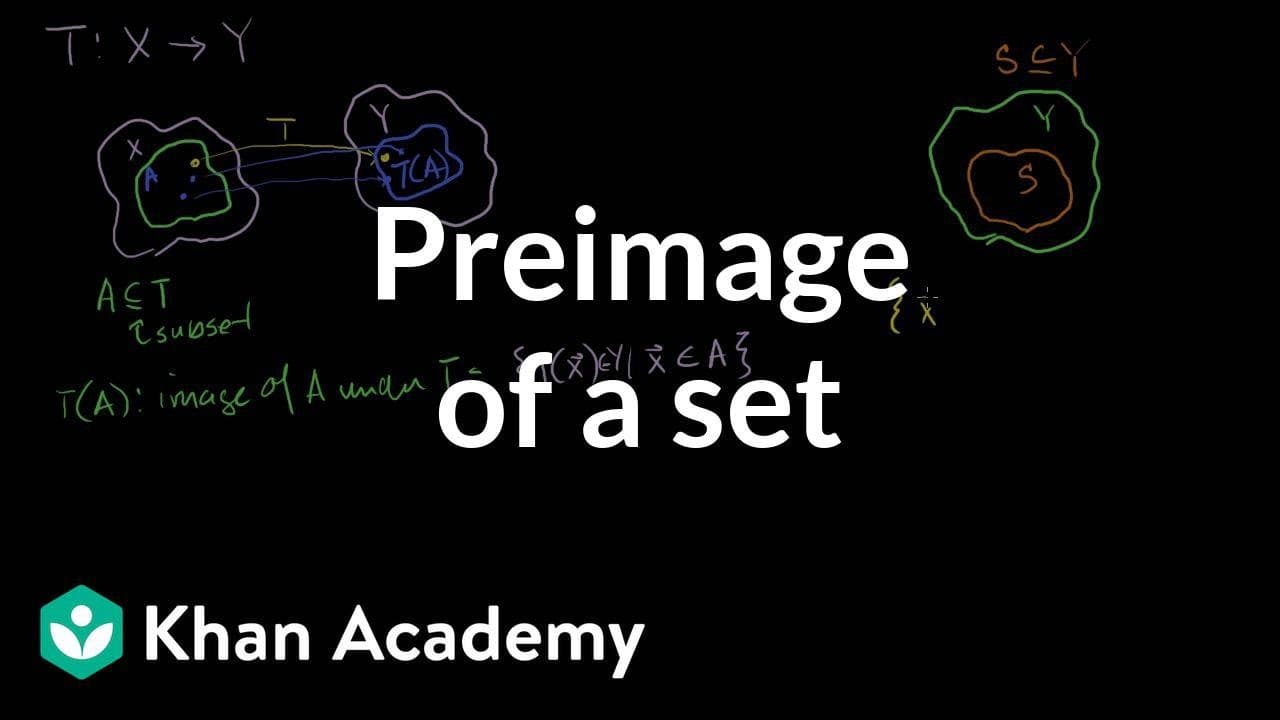
Let's add some transformation that maps elements in set X to set Y. We know that we call X the domain of T. So that's my set X and then my set that I'm mapping into, set Y, that's the codomain. We know that T is a transformation that if you take any member of X and you transform it, you'll associate it with a member of set Y. You'll map it to a mem... Read More
Key Insights
- 😫 A transformation, or function, in mathematics maps elements from one set (domain) to another set (codomain).
- 😫 The image of a subset A under a transformation T is the set of all transformations of the members in A.
- 😮 The pre-image of a subset S under a transformation T is the set of vectors in the domain that map into S.
- 🎅 The pre-image of a subset S may not include all elements in S, but only the vectors in the domain that map into S.
- 🎅 The inverse T of S is equal to the pre-image of S under T.
- 😑 The pre-image can be viewed as a cancellation of the image when constructing a subset of S.
- 😑 The inverse notation represents the pre-image and was likely introduced to indicate the cancellation of the image.
Install to Summarize YouTube Videos and Get Transcripts
Explore YouTube Video Summarizer or Get YouTube Transcript Extractor
Questions & Answers
Q: What is a transformation in mathematics?
A transformation, also known as a function, maps elements from one set (domain) to another set (codomain) in mathematics.
Q: How is the image of a subset defined under a transformation?
The image of a subset A under a transformation T is the set of all transformations of the members in A, which are subsets of the codomain.
Q: What is the pre-image of a subset in the codomain under a transformation?
The pre-image of a subset S in the codomain under a transformation T is the set of vectors in the domain that map into S.
Q: Do all elements in a subset S necessarily get mapped to from the domain?
No, the pre-image of a subset S only includes the vectors in the domain that map into S, but not necessarily all elements in S.
Summary & Key Takeaways
-
A transformation, also called a function, maps elements from one set (domain) to another set (codomain).
-
The image of a subset A in the domain under a transformation T is the set of all transformations of the members in A.
-
The pre-image of a subset S in the codomain under a transformation T is the set of vectors in the domain that map into S.
Read in Other Languages (beta)
Share This Summary 📚
Summarize YouTube Videos and Get Video Transcripts with 1-Click
Try YouTube Summary with ChatGPT & Claude or YouTube Transcript Generator
Explore More Summaries from Khan Academy 📚



Summarize YouTube Videos and Get Video Transcripts with 1-Click
Try YouTube Summary with ChatGPT & Claude or YouTube Transcript Generator