How to Count Place Value Blocks in Math
TL;DR
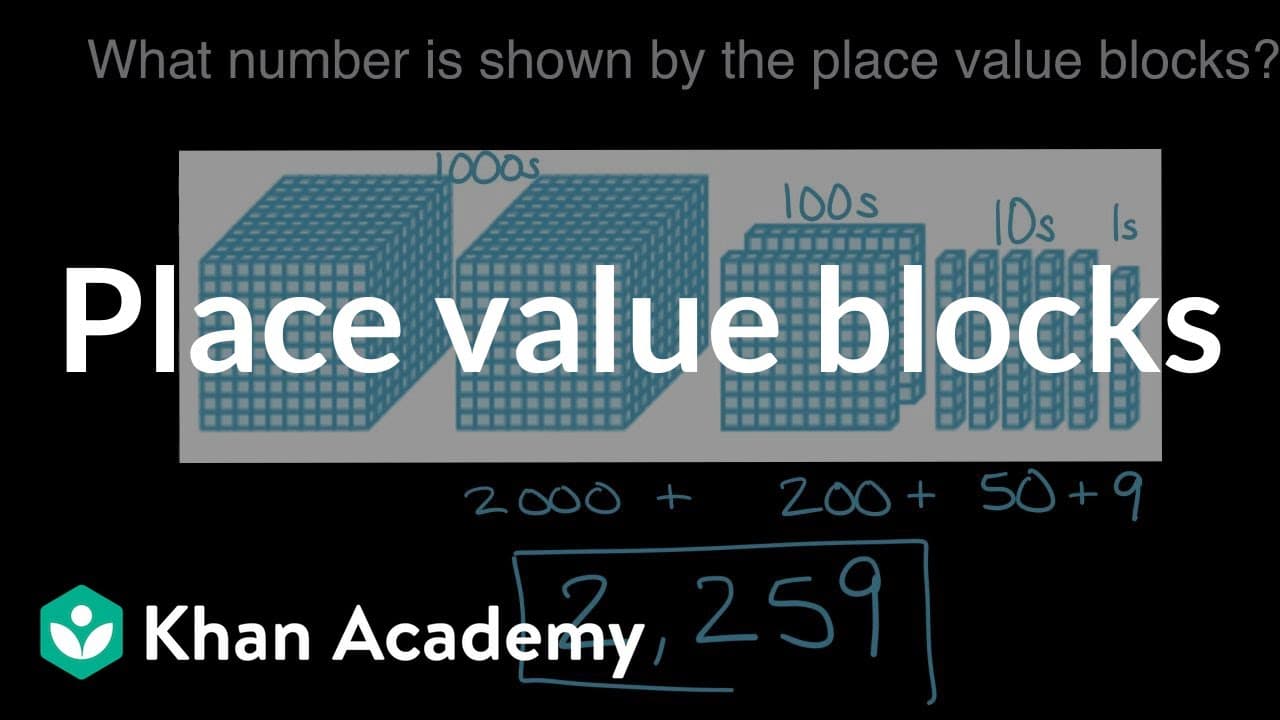
To count place value blocks, identify their values based on their arrangement: single blocks represent ones, columns of ten represent tens, slabs represent hundreds, and large cubes represent thousands. Combining these values allows you to determine the overall number, such as recognizing that 2,259 is made up of 2,000, 200, 50, and 9 blocks.
Transcript
- [Voiceover] What number is shown by the place value blocks? So here we have several sets of place value blocks, some with many many many blocks and some with just single blocks stacked on top of each other, and we want to know what number is represented bay all of the blocks combined. So let's start over here with the single blocks stacked on top... Read More
Key Insights
- 🥇 Place value blocks help visualize and understand the concept of place value in mathematics.
- 🥇 Counting place value blocks accurately is essential for accurately representing numbers.
- 🥇 Place value blocks are organized in a hierarchical manner, with each level representing a different place value.
- 👻 Combining the values of different place value blocks allows us to determine the overall number they represent.
- 🥇 The video provides a step-by-step example of counting and combining place value blocks.
- 🚫 Place value blocks can range from single blocks to columns, slabs, and sets, depending on the magnitude of the number they represent.
- 🥇 Each category of place value blocks has a specific value associated with it.
Install to Summarize YouTube Videos and Get Transcripts
Explore YouTube Video Summarizer or Get YouTube Transcript Extractor
Questions & Answers
Q: How are place value blocks counted and represented?
Place value blocks are counted by observing the number of single blocks, columns of tens, slabs of hundreds, and sets of thousands. Each category represents a specific numeric value.
Q: What is the significance of counting place value blocks?
Counting place value blocks allows us to understand and represent different numbers accurately, as each block represents a specific value within the number's place value system.
Q: How do you combine the values of different place value blocks?
To combine different place value blocks, you add up the number of ones, tens, hundreds, and thousands, ensuring each value is accounted for in the final number.
Q: Can we determine the number represented by place value blocks without counting them?
No, counting the place value blocks is necessary to determine the exact number they represent, as the value of each block must be counted and added together according to its place in the number structure.
Summary & Key Takeaways
-
The video explains how to count and determine the value of place value blocks, starting from ones, tens, hundreds, and thousands.
-
It provides examples of counting single blocks, columns of tens, slabs of hundreds, and sets of thousands.
-
The final example showcases how to combine the values of different place value blocks to represent a specific number, such as 3,038.
Read in Other Languages (beta)
Share This Summary 📚
Summarize YouTube Videos and Get Video Transcripts with 1-Click
Try YouTube Summary with ChatGPT & Claude or YouTube Transcript Generator
Explore More Summaries from Khan Academy 📚



Summarize YouTube Videos and Get Video Transcripts with 1-Click
Try YouTube Summary with ChatGPT & Claude or YouTube Transcript Generator