How to Convert Interval Notation to Set-Builder Notation
TL;DR
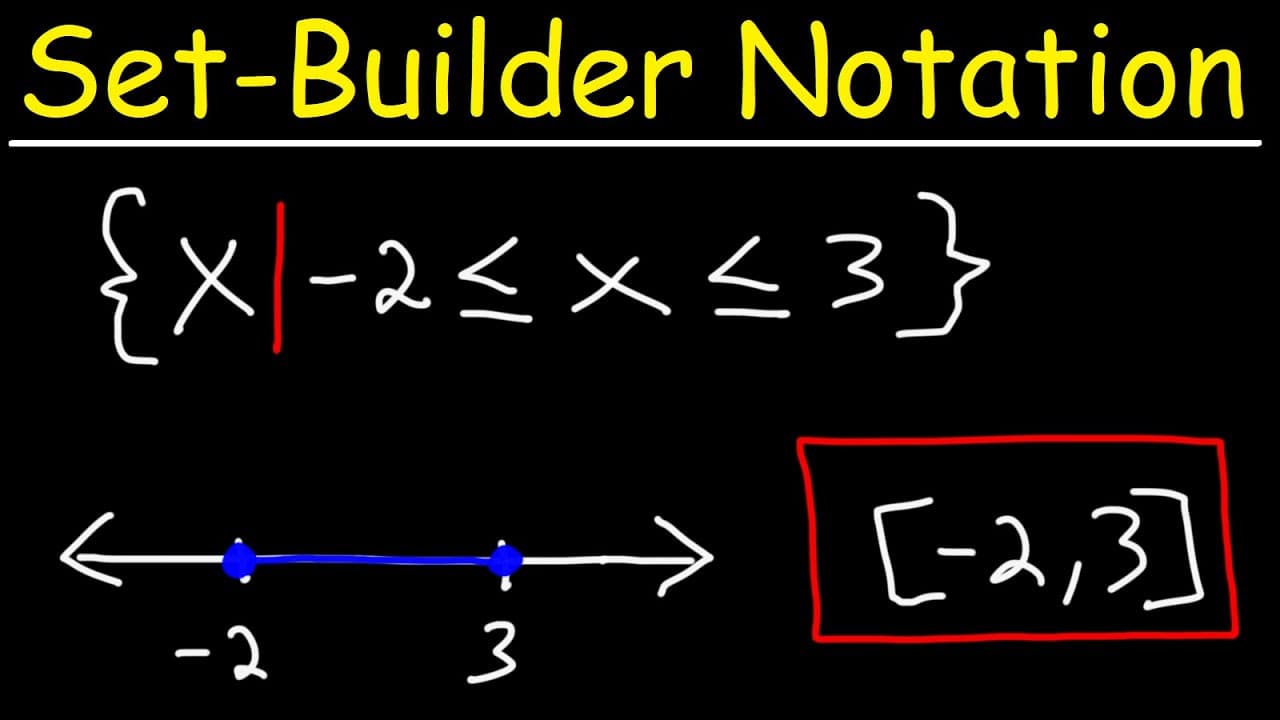
To convert interval notation to set-builder notation, identify whether the endpoints are included using brackets for closed intervals and parentheses for open intervals. For example, the interval [-2, 3) is expressed as {x | -2 ≤ x < 3}, while (−∞, -4) translates to {x | x < -4}.
Transcript
in this video we're going to talk about how to convert a mathematical expression from interval notation to set builder notation so let's start with a graph the interval on a number line and express it in set builder notation so here's the number line here's negative two this is three now we have brackets so what that means is we're going to have a ... Read More
Key Insights
- 😫 Interval notation can be converted to set builder notation by considering the inclusion or exclusion of the endpoints.
- 😚 Brackets [ ] represent closed circles on the number line, indicating inclusion.
- 🤗 Parentheses ( ) represent open circles, indicating exclusion.
- ♾️ Infinity is represented as "-∞" or "+∞" and implies no specific endpoint.
- 😑 Combining multiple intervals in one expression is done using the union symbol (∪).
Install to Summarize YouTube Videos and Get Transcripts
Explore YouTube Video Summarizer or Get YouTube Transcript Extractor
Questions & Answers
Q: How can you convert an interval notation with brackets to set builder notation?
When the interval has brackets, it means the endpoints are included. Graphically, it is represented by closed circles. In set builder notation, the expression would include "x is less than or equal to" the endpoint with a closed bracket.
Q: What if a parenthesis is used in the interval notation?
Parentheses indicate that the endpoint is not included in the interval. On a number line, this is represented by an open circle. In set builder notation, the expression would include "x is less than" or "x is greater than" the endpoint, but not equal to it.
Q: How do you represent an infinite interval in set builder notation?
An infinite interval, extending to either positive or negative infinity, is represented as "x is greater than" or "x is less than" respectively. There is no specific endpoint mentioned.
Q: Can you have multiple intervals combined in one mathematical expression?
Yes, multiple intervals can be combined using the union symbol. Each interval should be graphed separately on the number line and expressed individually in set builder notation. The union symbol connects the separate expressions.
Summary & Key Takeaways
-
The video explains how to convert a mathematical expression from interval notation to set builder notation using a number line representation.
-
It demonstrates the process for different interval types, including those with brackets and parentheses.
-
The instructor provides step-by-step instructions on graphing the intervals on a number line and expressing them in set builder notation.
Read in Other Languages (beta)
Share This Summary 📚
Summarize YouTube Videos and Get Video Transcripts with 1-Click
Try YouTube Summary with ChatGPT & Claude or YouTube Transcript Generator
Explore More Summaries from The Organic Chemistry Tutor 📚



Summarize YouTube Videos and Get Video Transcripts with 1-Click
Try YouTube Summary with ChatGPT & Claude or YouTube Transcript Generator