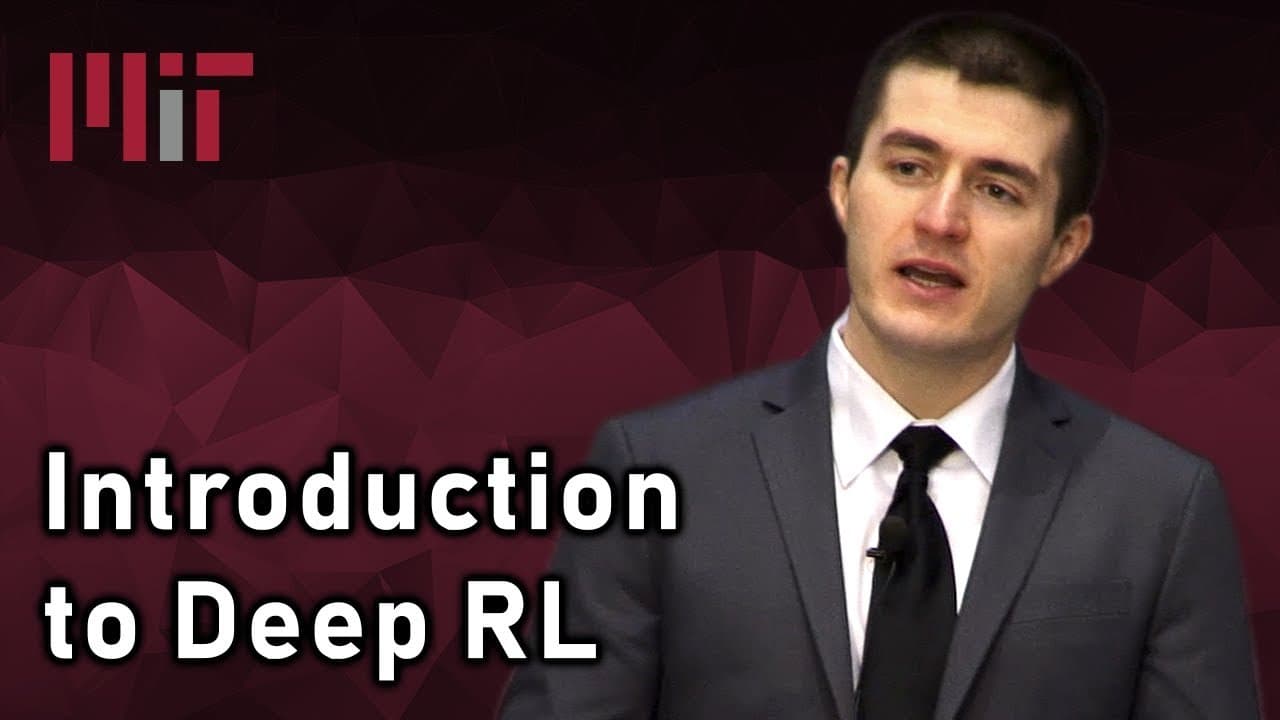
MIT 6.S091: Introduction to Deep Reinforcement Learning (Deep RL)
Transcript
today I'd like to overview the exciting field of deep reinforcement learning introduced overview and provide you some of the basics I think it's one of the most exciting fields in artificial intelligence it's marrying the power and the ability of deep neural networks to represent and comprehend the world with the ability to act on that understandin... Read More
Install to Summarize YouTube Videos and Get Transcripts
Explore YouTube Video Summarizer or Get YouTube Transcript Extractor
Summary
This video provides an overview of deep reinforcement learning, a field that combines the power of deep neural networks with the ability to make sequential decisions. The video discusses the different types of learning, the importance of supervision in reinforcement learning, and the challenges faced in real-world applications. It also introduces various algorithms used in reinforcement learning, such as deep Q-networks and policy gradients.
Questions & Answers
Q: What is deep reinforcement learning?
Deep reinforcement learning is the combination of deep learning, which uses neural networks to represent and comprehend data, with reinforcement learning, which involves making sequential decisions. It applies the power of deep neural networks to tasks where an agent needs to make a series of decisions that affect the environment.
Q: What is the fundamental process of learning for reinforcement learning agents?
The fundamental process of learning for reinforcement learning agents is trial and error. Agents learn by interacting with the environment, receiving feedback in the form of rewards, and adjusting their actions based on the outcome. This process allows them to learn from their mistakes and improve their decision-making over time.
Q: How does supervision work in reinforcement learning?
Supervision in reinforcement learning refers to providing guidance or feedback to the learning agent. While reinforcement learning is often seen as unsupervised learning, every type of machine learning is actually supervised by a loss function or a function that tells the agent what is good and what is bad. In reinforcement learning, the supervision comes from the reward signal that the agent receives from the environment.
Q: How do supervised learning and reinforcement learning differ?
The main difference between supervised learning and reinforcement learning lies in the source of supervision. In supervised learning, the supervision comes from manually annotated examples, while in reinforcement learning, it comes from the reward signal provided by the environment. However, both types of learning require some form of human input to determine what is good and what is bad.
Q: What is the role of neural networks in deep reinforcement learning?
Neural networks play a crucial role in deep reinforcement learning as they are responsible for representing the world and making decisions based on that representation. Neural networks are used to encode the raw sensory data from the environment and learn higher-order representations that can be used for reasoning and decision-making. They act as the framework for reinforcement learning algorithms.
Q: How does the reward structure affect the behavior of reinforcement learning agents?
The reward structure in reinforcement learning determines what is considered good and bad for the agent. It influences the behavior of the agent and the decisions it makes. For example, in an environment where every step incurs a negative reward, the agent will try to minimize the number of steps taken. On the other hand, in an environment where there are positive rewards for certain actions, the agent will seek to maximize those rewards.
Q: How can reinforcement learning be applied to real-world problems?
Reinforcement learning can be applied to real-world problems by defining the environment, states, actions, and the reward structure. The environment represents the world the agent interacts with, the states are the different configurations or observations of the environment, the actions are the possible choices the agent can make, and the reward structure determines what is considered good and bad for the agent. By formulating the problem in this way, reinforcement learning algorithms can learn to make intelligent decisions in complex real-world scenarios.
Q: What is the difference between model-based and model-free reinforcement learning?
Model-based reinforcement learning involves learning a model of the world, which represents the dynamics or physics of the environment. This allows the agent to plan and make predictions about future states and actions. Model-free reinforcement learning, on the other hand, does not require a model of the world. Instead, it directly learns the optimal policy or value function based on the observed experiences.
Q: What are some challenges in applying reinforcement learning to real-world applications?
One of the main challenges in applying reinforcement learning to real-world applications is the gap between simulation and the real world. Most successful applications of reinforcement learning have been in simulated environments, and transferring the learned policies to the real world is still a major challenge. Other challenges include the efficiency of learning from limited data, defining the reward structure to align with desired outcomes, and ensuring the safety and ethics of reinforcement learning agents in real-world contexts.
Q: What are some key algorithms used in reinforcement learning?
Some key algorithms used in reinforcement learning include deep Q-networks (DQNs) and policy gradients. DQNs use neural networks to estimate the quality of taking an action in a particular state and have been successful in achieving superhuman performance in gaming environments. Policy gradients, on the other hand, directly optimize the policy or strategy of the agent. These algorithms, along with variations such as dueling DQNs and prioritized experience replay, have contributed to the advancements in deep reinforcement learning.
Q: How can deep reinforcement learning have a real-world impact?
Deep reinforcement learning has the potential to have a real-world impact by enabling agents to learn and act autonomously in complex environments. By leveraging the power of deep neural networks, these agents can make intelligent decisions based on raw sensory information and learn from their interactions with the world. This can lead to advancements in robotics, autonomous driving, and various other fields where intelligent decision-making is crucial.
Takeaways
Reinforcement learning is a powerful field that combines deep learning with the ability to make sequential decisions. It allows agents to learn and act autonomously, driven by a reward structure. The field faces challenges regarding the gap between simulation and the real world, the efficiency of learning from limited data, and the formulation of reward structures. Key algorithms used in reinforcement learning include deep Q-networks and policy gradients. These algorithms have shown promising results in gaming environments and provide a path for real-world impact. However, safety and ethical considerations must be addressed as reinforcement learning agents interact with the real world. Overall, deep reinforcement learning holds great potential for creating intelligent agents that can learn and act in complex environments.
Read in Other Languages (beta)
Share This Summary 📚
Summarize YouTube Videos and Get Video Transcripts with 1-Click
Try YouTube Summary with ChatGPT & Claude or YouTube Transcript Generator
Explore More Summaries from Lex Fridman 📚





Summarize YouTube Videos and Get Video Transcripts with 1-Click
Try YouTube Summary with ChatGPT & Claude or YouTube Transcript Generator