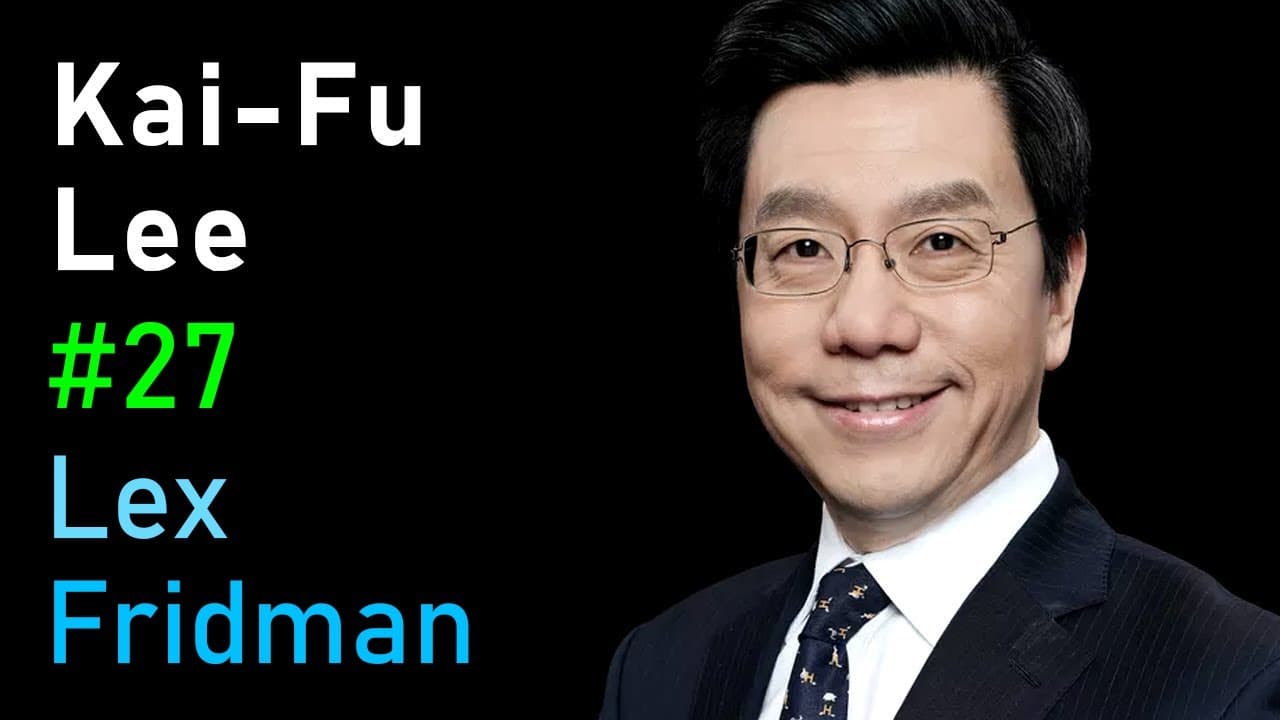
Kai-Fu Lee: AI Superpowers - China and Silicon Valley | Lex Fridman Podcast #27
TL;DR
Chi Fuli, former president of Google China, discusses the impact of AI on global innovation and the cultural perspectives that influence its development and adoption.
Transcript
the following is a conversation of Chi Fuli he's the chairman and CEO of sin evasion ventures that manages a two billion dollar dual currency investment fund with a focus on developing the next generation of Chinese high-tech companies he's the former president of Google China and the founder of what is now called Microsoft Research Asia an institu... Read More
Key Insights
- 🥺 China's history of poverty and recent economic growth have shaped the drive and work ethic of its people, leading to a deep hunger for success.
- ⛔ The Chinese rote learning tradition is effective for execution and results but may limit breakthrough innovation.
- 👶 Chinese AI engineers prioritize data cleansing, while American AI engineers focus on trying new things and using technology to solve problems.
- ✋ Routine and repetitive jobs are at the highest risk of automation, requiring individuals to retrain for non-routine jobs that involve creativity and compassion.
- ❓ Engagement and interaction between superpowers are crucial to prevent potential conflicts related to AI and cyberspace.
- 👤 Policies and technologies must be developed to balance privacy, data access, and user preferences, ensuring transparency and user control.
Install to Summarize YouTube Videos and Get Transcripts
Explore YouTube Video Summarizer or Get YouTube Transcript Extractor
Questions & Answers
Q: How does China's history of poverty and recent economic growth influence the drive and work ethic of its people?
The Chinese people have faced centuries of poverty, and in the past 40 years, they have shined with hope for prosperity. This has created a strong hunger, desire, and work ethic in the current generation.
Q: Can China's rote learning tradition hinder breakthrough innovation, unlike the creative approach of Silicon Valley?
Yes, the rote learning tradition in China may limit breakthrough innovation, as it emphasizes memorization and execution rather than creative thinking. This approach is effective for enhancing speed and execution but may suppress innovation.
Q: How does the Chinese approach to AI engineering differ from the American approach?
Chinese AI engineers focus on data cleansing and spend more time cleaning and organizing data to make it work in the system. American AI engineers, on the other hand, prioritize trying new things and using technology to solve problems.
Q: What is the future impact of AI on job automation, and how should individuals prepare for upcoming changes?
Routine and repetitive jobs are at the highest risk of automation in the next 5-10 years. It's crucial for individuals to focus on retraining for non-routine jobs that require creativity and compassion, as these are less likely to be automated.
Key Insights:
- China's history of poverty and recent economic growth have shaped the drive and work ethic of its people, leading to a deep hunger for success.
- The Chinese rote learning tradition is effective for execution and results but may limit breakthrough innovation.
- Chinese AI engineers prioritize data cleansing, while American AI engineers focus on trying new things and using technology to solve problems.
- Routine and repetitive jobs are at the highest risk of automation, requiring individuals to retrain for non-routine jobs that involve creativity and compassion.
- Engagement and interaction between superpowers are crucial to prevent potential conflicts related to AI and cyberspace.
- Policies and technologies must be developed to balance privacy, data access, and user preferences, ensuring transparency and user control.
- Long-term success is found in maintaining the balance between profit-driven decisions and the heart and soul of a company.
Summary
In this video, Lex Friedman interviews Chi-Fu Lee, the chairman and CEO of Sinovation Ventures, about the future of AI and global innovation. They discuss various topics, including the Chinese soul, differences between Chinese and American AI engineers, the culture of Silicon Valley, job automation, and the role of government in supporting entrepreneurship.
Questions & Answers
Q: Can you describe the Chinese soul and what defines it?
The Chinese soul is deeply rooted in the history of the country, from centuries of poverty to the hope of prosperity that emerged in the past 40 years. The people have a strong desire for success and a strong work ethic that drives them forward.
Q: Is there something unique to China that influences the people's approach to excellence and results?
Yes, the Chinese tradition emphasizes excellence, dedication, and results. The educational system in China focuses on rote learning and memorization, which enhances execution and speed. This tradition has shaped the historic basis of Chinese culture and its approach to innovation.
Q: Do you think Chinese AI engineers and American AI engineers differ in any way?
While there are similarities in their work, the Chinese engineers may focus more on data cleansing and working with large amounts of data, while American engineers may focus on trying new things and solving problems using technology. The Chinese approach is more focused on execution and using data, while the American approach emphasizes innovation and new algorithms.
Q: What do you believe will have the biggest impact in the next 10 years - breakthrough algorithms or rigorous data cleaning and organizing?
The use of known techniques and enhancing data seems to be the more expedient approach for delivering results. The Chinese approach of data cleaning and organizing has proven to be successful in many areas. However, for more challenging problems like autonomous vehicles and medical diagnosis, breakthrough algorithms may be needed and could give an advantage to those using an innovative approach.
Q: Can you describe the culture of Silicon Valley and the unique characteristics of the major tech companies?
Silicon Valley is known for its visionary goals and belief in technology conquering all. The companies have a self-confidence and entitlement that their products are the best and should be used by everyone. Each company also has its own unique characteristics - Apple focuses on design and brand, Microsoft on building efficient products, Google on connecting information, and Facebook and Amazon on aggressively expanding into adjacent markets.
Q: How does the Chinese approach to entrepreneurship differ from Silicon Valley?
In China, there is a winner-takes-all mentality and a focus on dominating market categories to extract maximum value. Chinese entrepreneurs are more willing to copy existing successful products and iterate on them, whereas Silicon Valley places a higher emphasis on originality and innovation. This flexibility and speed of execution have given Chinese entrepreneurs an edge in certain areas.
Q: Can you explain how the Chinese government supports entrepreneurship and the role of VCs in the ecosystem?
The Chinese government supports entrepreneurship by creating infrastructure and providing funding through guiding funds and incubators. The government does not directly interfere in the private enterprise but facilitates the growth of entrepreneurship by building infrastructure and allocating funds to support startups. The VC ecosystem in China is rapidly growing, with increasing amounts of funding being raised and invested in different stages of startups.
Q: How can other countries, like the United States, learn from the Chinese government's support of entrepreneurship?
Other countries can learn from the Chinese government's approach by creating incentives for entrepreneurship, building infrastructure, and investing in startups. The success of the Chinese ecosystem is a result of trial and error, learning from other countries, and competition among local governments. It may be challenging to inject the Chinese approach into Western countries, but encouraging the entrepreneurial VC ecosystem and providing guidance and support to startups can help foster innovation.
Q: How has AI changed over the past 30 years in the West and the East?
AI started as a pursuit to understand human intelligence but has shifted towards machine intelligence, which focuses on pattern recognition and optimization. Most people still misunderstand AI and think it's about replicating human intelligence, but the current AI products are closer to inventions like the internet or the spreadsheet. AI is better at specific tasks but still far from human-level intelligence.
Q: Which jobs do you believe will be automated in the next 5-10 years?
Routine jobs, both white-collar and blue-collar, are at risk of being automated. Back-office tasks, such as data management and simple computer programs, telesales, telemarketing, customer service, repetitive physical jobs like fruit picking and assembly line inspection, and eventually jobs in fields like autonomous vehicles, will all be affected.
Q: What are your thoughts on Andrew Yang's concerns about job loss due to automation and his proposal of universal basic income?
Chi-Fu Lee agrees with Yang's concerns about displacement due to automation. However, he believes that the focus should be on retraining rather than providing a universal basic income. The key is to help workers transition to non-routine jobs that will be in demand and provide a sense of meaning and satisfaction.
Q: Can you elaborate on the kinds of jobs that are difficult to automate due to creativity and compassion?
Jobs that require creativity, complex problem-solving, strategic thinking, and non-routine decision-making are difficult to automate. This includes jobs in fields like drug discovery, painting, managing a company, and those that require empathy and human touch, like compassionate care. AI systems lack the ability to reason, plan, and think creatively, making these jobs less susceptible to automation.
Takeaways
In this conversation, Chi-Fu Lee provides insights into the Chinese soul, the differences between Chinese and American AI engineers, the culture of Silicon Valley, job automation, and the role of government in supporting entrepreneurship. He highlights the importance of retraining workers who are at risk of displacement and emphasizes the need to find meaning in work. While routine jobs will be automated, jobs that require creativity and compassion are difficult to replace. Supporting entrepreneurship and creating an environment for innovation are crucial for future economic growth.
Summary & Key Takeaways
-
Chi Fuli highlights the unique spirit and drive of the Chinese people, shaped by centuries of poverty and the hope of prosperity in recent years.
-
He acknowledges the strength of China's rote learning tradition, which enhances execution and results but may suppress breakthrough innovation.
-
Chi Fuli explains the difference in approach between Chinese and American AI engineers, with the former emphasizing data cleansing and the latter focusing on trying new things and using technology to solve problems.
Read in Other Languages (beta)
Share This Summary 📚
Summarize YouTube Videos and Get Video Transcripts with 1-Click
Try YouTube Summary with ChatGPT & Claude or YouTube Transcript Generator
Explore More Summaries from Lex Fridman Podcast 📚




Summarize YouTube Videos and Get Video Transcripts with 1-Click
Try YouTube Summary with ChatGPT & Claude or YouTube Transcript Generator