How to Conduct a Chi-Squared Test for Association
TL;DR
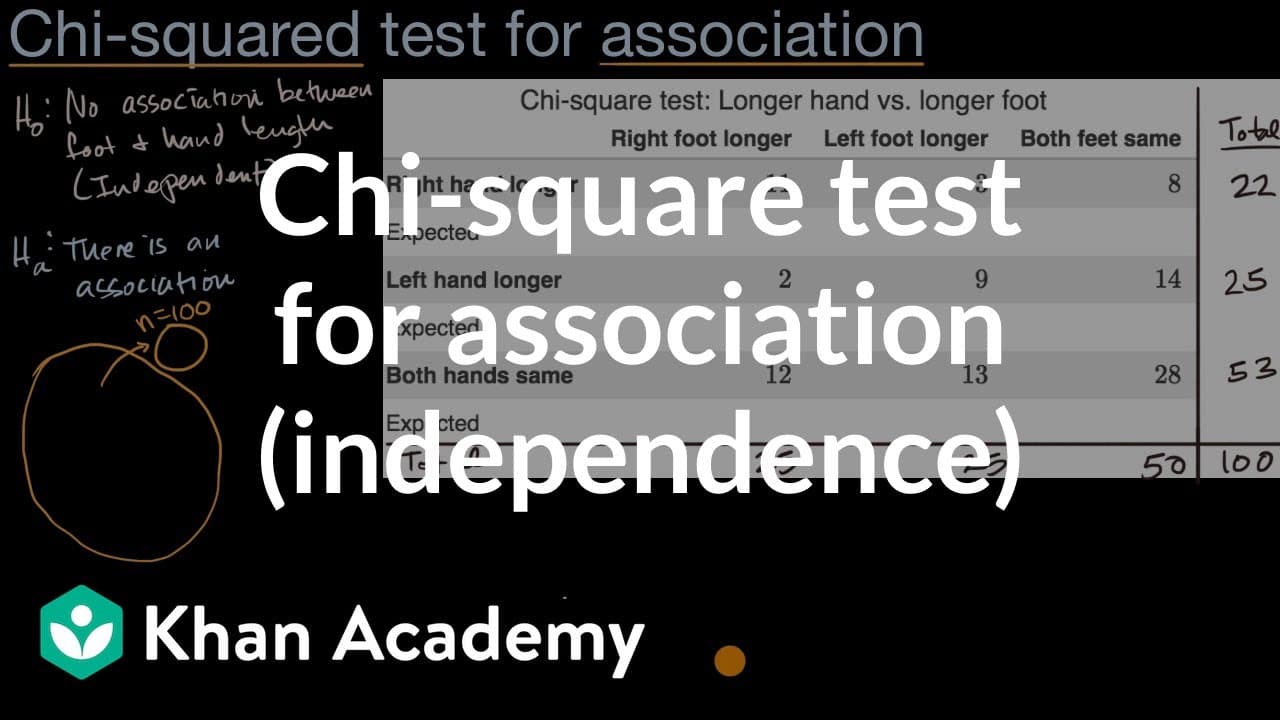
A chi-squared test for association evaluates if there’s a relationship between hand length and foot length by comparing observed data to expected values. With a chi-squared statistic of 11.942 and a p-value of 0.018, the test rejects the null hypothesis, indicating that hand and foot lengths may be associated.
Transcript
- [Instructor] We're already familiar with the chi-squared statistic. If you're not, I encourage you to review the videos on that. And we've already done some hypothesis testing with the chi-squared statistic, and we've even done some hypothesis testing based on two-way tables. And now we're going to extend that by thinking about a chi-squared test... Read More
Key Insights
- 🤏 The chi-squared test for association is an extension of the chi-squared test, specifically used to determine if two variables are independent or associated.
- 😫 The test involves setting up null and alternative hypotheses, collecting observed data, calculating expected values assuming independence, and comparing the observed and expected values using a chi-squared statistic.
- ➖ The degrees of freedom for the test can be calculated as the number of rows minus one times the number of columns minus one, or by using the known values to determine the remaining data points.
Install to Summarize YouTube Videos and Get Transcripts
Explore YouTube Video Summarizer or Get YouTube Transcript Extractor
Questions & Answers
Q: What is the purpose of a chi-squared test for association?
A chi-squared test for association is used to determine if there is a relationship between two variables. In this case, it is used to examine the association between hand length and foot length.
Q: How is the null hypothesis defined in this test?
The null hypothesis for this test assumes that there is no association between hand length and foot length. It suggests that the variables are independent.
Q: How is the expected value calculated in the chi-squared test?
The expected value is calculated assuming the null hypothesis is true, i.e., assuming the variables are independent. It is based on the marginal totals of the observed data and the probabilities of different outcomes.
Q: What are the conditions that need to be met for a chi-squared test?
The conditions include taking a random sample, having expected values of at least five for each data point, and ensuring independence either through sampling with replacement or having the sample size be no more than 10% of the population.
Summary & Key Takeaways
-
The chi-squared test for association is used to determine if two variables, hand length and foot length, are independent or associated.
-
A random sample of 100 individuals is taken and their hand and foot lengths are recorded.
-
The observed data is compared to the expected values assuming independence, and a chi-squared statistic of 11.942 is obtained.
-
The resulting p-value of 0.018 is less than the significance level of 0.05, leading to the rejection of the null hypothesis and suggesting an association between hand length and foot length.
Read in Other Languages (beta)
Share This Summary 📚
Summarize YouTube Videos and Get Video Transcripts with 1-Click
Try YouTube Summary with ChatGPT & Claude or YouTube Transcript Generator
Explore More Summaries from Khan Academy 📚



Summarize YouTube Videos and Get Video Transcripts with 1-Click
Try YouTube Summary with ChatGPT & Claude or YouTube Transcript Generator