What Are Limits in Mathematics and How Are They Evaluated?
TL;DR
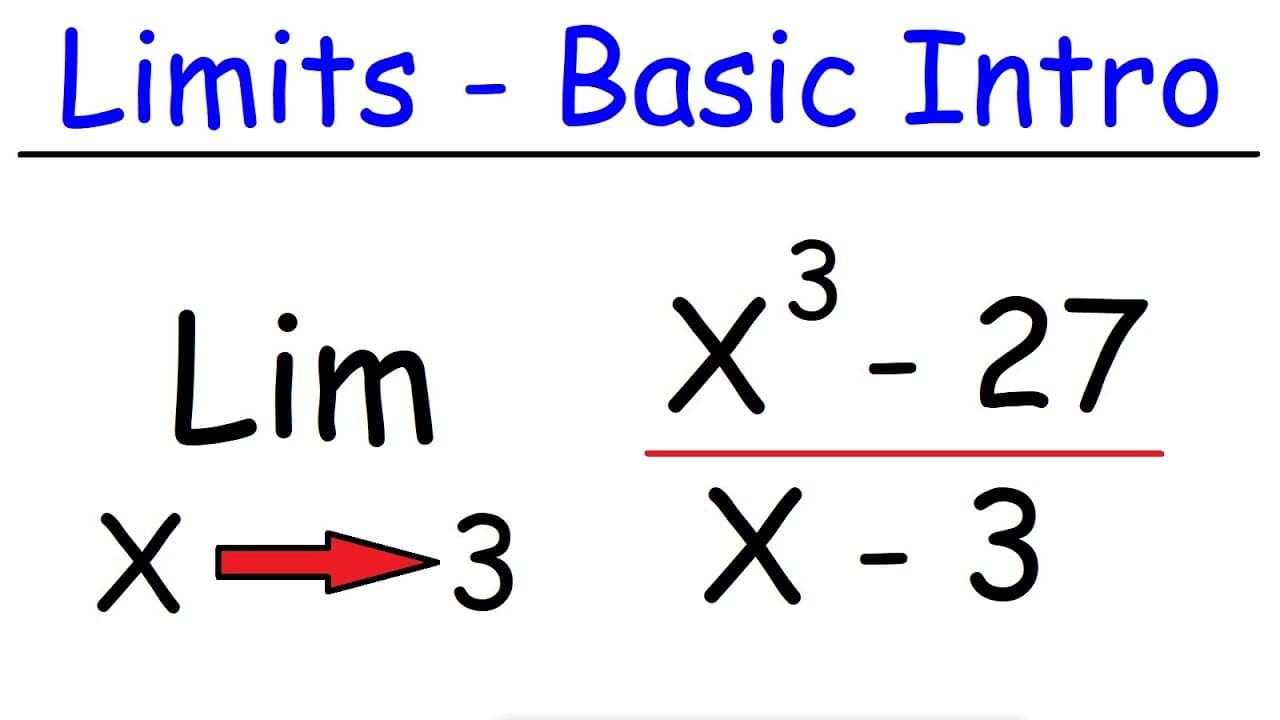
Limits in mathematics refer to the value a function approaches as the input variable approaches a specific point. They can be evaluated using techniques such as direct substitution and are crucial for understanding function behavior, especially when indeterminate forms like 0/0 occur. Trigonometric functions can also be analyzed using limits based on specific angle values.
Transcript
let's talk about limits what exactly is a limit so let's say if we want to find the limit as x approaches 2 of the function x squared minus 4 divided by x minus two now this is different than plugging in two if you want to find the value of the function and when x is two you would substitute this would be 2 squared minus 4 divided by 2 minus 2. 2 s... Read More
Key Insights
- 😥 Limits help determine the behavior and trend of a function as it approaches a specific point.
- 💁 Indeterminate forms, such as 0/0, indicate that further analysis using limits is required to find the actual value.
- 🔌 Direct substitution is a straightforward method for evaluating limits when it is possible to plug in the given value.
- ⛔ Trigonometric functions can also be evaluated using limits, considering their values at specific angles.
- 😑 Rational functions can be evaluated by plugging in the given value and simplifying the expression to find the limit.
- 🖐️ Limits play a crucial role in calculus and are essential for studying functions and their behavior.
- 😥 Limits provide a way to understand the behavior of functions near certain points, even when the function is undefined at that point.
Install to Summarize YouTube Videos and Get Transcripts
Explore YouTube Video Summarizer or Get YouTube Transcript Extractor
Questions & Answers
Q: What is a limit in mathematics?
A limit in mathematics refers to the value that a function approaches as a variable gets arbitrarily close to a particular point.
Q: How is direct substitution used to evaluate limits?
Direct substitution involves plugging the given value directly into the function and evaluating the expression to find the limit.
Q: Can trigonometric functions be evaluated using limits?
Yes, trigonometric functions can be evaluated using limits. The values of trigonometric functions at specific angles can be found using a unit circle or calculator.
Q: How can a rational function be evaluated using direct substitution?
To evaluate a rational function using direct substitution, plug in the given value for the variable and simplify the expression to find the limit.
Summary & Key Takeaways
-
Limits help determine the value a function approaches as a variable approaches a given point.
-
Direct substitution is a technique used to evaluate limits analytically.
-
Trigonometric functions, such as sine and tangent, can also be evaluated using limits.
Read in Other Languages (beta)
Share This Summary 📚
Summarize YouTube Videos and Get Video Transcripts with 1-Click
Try YouTube Summary with ChatGPT & Claude or YouTube Transcript Generator
Explore More Summaries from The Organic Chemistry Tutor 📚


Summarize YouTube Videos and Get Video Transcripts with 1-Click
Try YouTube Summary with ChatGPT & Claude or YouTube Transcript Generator