How to Calculate Power Dissipation in Resistors and LEDs
TL;DR
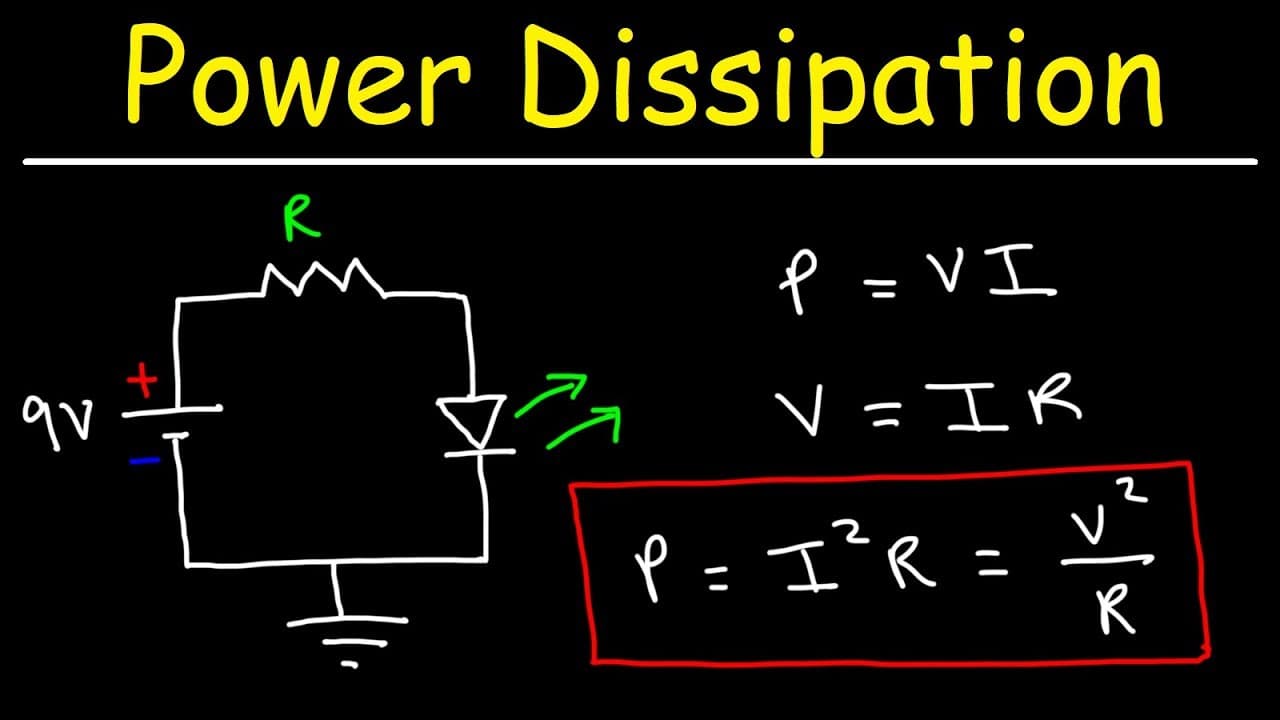
To calculate power dissipation in resistors, use the formulas P = V × I, P = I² × R, and P = V² / R. In series circuits, total resistance equals the sum of resistances, and current is the same through each resistor. For parallel connections, voltage remains constant while current varies; ensure that the power delivered by the battery equals the total power dissipated.
Transcript
in this video we're going to talk about how to find the power dissipated in each resistor in this example we have two resistors in series we can call them r1 and r2 now in order to calculate the power dissipated by each resistor we could use any one of the three formulas power is equal to voltage times current it's also equal to the square of the c... Read More
Key Insights
- 🤭 Power dissipation in a resistor can be calculated using various formulas, including P = V * I and P = I^2 * R.
- 🍹 In a series circuit, the total resistance is the sum of the resistances of all the resistors.
- 🔋 According to the law of conservation of energy, the power delivered by the battery should equal the power dissipated by the resistors in a series circuit.
- 💐 In a parallel circuit, the current flowing through each resistor is different, but the voltage across them is the same.
- ✊ The maximum voltage and current that should be applied to a resistor can be determined based on its maximum power rating and resistance.
Install to Summarize YouTube Videos and Get Transcripts
Explore YouTube Video Summarizer or Get YouTube Transcript Extractor
Questions & Answers
Q: How can you calculate the total resistance in a series circuit?
To calculate the total resistance in a series circuit, you need to sum up the resistances of all the resistors in the circuit.
Q: How do you calculate the power dissipated by each resistor in a series circuit?
To calculate the power dissipated by each resistor in a series circuit, you need to square the current flowing through the resistor and multiply it by the resistance.
Q: What is the relationship between the power delivered by the battery and the power dissipated by the resistors in a series circuit?
According to the law of conservation of energy, the power delivered by the battery should be equal to the sum of the power dissipated by the resistors in a series circuit.
Q: How do you calculate the current flowing through each resistor in a parallel circuit?
In a parallel circuit, the current flowing through each resistor is different. You can calculate the current by dividing the voltage across the resistor by its resistance using Ohm's law.
Q: What is the maximum voltage that should be applied to a resistor with a maximum power rating of 0.5 watts and a resistance of 220 ohms?
The maximum voltage that should be applied to the resistor can be calculated using the formula V = √(P * R), where P is the maximum power rating and R is the resistance.
Q: How do you determine the maximum current that should flow through a resistor with a maximum power rating and resistance?
The maximum current can be calculated using the formula I = √(P / R), where P is the maximum power rating and R is the resistance of the resistor.
Q: What is the power dissipated by a diode with a forward voltage drop of 0.6 volts in a circuit with a 6 volt battery and a 100-ohm resistor?
The power dissipated by the diode can be calculated using the formula P = V * I, where V is the voltage drop across the diode and I is the current flowing through it.
Q: How do you calculate the power dissipated by a LED with a forward voltage drop of 2 volts in a circuit with a 9 volt battery and a 680-ohm resistor?
The power dissipated by the LED can be calculated using the formula P = V * I, where V is the voltage drop across the LED and I is the current flowing through it.
Summary & Key Takeaways
-
The video discusses how to calculate power dissipation in resistors using formulas such as P = V * I and P = I^2 * R.
-
It explains how to calculate the total resistance in a series circuit and the current flowing through each resistor using Ohm's law.
-
The video also demonstrates how to calculate the power dissipation in resistors connected in parallel and the power delivered by the battery.
Read in Other Languages (beta)
Share This Summary 📚
Summarize YouTube Videos and Get Video Transcripts with 1-Click
Try YouTube Summary with ChatGPT & Claude or YouTube Transcript Generator
Explore More Summaries from The Organic Chemistry Tutor 📚





Summarize YouTube Videos and Get Video Transcripts with 1-Click
Try YouTube Summary with ChatGPT & Claude or YouTube Transcript Generator