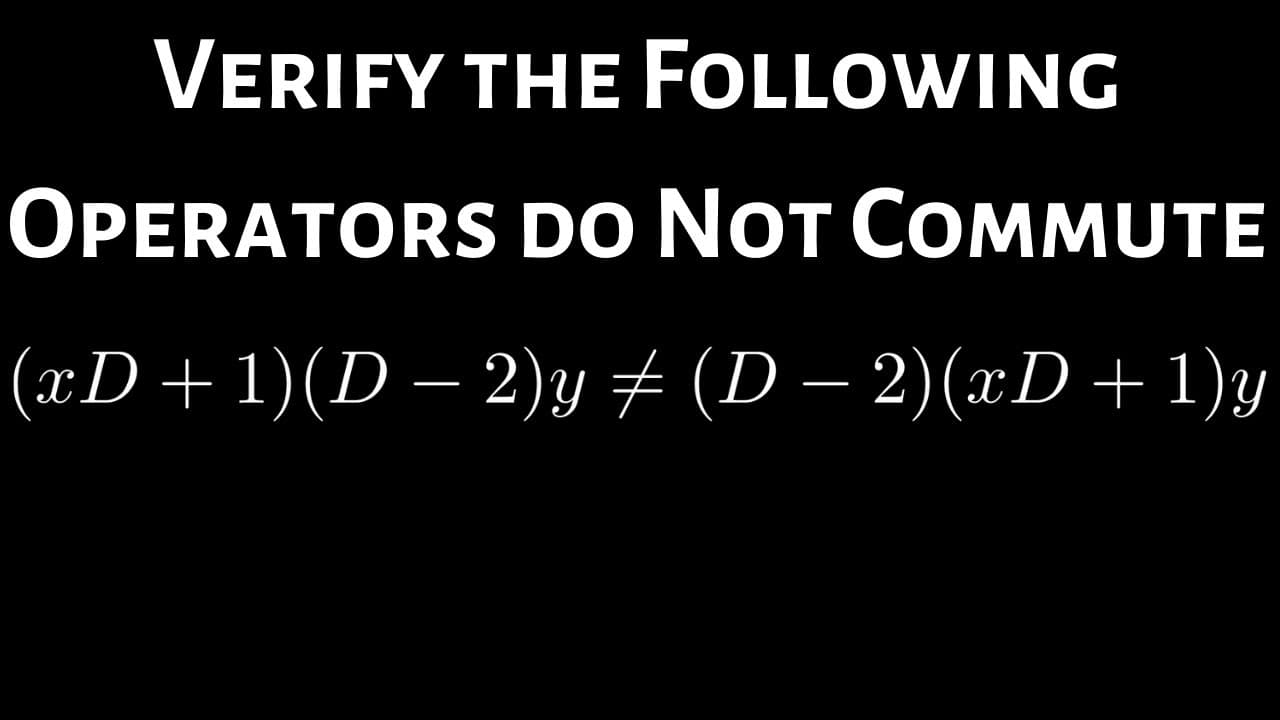
Verify that (xD + 1)(D - 2)y != (D - 2)(xD + 1)y where D is the Differential Operator
TL;DR
Detailed breakdown of differential operator notation and its application in a mathematical equation.
Transcript
in this problem we're going to verify that this equation is not true so we'll just work out each side and then at the end we'll show that they're just not the same so solution so let's start with the left hand side we have x times big d plus 1 and then big d minus 2 times y oh and so so what is big d big d is the differential operator so if you tak... Read More
Key Insights
- ❓ Differential operator notation involves applying operators to functions to find their derivatives.
- 💦 Precision is crucial when working with differential operators to prevent errors in calculations.
- 💁 Representing equations in operator form using differential operators simplifies the analysis process.
- 🙃 Comparison of results from different sides of an equation is essential to verify its validity.
- ❓ Understanding and practicing differential operator notation can enhance mathematical problem-solving skills.
- 🥡 Product rule in calculus is applied when taking the derivative of a product of functions.
- 😃 Differential operators, such as 'big d,' operate on functions to yield their derivatives.
Install to Summarize YouTube Videos and Get Transcripts
Explore YouTube Video Summarizer or Get YouTube Transcript Extractor
Questions & Answers
Q: What is a differential operator and how does it operate on functions?
A differential operator, denoted as 'big d,' acts on functions by taking their derivatives. When applied to a function, it yields the derivative of that function.
Q: How is differential operator notation used to solve mathematical equations?
By applying differential operators to functions on each side of an equation, one can simplify expressions and compare results to verify the validity of the equation.
Q: Why is precision important when working with differential operator notation?
Precision is crucial because slight errors in applying operators or simplifying expressions can lead to incorrect results, highlighting the need for meticulous calculations in mathematical operations.
Q: What is the significance of representing equations in operator form using differential operators?
Representing equations in operator form with differential operators provides a concise and systematic way to manipulate functions and their derivatives, aiding in the analysis and solving of mathematical problems.
Summary & Key Takeaways
-
Explanation of differential operator notation and its application in solving equations.
-
Illustration of applying differential operators to functions to find derivatives.
-
Comparison of results from different sides of the equation to demonstrate the importance of precision in mathematical operations.
Read in Other Languages (beta)
Share This Summary 📚
Summarize YouTube Videos and Get Video Transcripts with 1-Click
Try YouTube Summary with ChatGPT & Claude or YouTube Transcript Generator
Explore More Summaries from The Math Sorcerer 📚


Summarize YouTube Videos and Get Video Transcripts with 1-Click
Try YouTube Summary with ChatGPT & Claude or YouTube Transcript Generator