Polar coordinates 2 | Parametric equations and polar coordinates | Precalculus | Khan Academy
TL;DR
This video explains the conversion between polar and rectangular coordinates, using various equations and examples.
Transcript
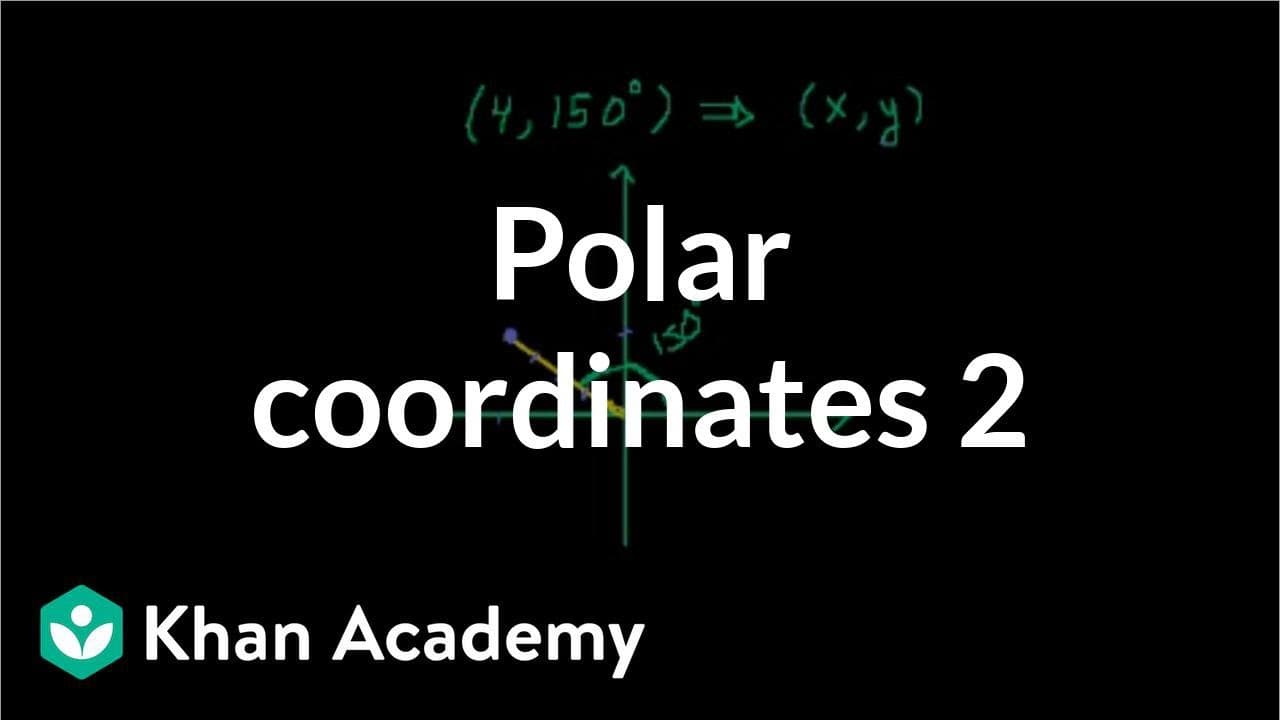
We're now equipped, I think, with all of the tools to convert back and forth between polar and rectangular coordinates. And hopefully you have a reasonable intuition. I mean, they're both just two ways of specifying a point in two dimensions. Cartesian, you kind of say how far left and right you go-- that's the x-coordinate. And then the y-coordina... Read More
Key Insights
- 😥 Polar and rectangular coordinates are two ways of representing points in two dimensions.
- 🐻❄️ The conversion between polar and rectangular coordinates involves using trigonometric functions.
- 🐻❄️ Polar coordinates are useful for describing functions and shapes with rotational symmetry.
Install to Summarize YouTube Videos and Get Transcripts
Explore YouTube Video Summarizer or Get YouTube Transcript Extractor
Questions & Answers
Q: What is the difference between polar and rectangular coordinates?
Polar coordinates use an angle and a distance from the origin to specify a point, while rectangular coordinates use x and y coordinates.
Q: How do you convert a polar coordinate to Cartesian coordinates?
To convert a polar coordinate (r, theta) to Cartesian coordinates (x, y), use the equations x = r * cos(theta) and y = r * sin(theta).
Q: When might it be better to use polar coordinates instead of rectangular coordinates?
Polar coordinates are often used when describing functions or shapes that have symmetry around a central point, such as circles or spirals.
Q: How can negative radius values be interpreted in polar coordinates?
A negative radius means moving in the opposite direction of the angle. It represents a point in the opposite quadrant or direction from the positive radius value.
Summary & Key Takeaways
-
Polar and rectangular coordinates are two ways of specifying a point in two dimensions.
-
In Cartesian coordinates, the x-coordinate represents left-right position, and the y-coordinate represents up-down position. In polar coordinates, the angle represents direction, and the radius represents distance.
-
To convert a polar coordinate to Cartesian coordinates, use the equations x = r * cos(theta) and y = r * sin(theta).
Read in Other Languages (beta)
Share This Summary 📚
Summarize YouTube Videos and Get Video Transcripts with 1-Click
Try YouTube Summary with ChatGPT & Claude or YouTube Transcript Generator
Explore More Summaries from Khan Academy 📚



Summarize YouTube Videos and Get Video Transcripts with 1-Click
Try YouTube Summary with ChatGPT & Claude or YouTube Transcript Generator