What Did the Progressives Achieve and Why?
TL;DR
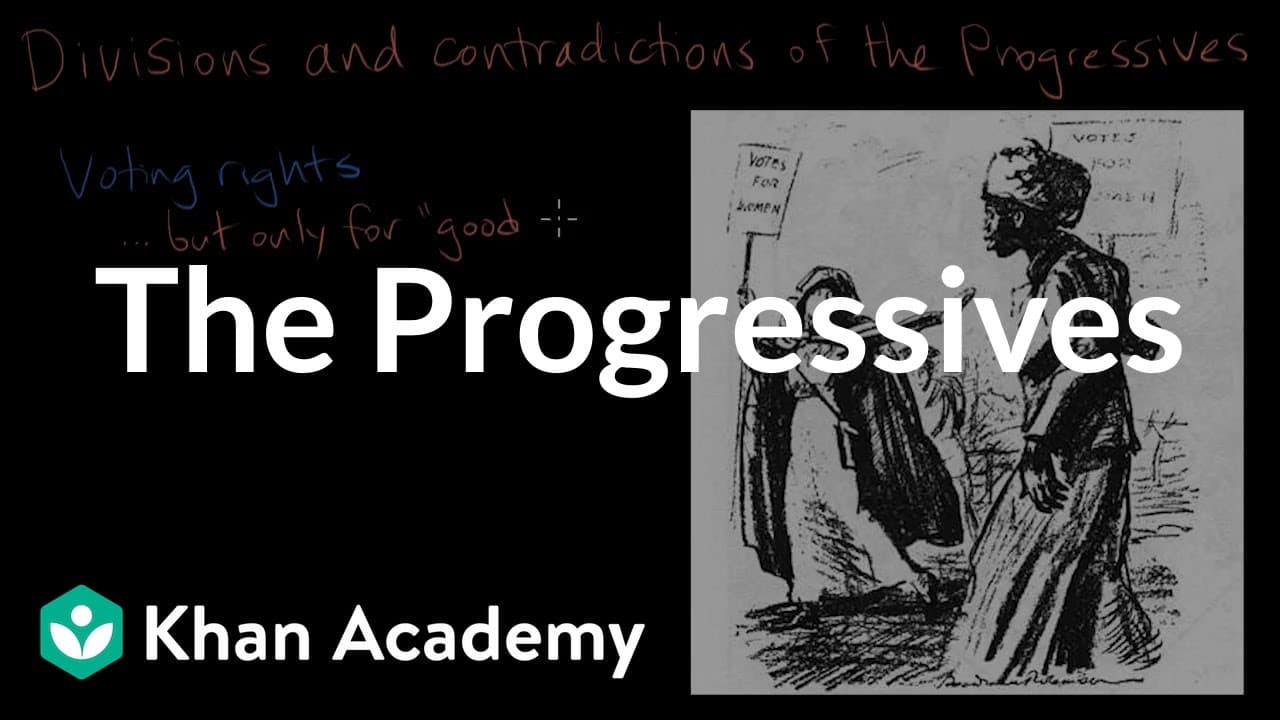
The Progressives, active from the 1890s to the 1920s, aimed to improve social conditions in America through government reforms addressing issues like poverty, worker rights, and women's suffrage. While they shared a belief in progress, divisions existed over voting rights and racial equality, limiting their overall impact on society.
Transcript
- [Instructor] After the Civil War there were enormous changes in American life. With industrialization, urbanization, and immigration changing the composition of who lived in the United States, where they lived, and what they did for a living. But city living and factory work came with new social problems like poverty and unsafe working and living... Read More
Key Insights
- 🏈 The Progressive Era was characterized by significant changes in American society, driven by industrialization, urbanization, and immigration.
- ❓ Progressives believed in progress and government intervention to address social problems.
- 🕵️♀️ Different types of reformers, such as muckrakers, politicians, conservationists, and female activists, pursued diverse goals and solutions.
- 👩💼 The Progressives achieved reforms in areas such as sanitation, worker protections, women's suffrage, and regulation of big business.
- 🗯️ However, divisions and contradictions arose within the Progressive Movement, particularly around voting rights, immigration, and racial issues.
- 🏈 Progressives had limited goals and advocated for improvements primarily for those they deemed worthy of American society.
- 🙈 The effectiveness of Progressive reforms can be seen in the improvement of certain conditions, but their long-term impact requires further examination.
Install to Summarize YouTube Videos and Get Transcripts
Explore YouTube Video Summarizer or Get YouTube Transcript Extractor
Questions & Answers
Q: What were some of the reforms advocated by Progressives?
Progressives advocated for sanitation and consumer protections, worker protections, women's and children's rights, regulation of big business, and moral reform, including the prohibition of alcohol.
Q: Why did the Progressives believe in government intervention?
The Progressives believed that the problems they sought to solve were too big for private charities or voluntary associations to handle. They saw government as the key to implementing meaningful change through laws and constitutional amendments.
Q: Were the Progressives united in their goals?
No, the Progressives had divisions and contradictions. For example, they expanded democracy by fighting for women's suffrage, but also supported restrictions on voting rights based on race and education. They also had differing views on immigration and racial issues.
Q: How effective were the Progressive reforms?
The Progressive reforms were successful in curbing some of the worst problems of corruption, sanitation, and exploitation. However, to fully assess their impact, it is necessary to consider the subsequent decades and the Great Depression.
Summary & Key Takeaways
-
The Progressive Era, lasting from the 1890s to the 1920s, was a time of significant change in American society, driven by industrialization, urbanization, and immigration.
-
Progressives sought to address social problems such as poverty and unsafe working conditions through various reforms, including sanitation and consumer protections, worker protections, women's and children's rights, and the regulation of big business.
-
The Progressives shared a belief in progress and government intervention, but were divided on issues such as voting rights, immigration, and racial inequalities.
Read in Other Languages (beta)
Share This Summary 📚
Summarize YouTube Videos and Get Video Transcripts with 1-Click
Try YouTube Summary with ChatGPT & Claude or YouTube Transcript Generator
Explore More Summaries from Khan Academy 📚



Summarize YouTube Videos and Get Video Transcripts with 1-Click
Try YouTube Summary with ChatGPT & Claude or YouTube Transcript Generator