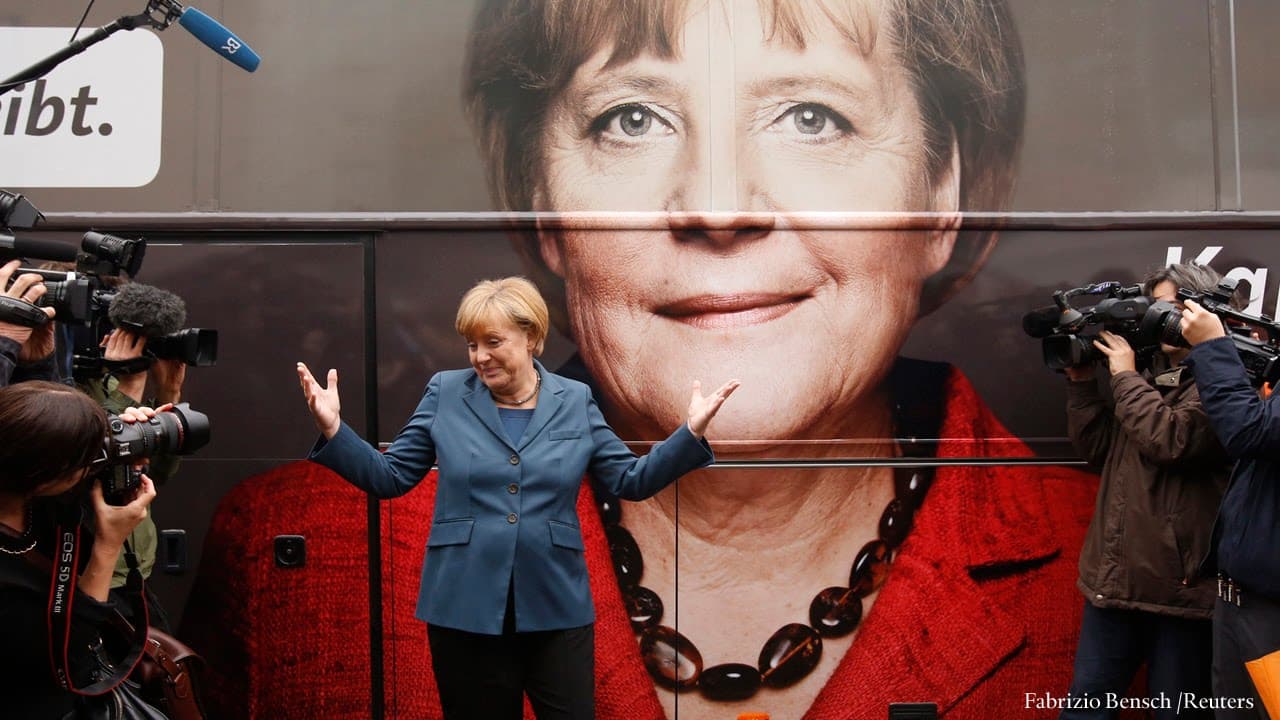
Power Profile: Angela Merkel
TL;DR
Discussion on Merkel's leadership amid European crises.
Transcript
HAMILTON: Good afternoon, everyone. Thanks for joining us. My name�s Dan Hamilton. I direct the Center for Transatlantic Relations at Johns Hopkins University School of Advanced International Studies, down the street on Dupont Circle. I�m going to moderate our discussion today. You have everyone�s bios, so I�m not going to get into great detail her... Read More
Key Insights
- Angela Merkel's leadership style is characterized by principled pragmatism, balancing moral convictions with pragmatic decisions.
- Merkel's decision to open Germany's borders to refugees stems from a deep moral conviction and historical responsibility.
- Germany's approach to the refugee crisis highlights the tension between national policies and the need for European solidarity.
- Merkel's leadership is tested by domestic pressures and the challenge of maintaining high popularity amid crises.
- Germany's role in Europe is evolving, with Merkel's leadership extending beyond regional issues to global diplomacy.
- The refugee crisis is unprecedented in scale, but Germany has experience integrating large numbers of migrants from past conflicts.
- Merkel's relationship with other European leaders, particularly in the UK, is crucial in navigating EU dynamics and Brexit concerns.
- Germany's economic needs align with the potential benefits of integrating refugees into the workforce, despite the challenges.
Install to Summarize YouTube Videos and Get Transcripts
Explore YouTube Video Summarizer or Get YouTube Transcript Extractor
Questions & Answers
Q: How does Angela Merkel's leadership style influence her decision-making?
Angela Merkel's leadership is characterized by principled pragmatism, a blend of firm moral convictions and practical decision-making. This approach allows her to navigate complex challenges, such as the refugee crisis, by maintaining a balance between ethical considerations and pragmatic solutions, ensuring both domestic and international stability.
Q: What prompted Merkel's decision to open Germany's borders to refugees?
Merkel's decision to open Germany's borders was driven by a deep moral conviction and historical responsibility. She viewed the refugee crisis as a humanitarian issue, akin to past European conflicts, and believed that Germany, given its history and economic strength, had a duty to provide refuge and uphold the principles of asylum.
Q: How is Germany's role in Europe evolving under Merkel?
Under Merkel, Germany's role in Europe is shifting from a traditionally cautious approach to a more assertive leadership position. This evolution is evident in Germany's handling of the eurozone crisis and its proactive stance on the refugee issue, reflecting a broader engagement in both regional and global diplomatic efforts.
Q: What challenges does Merkel face in integrating refugees into German society?
Merkel faces significant challenges in integrating refugees, including language barriers, cultural differences, and the need to create employment opportunities. The success of this integration is crucial for social cohesion and economic stability, requiring coordinated efforts from both government and private sectors to provide education, training, and job placements.
Q: How does Merkel manage domestic pressures amid the refugee crisis?
Merkel manages domestic pressures by maintaining open communication with the public, emphasizing the moral and economic benefits of accepting refugees. She faces criticism from within her party and the public, but her principled stance and pragmatic adjustments, such as tightening asylum processes, aim to address concerns while upholding Germany's humanitarian commitments.
Q: What impact does Merkel's leadership have on Germany's global diplomacy?
Merkel's leadership has significantly impacted Germany's global diplomacy, positioning the country as a key player in international negotiations, such as the Iran nuclear deal and the Syrian conflict. Her scientific approach to problem-solving and ability to build consensus have enhanced Germany's diplomatic influence and fostered transatlantic partnerships.
Q: How do historical factors influence Merkel's approach to the refugee crisis?
Historical factors play a crucial role in Merkel's approach, as Germany's past experiences with displacement and asylum inform its current policies. The constitutional right to asylum, rooted in post-World War II lessons, underscores Merkel's commitment to providing refuge and reflects a broader European responsibility to prevent humanitarian crises.
Q: What are the implications of Merkel's refugee policy for EU dynamics?
Merkel's refugee policy has significant implications for EU dynamics, highlighting the challenges of achieving consensus among member states. Her leadership underscores the need for a unified European response to migration, balancing national interests with collective responsibility, and testing the EU's ability to adapt to contemporary challenges.
Summary & Key Takeaways
-
Angela Merkel's leadership style is defined by a balance of principled pragmatism, allowing her to navigate complex crises like the refugee situation and eurozone challenges. Her approach often involves making difficult decisions rooted in moral conviction, while also considering pragmatic outcomes.
-
Merkel's decision to open Germany's borders to refugees reflects a historical sense of responsibility and moral duty, despite the domestic and European political challenges it presents. Her leadership is both praised and criticized for its steadfast commitment to humanitarian principles.
-
The refugee crisis has highlighted the limitations of national policies and the need for a unified European response. Merkel's leadership is pivotal in shaping Germany's role within the EU, as well as its broader global diplomatic engagements, while managing domestic pressures.
Read in Other Languages (beta)
Share This Summary 📚
Summarize YouTube Videos and Get Video Transcripts with 1-Click
Try YouTube Summary with ChatGPT & Claude or YouTube Transcript Generator
Explore More Summaries from Council on Foreign Relations 📚

Summarize YouTube Videos and Get Video Transcripts with 1-Click
Try YouTube Summary with ChatGPT & Claude or YouTube Transcript Generator