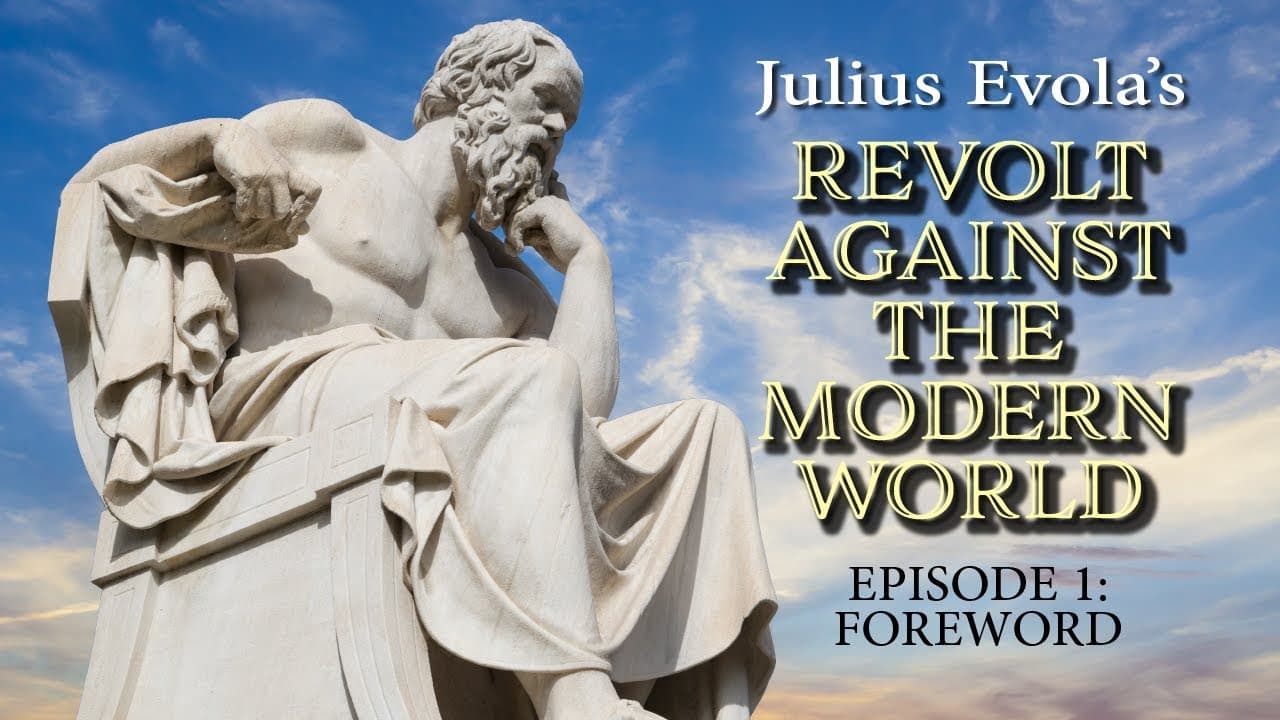
Julius Evola - Revolt Against the Modern World - Episode 1: Foreword
TL;DR
This content explores Julius Evola's critique of modernity and the need to rediscover tradition.
Transcript
The modern world is always rushing and rushing, but it knows not where it rushes to. Frenetic, grasping, but eternally insufficient, consumption without ending Iit is energy without purpose, no vision, no truth. Form without meaning. Power without grounding, lost and drifting through time. How can we live in this madness. We are bound in many ways ... Read More
Key Insights
- 👾 Evola believes the modern world is characterized by a rapid pace of life that lacks meaningful direction and spiritual grounding.
- ⌛ He introduces the concept of linear vs. cyclical time, arguing that traditional societies experienced time in a way that connected them more closely to the metaphysical.
- 🥺 The disconnection from tradition leads to a collective ennui and malaise in modernity, risking the loss of important cultural values.
- 🍝 Reconnecting with the wisdom of the past through literature and spiritual practice is essential for overcoming modern societal ailments.
- 🤘 Modern achievements in technology and rationalism are viewed critically as signs of societal decline rather than progress.
- ❓ Evola asserts that the revolt against modernity must originate from deep introspection and personal action, rather than external reactions.
- ❓ He emphasizes the necessity of understanding history not as a linear progression, but as interconnected experiences that offer lessons for contemporary society.
Install to Summarize YouTube Videos and Get Transcripts
Explore YouTube Video Summarizer or Get YouTube Transcript Extractor
Questions & Answers
Q: Who is Julius Evola and why is he significant in this content?
Julius Evola was an Austrian philosopher and esotericist who critiqued modernity through a traditional lens. His work, "Revolt Against the Modern World," serves as a foundational text for understanding the decline of civilization and the importance of reconnecting with traditional values and practices. Evola emphasizes that modern man is spiritually adrift, urging a return to enduring principles rooted in a shared human heritage.
Q: What does the term 'world of tradition' refer to in this context?
The 'world of tradition' signifies a way of living that is deeply connected to spiritual truths, values, and practices that have been passed down through generations. It stands in contrast to the modern world, characterized by materialism and superficiality. This world is perceived as a repository of wisdom and grounding principles that can help us navigate and resist the forces driving contemporary society towards chaos and disconnection.
Q: How does Evola view the concept of time differently from modern perspectives?
Evola argues that linear time, as understood in modernity, is a limited perspective that separates historical phases into distinct, progressive eras. He posits that prehistoric experiences of time were cyclical, allowing for a direct connection to the metaphysical realm. In this view, past, present, and future coexist, reflecting a richer, more profound understanding of existence that transcends material limitations.
Q: What does Evola suggest as a means of 'revolting' against modernity?
Evola advocates for a revolt characterized by spiritual awakening and personal introspection rather than superficial protests. He believes individuals should strive to reconnect with inner principles, cultivate wisdom, and transform themselves, approaching life with a constructive mindset. This involves actively seeking out knowledge and integrating traditional values into one’s lifestyle, counteracting the chaotic influences of modern society.
Q: What critique does Evola have regarding modern politics and societal engagement?
Evola criticizes modern political activism as reactionary, suggesting it often devolves into mere debates and noise without substantial change. He argues that true tradition cannot be defended through reactive measures; instead, it must be cultivated internally, focusing on personal development, spirituality, and the creation of a meaningful life that reflects deeper truths rather than temporary societal trends.
Q: How does the content suggest the modern individual seeks fulfillment?
The modern individual often seeks fulfillment through distraction and consumption, as a response to the fears and anxieties of contemporary life. However, this approach is depicted as superficial and ultimately empty, sedating true vitality. The content implies that genuine fulfillment lies in recognizing and connecting with tradition, seeking deeper understanding and engagement with spiritual realities.
Summary & Key Takeaways
-
The content discusses the rapid pace and superficiality of modern life, suggesting that it lacks purpose and meaningful connection to tradition.
-
It introduces Julius Evola’s “Revolt Against the Modern World” as a guide to reconnecting with ancient wisdom and understanding the cyclical nature of time.
-
Evola critiques modernity's focus on linear time and technological advancement, advocating for an awakening to deeper spiritual principles and internal actions rather than mere reactions to societal decay.
Read in Other Languages (beta)
Share This Summary 📚
Summarize YouTube Videos and Get Video Transcripts with 1-Click
Try YouTube Summary with ChatGPT & Claude or YouTube Transcript Generator
Explore More Summaries from Julius Evola : Revolt Against the Modern World Episodes 📚
Summarize YouTube Videos and Get Video Transcripts with 1-Click
Try YouTube Summary with ChatGPT & Claude or YouTube Transcript Generator