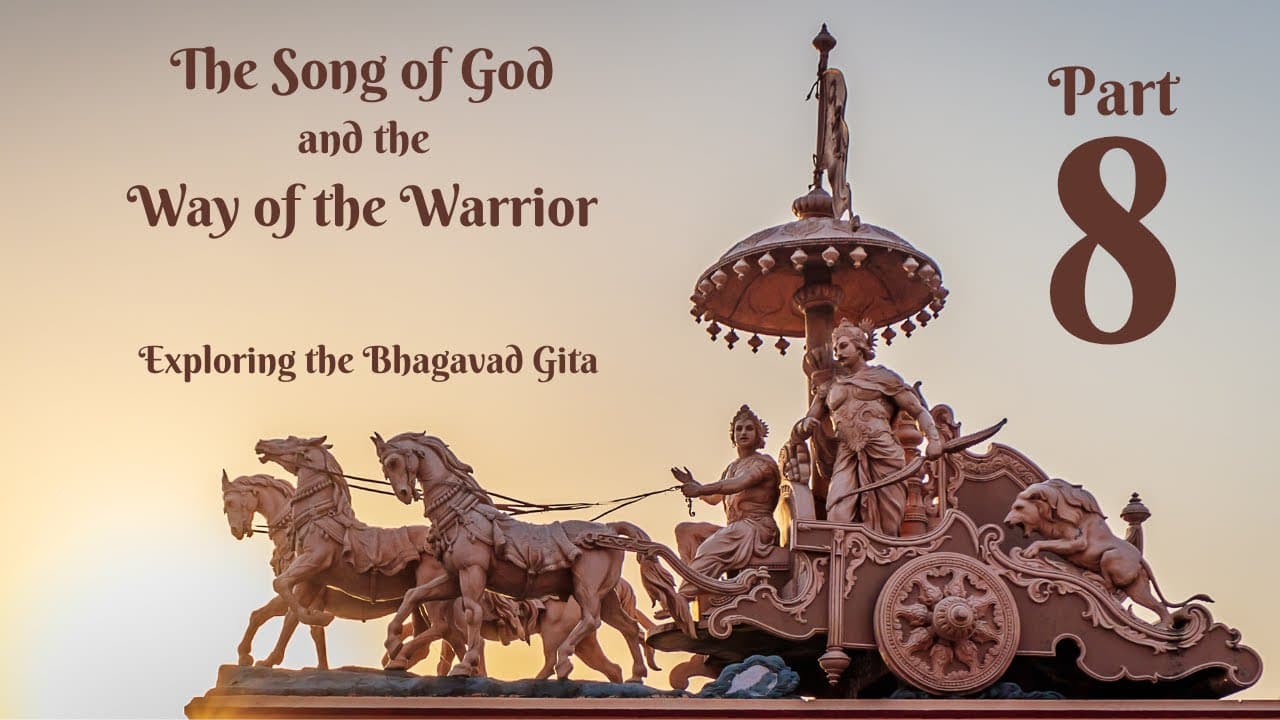
8 - The Song of God and the Way of the Warrior (Bhagavad Gita Commentary)
TL;DR
Chapter 9 of the Bhagavad-Gita discusses the significance of faith, devotion, and the nature of worship.
Transcript
hey everybody welcome back it's been a while since our last stream we are going to be going through chapter 9 of the bhagavad-gita this evening uh for anybody who's new this is the version that I use uh you can use any version you want there's tons of different translations available for free online so the usual format is that we read the chapter w... Read More
Key Insights
- 👻 Faith is essential for attaining spiritual knowledge and connection to the divine, allowing for personal transformation.
- 🫨 Krishna, representing the Supreme Being, emphasizes the inseparability of Him from the universe while remaining beyond it, akin to the wind moving through space.
- 🧑🏭 Genuinely devotional acts, regardless of one's status or past deeds, demonstrate the accessibility of divine grace.
- 🥰 The nature of offerings highlights the importance of intention and love over ritualistic precision in establishing a relationship with the divine.
- 🥺 Ignorance and material attachment lead individuals away from recognizing the divine's true nature, resulting in a continual cycle of suffering.
- 🙈 Direct experiential knowledge is superior to blind faith; spiritual practice should accompany beliefs for meaningful results.
- ❓ The cyclical nature of existence reflects the continuous interplay between creation, preservation, and destruction, all governed by divine will.
Install to Summarize YouTube Videos and Get Transcripts
Explore YouTube Video Summarizer or Get YouTube Transcript Extractor
Questions & Answers
Q: What is the main focus of Chapter 9 of the Bhagavad-Gita?
Chapter 9 emphasizes the importance of faith and devotion in understanding life’s ultimate truths. Krishna reveals that genuine devotion to Him can liberate individuals from the cyclical nature of existence. This chapter highlights that true wisdom leads to eternal freedom from suffering and the cycle of death and rebirth, encouraging followers to trust in divine guidance.
Q: How does Krishna describe His relationship with the universe?
Krishna describes Himself as permeating the entire universe in an unmanifest form, where all beings exist within Him. He uses the analogy of the wind, which moves within the vastness of space yet remains untouched by it, to illustrate that while He sustains all life, He is beyond their existence and unaffected by their actions.
Q: What does Krishna mean by stating that even heartless criminals can attain Him?
Krishna reassures that even those considered sinners can achieve purity and salvation if they surrender to Him with genuine love. This emphasizes the non-discriminative nature of divine love, which accepts all beings regardless of their past actions, as long as they engage in sincere devotion and strive towards Him.
Q: How does worship differ between Krishna and other gods according to this chapter?
Krishna states that worshiping other gods, while still valid, does not lead to the highest spiritual attainment. Unlike complex rituals for celestial gods, Krishna accepts even the simplest offerings—such as a leaf or water—if given with love. This indicates that direct devotion without the need for elaborate practices is powerful in seeking connection with the divine.
Q: What does Krishna identify as the pitfalls of ignorance in understanding Him?
Krishna points out that ignorant individuals despise His divine form, blinded by their material desires and ignorance of His true nature. They fail to recognize that their actions are governed by their misconceptions and attachments, ultimately leading to suffering and a return to the mortal realm.
Q: Why is direct experiential knowledge crucial in spirituality, according to the commentary?
The commentary emphasizes that relying solely on faith and beliefs without practicing the spiritual path will not yield results. Direct experiential knowledge allows an individual to engage with the divine and gain insights that transcend rational understanding, thus fostering a deeper relationship with God.
Q: What key message does Krishna convey about offerings to Him?
Krishna conveys that any heartfelt offering—be it food, prayers, or actions—when dedicated to Him, is accepted. This principle highlights the significance of intention and devotion over the material value of offerings, emphasizing that love in one's actions is what truly matters in spiritual practice.
Q: How does Krishna describe the cyclical nature of life and death?
Krishna elaborates on the cosmic cycle where souls are gathered back into Him at the end of a cycle, only to be sent forth again into new forms of life. This cyclical existence reflects the integral connection between the divine and all beings, underscoring that true liberation can only be attained through devotion and realization of their spiritual essence.
Summary & Key Takeaways
-
Chapter 9, titled "The Secret of Life," emphasizes the necessity of faith and devotion in attaining spiritual understanding and connection with God, illustrating that even the lowest of beings can find salvation through sincere love for the divine.
-
Krishna explains the inherent unity of all beings within Him while remaining apart from their actions, highlighting the endless cosmic cycle of life, death, and rebirth, and urging individuals to work towards realizing the Supreme Lord.
-
The chapter contrasts worshiping various gods with the direct worship of Krishna, underscoring that only through true devotion and an offering of one's heart can one transcend the cycle of material existence and attain everlasting bliss.
Read in Other Languages (beta)
Share This Summary 📚
Summarize YouTube Videos and Get Video Transcripts with 1-Click
Try YouTube Summary with ChatGPT & Claude or YouTube Transcript Generator
Explore More Summaries from PhilosophiCat 📚





Summarize YouTube Videos and Get Video Transcripts with 1-Click
Try YouTube Summary with ChatGPT & Claude or YouTube Transcript Generator