What Is the Relationship Between Angular Velocity and Speed?
TL;DR
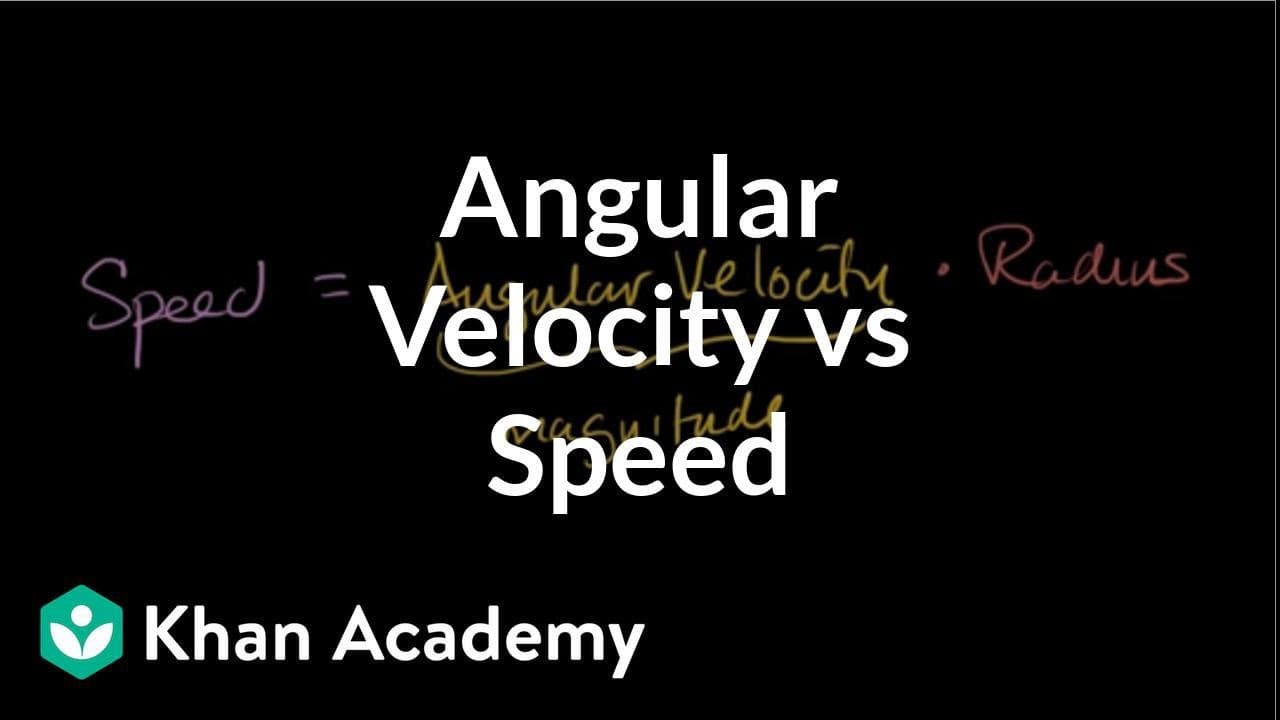
Angular velocity measures how quickly an object rotates around a center point, expressed in radians per second. The speed of an object in circular motion can be calculated using the formula: speed = angular velocity × radius. Thus, to find angular velocity, divide speed by the radius.
Transcript
Let's say we have some object that's moving in a circular path Let's say this is the center of the object path, the center of the circle So the object is moving in a circular path that looks something like that counterclockwise circular path--you could do that with clockwise as well I want to think about how fast it is spinning or orbiting around t... Read More
Key Insights
- 😥 Angular velocity measures how fast an object is rotating around a center point in radians per second.
- 🤨 The conversion factor between revolutions and radians is 2 pi.
- 📐 Angular velocity can be considered as angular speed, but it is actually a vector quantity that depends on the direction of rotation.
- 🐎 The magnitude of velocity (speed) in circular motion can be calculated by multiplying the angular velocity by the radius.
- 🐎 The relationship between speed and angular velocity is given by the equation: speed = angular velocity x radius.
- 🤨 Angular velocity can be converted to revolutions per second by dividing it by 2 pi.
- 🤒 Speed can be measured in meters per second and is equal to angular velocity times the radius.
Install to Summarize YouTube Videos and Get Transcripts
Explore YouTube Video Summarizer or Get YouTube Transcript Extractor
Questions & Answers
Q: What is angular velocity?
Angular velocity measures how fast an object is rotating around a center point, indicating the rate at which the angle is changing with respect to time.
Q: How is angular velocity calculated?
Angular velocity can be calculated by dividing the number of revolutions per second by 2 pi, which corresponds to the number of radians per revolution.
Q: Is angular velocity a vector quantity?
Yes, angular velocity is a vector quantity that has both magnitude and direction. The direction of the angular velocity vector depends on the direction of rotation (clockwise or counterclockwise).
Q: How does angular velocity relate to speed in circular motion?
The magnitude of the velocity (speed) in circular motion is equal to the product of the angular velocity and the radius of the circle. Speed = angular velocity x radius.
Summary & Key Takeaways
-
Angular velocity measures how fast an object is rotating around a center point in radians per second.
-
Speed, or magnitude of velocity, in circular motion can be calculated by multiplying the angular velocity by the radius of the circle.
-
Angular velocity can be determined by dividing the speed by the radius of the circle.
Read in Other Languages (beta)
Share This Summary 📚
Summarize YouTube Videos and Get Video Transcripts with 1-Click
Try YouTube Summary with ChatGPT & Claude or YouTube Transcript Generator
Explore More Summaries from Khan Academy 📚



Summarize YouTube Videos and Get Video Transcripts with 1-Click
Try YouTube Summary with ChatGPT & Claude or YouTube Transcript Generator