What Are Isomers and Why Are They Important?
TL;DR
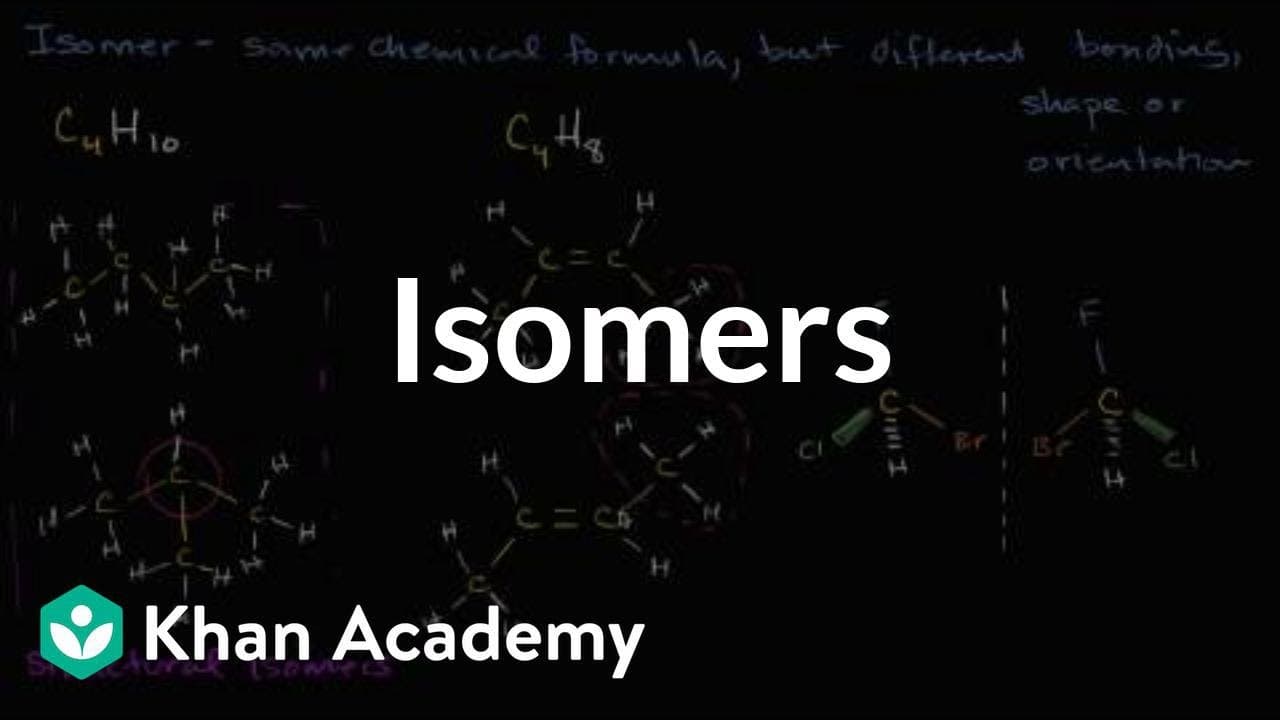
Isomers are compounds that share the same chemical formula but differ in their bonding, shape, or orientation. Key types include structural isomers, which have different bonding patterns; geometric (cis-trans) isomers, which differ in spatial arrangement; and enantiomers, which are mirror images with distinct chemical properties. Understanding these variations is crucial as different isomers can have significantly different effects in biological systems.
Transcript
- Many times in chemistry we'll see different molecules that have the same constituent atoms. For example, these two molecules here, they both have four carbons. One, two, three, four. One, two, three, four. So if I were to write their chemical formula, it would be C4 and then they both have, one, two, three, four, five, six, seven, eight, nine, te... Read More
Key Insights
- 💠 Isomers have the same chemical formula but differ in bonding, shape, or orientation.
- 🫀 Structural isomers have different bonding patterns but the same constituent atoms.
- 🏃 Geometric isomers, specifically cis-trans isomers, have the same bonding but different spatial arrangements.
- 🪩 Enantiomers cannot be superimposed and are mirror images with different chemical properties.
- ❓ Isomerism is important in understanding differences in chemical properties and biological activity.
- 🧑⚕️ Different isomers can have varying effects on human health and biology.
- 🙂 Isomers play a crucial role in pharmaceuticals, as slight changes in spatial arrangement can affect drug effectiveness.
Install to Summarize YouTube Videos and Get Transcripts
Explore YouTube Video Summarizer or Get YouTube Transcript Extractor
Questions & Answers
Q: What are isomers in chemistry?
Isomers refer to molecules with the same chemical formula but different bonding, shape, or orientation.
Q: What are structural isomers?
Structural isomers have the same constituent atoms but different bonding patterns, resulting in different molecules.
Q: What are geometric isomers?
Geometric isomers have the same bonding but differ in spatial arrangement. Cis-trans isomers are a subset of geometric isomers.
Q: What are enantiomers?
Enantiomers are mirror images of each other and cannot be superimposed. They have different chemical properties and are a subset of stereoisomers.
Summary & Key Takeaways
-
Isomers are molecules with the same chemical formula but different bonding or shape.
-
Structural isomers have the same atoms but different bonding patterns.
-
Geometric isomers (cis and trans) have the same bonding but different spatial arrangements.
-
Enantiomers are mirror images of each other and have different chemical properties.
Read in Other Languages (beta)
Share This Summary 📚
Summarize YouTube Videos and Get Video Transcripts with 1-Click
Try YouTube Summary with ChatGPT & Claude or YouTube Transcript Generator
Explore More Summaries from Khan Academy 📚



Summarize YouTube Videos and Get Video Transcripts with 1-Click
Try YouTube Summary with ChatGPT & Claude or YouTube Transcript Generator