How Do Nonlinear & Linear Training Influence Quantity & Quality of Search for a Movement Solution
TL;DR
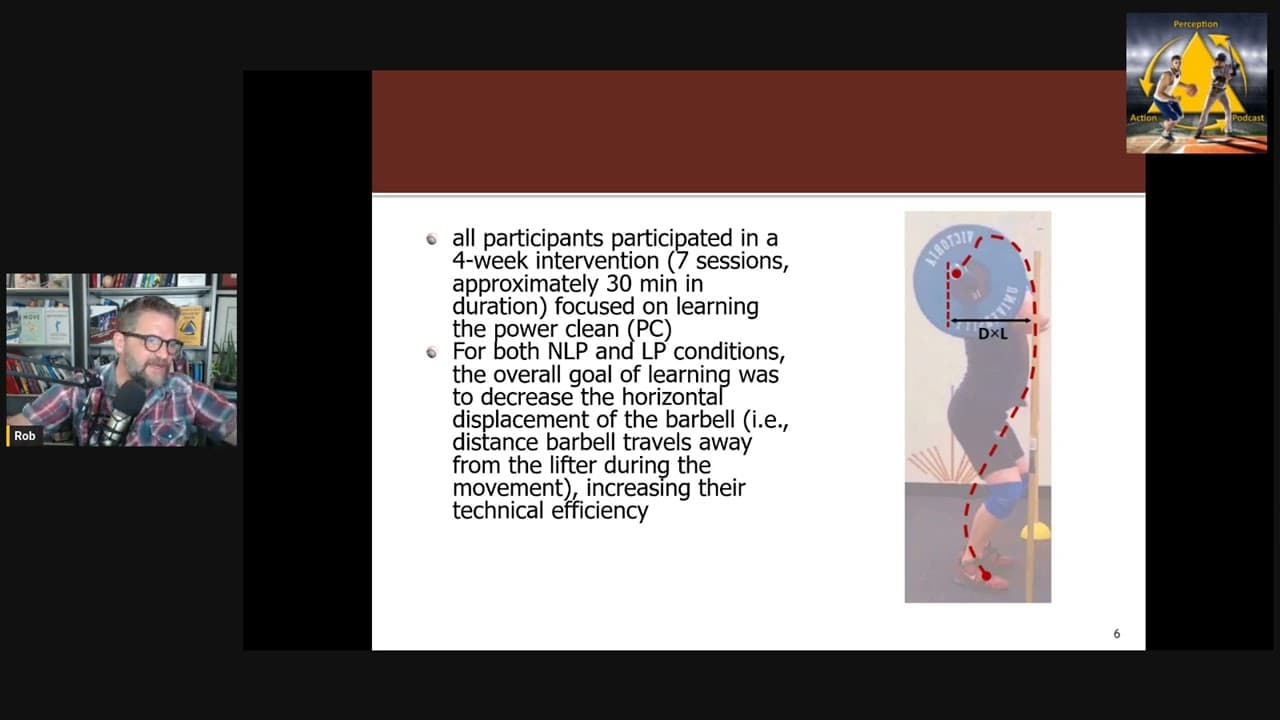
In this video, Rob Gray reviews a study comparing nonlinear and linear pedagogy approaches in weightlifting training. The video explores how these methods influence the quantity and quality of search for movement solutions, challenging assumptions about linear pedagogy's limitations in fostering functional movement variability. Gray questions the necessity of linear pedagogy, advocating for nonlinear methods as they encourage more exploration and adaptability.
Transcript
Hi everyone, this is Rob Gray from ASU and the Perception Action podcast back with another article review. In this episode, I want to look at a recent really recent interesting article by Lindsay and colleagues looking comparing nonlinear pedagogy and linear pedagogy approaches for weightlifting. This is a a part of a series of studies these author... Read More
Key Insights
- The study compares nonlinear and linear pedagogy approaches in weightlifting, focusing on their influence on movement solution exploration.
- Nonlinear pedagogy allows for greater freedom in movement exploration, potentially leading to more functional variability and adaptability.
- Linear pedagogy prescribes specific movement solutions with low variability, which might limit exploration but still allows some adaptability.
- The study found no significant improvement in performance across sessions, suggesting that the training duration might have been too short.
- Cluster analysis revealed 13 different movement patterns, with nonlinear pedagogy encouraging more exploratory behavior.
- The study challenges the assumption that linear pedagogy restricts functional movement variability, suggesting it might not be as limiting as previously thought.
- Despite the findings, the reviewer questions the necessity of linear pedagogy, advocating for nonlinear methods as they promote exploration and adaptability.
- The study suggests that nonlinear pedagogy might be more efficient in developing functional movement variability from the start.
Install to Summarize YouTube Videos and Get Transcripts
Explore YouTube Video Summarizer or Get YouTube Transcript Extractor
Questions & Answers
Q: What is the main focus of the study reviewed in the video?
The main focus of the study reviewed in the video is to compare the effects of nonlinear and linear pedagogy approaches on the quantity and quality of search for movement solutions in weightlifting. The study aims to challenge the assumption that linear pedagogy restricts the development of functional movement variability, exploring how these methods influence adaptability and exploration.
Q: What are the key differences between nonlinear and linear pedagogy?
Nonlinear pedagogy allows for greater freedom and exploration in movement solutions, encouraging functional variability and adaptability. It uses task constraints and analogy-based instructions without prescribing specific techniques. In contrast, linear pedagogy prescribes specific movement solutions with low variability, using internally focused instructions and corrective feedback to guide learners through distinct phases of a task.
Q: What were the main findings of the study regarding performance improvement?
The study found no significant improvement in performance across sessions for either the nonlinear or linear pedagogy groups, suggesting that the training duration might have been too short. This lack of performance change limits the conclusions that can be drawn about the effectiveness of the two approaches in enhancing learning or skill acquisition in weightlifting.
Q: How did the study measure movement exploration?
The study measured movement exploration using cluster analysis and a drifting Markov model. Cluster analysis identified different movement patterns, while the Markov model assessed transitions between coordination solutions and their relationship to performance variables. These methods helped evaluate the quantity and quality of exploration in both pedagogy approaches.
Q: What did the study reveal about the adaptability of learners in linear pedagogy?
The study revealed that even within the structured limits of linear pedagogy, participants exhibited meaningful adaptable behavior through minor movement adjustments. This suggests that linear pedagogy may not completely restrict functional movement variability, allowing some degree of exploration and adaptability despite its prescriptive nature.
Q: Why does the reviewer question the necessity of linear pedagogy?
The reviewer questions the necessity of linear pedagogy because nonlinear methods encourage more exploration and adaptability without negatively impacting performance. Since nonlinear pedagogy fosters functional movement variability from the start, the reviewer sees no compelling reason to restrict learners with linear methods, which may be less efficient in promoting exploration.
Q: What are the implications of the study for ecological dynamics?
The study's findings suggest that the assumption in ecological dynamics that linear pedagogy restricts functional movement variability may be overstated. While linear pedagogy may not be as limiting as previously thought, the study supports the idea that nonlinear approaches are more effective in promoting exploration and adaptability, aligning with ecological dynamics principles.
Q: What is the reviewer's overall conclusion about the study?
The reviewer's overall conclusion is that while the study challenges some assumptions about linear pedagogy, it does not provide strong evidence for its necessity. Nonlinear pedagogy remains more efficient in developing functional movement variability, and there is no compelling reason to use linear methods when nonlinear approaches better facilitate exploration and adaptability in weightlifting training.
Summary & Key Takeaways
-
Rob Gray reviews a study comparing nonlinear and linear pedagogy in weightlifting, focusing on movement solution exploration. The study challenges assumptions about linear pedagogy's limitations, suggesting it might not restrict functional variability as much as previously thought. However, Gray questions the necessity of linear pedagogy, advocating for nonlinear methods.
-
The study found no significant performance improvement across sessions, indicating the training duration might have been too short. Nonlinear pedagogy encouraged more exploratory behavior, revealing 13 different movement patterns. Despite some adaptability in linear pedagogy, nonlinear methods were more efficient in promoting functional movement variability.
-
Gray concludes that nonlinear pedagogy is more efficient in developing functional movement variability, questioning the need for linear methods. The study suggests linear pedagogy might not be as limiting as assumed, but nonlinear approaches encourage more exploration and adaptability, making them preferable for weightlifting training.
Read in Other Languages (beta)
Share This Summary 📚
Summarize YouTube Videos and Get Video Transcripts with 1-Click
Try YouTube Summary with ChatGPT & Claude or YouTube Transcript Generator
Explore More Summaries from Rob Gray 📚
Summarize YouTube Videos and Get Video Transcripts with 1-Click
Try YouTube Summary with ChatGPT & Claude or YouTube Transcript Generator