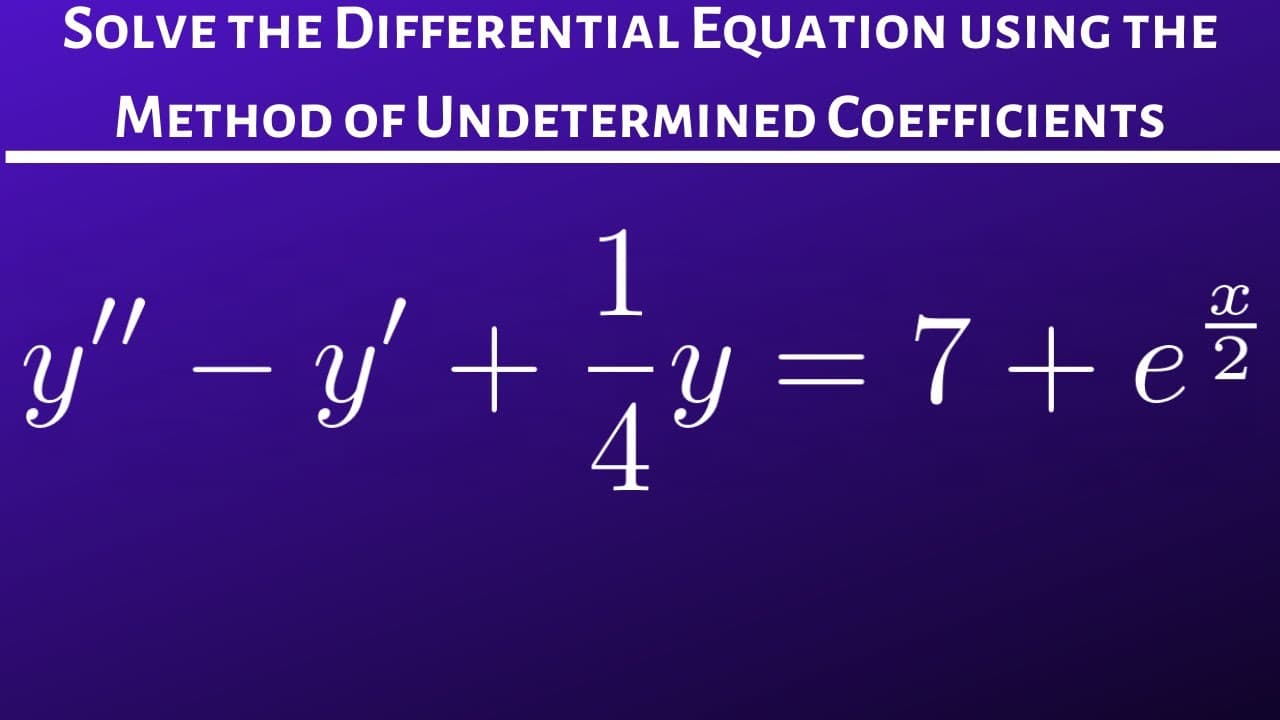
How to Solve DE's with the Method of Undetermined Coefficients y'' - y' + (1/4)y = 7 + e^(x/2)
TL;DR
Detailed step-by-step process for solving non-homogeneous linear differential equations.
Transcript
in this problem we're going to solve this differential equation this is a linear differential equation with constant coefficients and it's non-homogeneous because the right-hand side is not 0 so the solution to this differential equation is of the form y equals y sub c plus y sub p so we'll start by finding Y sub C which is the Associated homogeneo... Read More
Key Insights
- 🫱 Differential equations with non-zero right-hand sides require the sum of associate homogeneous and particular solutions.
- 🫚 Identifying repeated real roots in the associate homogeneous solution signifies multiplicity.
- 🦻 Initial and modified guesses aid in determining the form of the particular solution.
- ❓ Deriving the differential equation solution involves extensive calculus operations.
- ❓ Matching coefficients between associate homogeneous and particular solutions is crucial.
- ❓ Understanding the process step-by-step is essential in solving complex differential equations.
- ❓ The final solution combines the associate homogeneous and particular solutions seamlessly.
Install to Summarize YouTube Videos and Get Transcripts
Explore YouTube Video Summarizer or Get YouTube Transcript Extractor
Questions & Answers
Q: How is a non-homogeneous linear differential equation solved?
Non-homogeneous linear differential equations are solved by finding the associate homogeneous solution and particular solution, which are then combined to obtain the final solution.
Q: What is the process for finding the associate homogeneous solution?
The process involves deriving the characteristic equation and solving for the roots, including repeated real roots that indicate a multiplicity in the solution.
Q: How is the particular solution determined in a non-homogeneous differential equation?
The particular solution is determined through initial and modified guesses based on the right-hand side of the differential equation, followed by matching coefficients to derive the final form.
Q: Why is it necessary to eliminate repetition between the associate homogeneous and particular solutions?
Eliminating repetition ensures that the particular solution provides new information to the overall differential equation solution, preventing redundancy and ensuring accuracy in the final answer.
Summary & Key Takeaways
-
Differential equation solved using associate homogeneous solution and particular solution.
-
Finding homogeneous solution step-by-step with repeated real roots.
-
Establishing particular solution through initial and modified guesses, leading to final differential equation solution.
Read in Other Languages (beta)
Share This Summary 📚
Summarize YouTube Videos and Get Video Transcripts with 1-Click
Try YouTube Summary with ChatGPT & Claude or YouTube Transcript Generator
Explore More Summaries from The Math Sorcerer 📚


Summarize YouTube Videos and Get Video Transcripts with 1-Click
Try YouTube Summary with ChatGPT & Claude or YouTube Transcript Generator