How Can Integrated Pest Management Protect Crops?
TL;DR
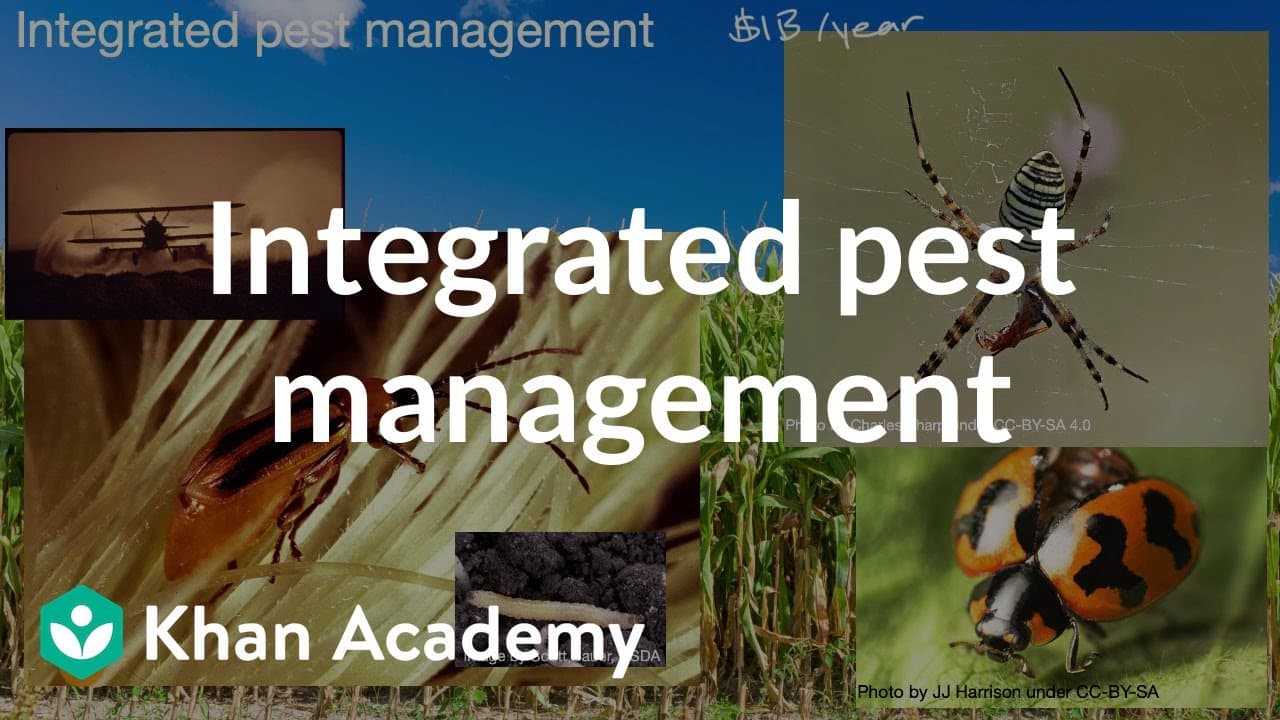
Integrated Pest Management (IPM) combines diverse strategies to combat crop pests, enhancing crop resilience. Techniques like introducing natural predators, crop rotation, and genetically modified organisms work together to minimize damage while reducing reliance on harmful pesticides.
Transcript
- [Instructor] Let's imagine your corn farmer and you would dream of having nice, healthy corn crop, like we see in this picture. But being a farmer isn't as simple as planting the seeds and making sure that the crop gets enough sunshine and water and fertilizer, you also have to deal with pests. And pests you can view as anything that might eat yo... Read More
Key Insights
- 🧑⚕️ Integrated Pest Management offers a holistic approach to crop protection, considering ecological, economic, and health aspects.
- 🦄 Natural predators, including wasp spiders and ladybugs, can be effective in controlling pests like the Western corn rootworm.
- 🎙️ Early planting, hybrid crop variants, and genetic modifications like BT corn can improve crop resilience against pests.
- 🎙️ Crop rotation disrupts pest lifecycles by alternating between crops that are not suitable for pests, reducing the need for pesticides.
- 💞 Integrated Pest Management is a dynamic and evolving field that continually seeks new techniques for effective pest control.
- 😒 The use of pesticides in crop protection presents environmental concerns, such as pollution and the development of insecticide-resistant pests.
- 🥺 Variation within pest populations can lead to the evolution of new behaviors or traits that pose challenges for farmers.
Install to Summarize YouTube Videos and Get Transcripts
Explore YouTube Video Summarizer or Get YouTube Transcript Extractor
Questions & Answers
Q: How does integrated pest management differ from traditional pesticide-based approaches?
Integrated Pest Management takes a comprehensive and sustainable approach to pest control by utilizing multiple strategies instead of solely relying on pesticides. It considers the ecological impact, health concerns, and potential development of resistant pests.
Q: What are some alternative methods used in integrated pest management?
In addition to pesticides, IPM incorporates the use of natural predators like wasp spiders and ladybugs as a means to control pest populations. It also emphasizes cultural practices such as early planting, crop rotation, and genetic modifications to enhance crop resilience.
Q: What is BT corn, and how does it relate to integrated pest management?
BT corn is a genetically modified crop that contains DNA from a bacteria. This transgenic corn produces a protein toxic to certain rootworms, providing built-in pest resistance. BT corn is a controversial topic, and its use is one approach within the integrated pest management framework.
Q: How does crop rotation contribute to integrated pest management?
Crop rotation involves planting different crops in a specific sequence. By alternating between crops that are not suitable for pests, such as corn and soybeans, the pest population's lifecycle is disrupted, reducing damage to crops.
Summary & Key Takeaways
-
Farmers face challenges in maintaining a healthy crop due to pests, which can result in significant financial losses.
-
Integrated Pest Management (IPM) combines multiple strategies, including the use of pesticides, natural predators, early planting, and genetic modifications, to control pests effectively.
-
IPM techniques such as introducing predators like ladybugs, crop rotation, and hybrid crop variants can help minimize pest damage and increase crop resilience.
Read in Other Languages (beta)
Share This Summary 📚
Summarize YouTube Videos and Get Video Transcripts with 1-Click
Try YouTube Summary with ChatGPT & Claude or YouTube Transcript Generator
Explore More Summaries from Khan Academy 📚

Summarize YouTube Videos and Get Video Transcripts with 1-Click
Try YouTube Summary with ChatGPT & Claude or YouTube Transcript Generator