Lecture 9.2 - Convergence of Graph Sequences
TL;DR
This video explains the concept of convergence in graph sequences, focusing on homomorphism densities as a measure of convergence. It introduces graphons as the limit objects of convergent graph sequences and delves into related concepts such as motifs, homomorphisms, and homomorphism densities. The video provides examples of convergent graph sequences and their associated graphons, illustrating the theoretical framework with practical examples.
Transcript
we consider graph sequences and introduce the notion of convergence in terms of homomorphism densities we use this convergence notion to define graphones as the limit objects of convergent graph sequences consider a sequence of graphs gn with growing number of nodes n each of the graphs in the sequence is characterized by a set of vertices vn a set... Read More
Key Insights
- Graph sequences are explored through the lens of homomorphism densities, which offer a measure of how sequences converge to graphons, the limit objects of these sequences.
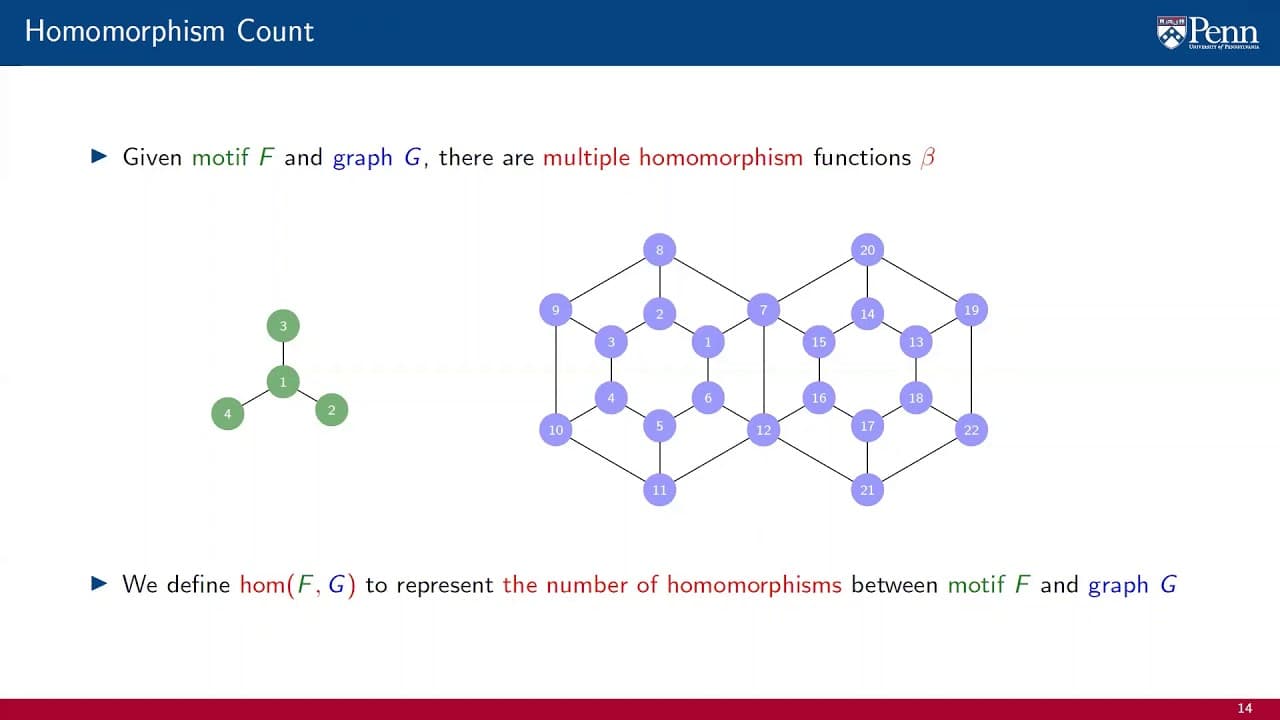
- Motifs are small graphs that can be embedded into larger graphs in multiple ways, forming the basis for understanding homomorphisms and homomorphism densities.
- Homomorphisms are adjacency-preserving maps from a motif to a larger graph, and their count is crucial for determining homomorphism densities.
- Homomorphism density is defined as the fraction of maps that are homomorphisms, offering a relative measure of how motifs can be embedded into graphs.
- The concept of graphons is introduced as the limit objects of convergent graph sequences, providing a framework for understanding graph convergence.
- Convergence of graph sequences to graphons is defined in terms of homomorphism densities, with every graphon being the limit of a convergent graph sequence.
- Random graphs drawn from a graphon demonstrate almost sure convergence to the graphon, illustrating the theoretical concepts with practical examples.
- The notion of the graphon-induced graph is introduced, where each undirected graph can be represented by a graphon, providing a new perspective on graph representation.
Install to Summarize YouTube Videos and Get Transcripts
Explore YouTube Video Summarizer or Get YouTube Transcript Extractor
Questions & Answers
Q: What is the main focus of the video?
The main focus of the video is to explain the concept of convergence in graph sequences using homomorphism densities as a measure. It introduces graphons as the limit objects of these convergent sequences and delves into related concepts such as motifs, homomorphisms, and homomorphism densities, providing examples and theoretical frameworks.
Q: How are motifs used in the context of graph sequences?
Motifs are small graphs that can be embedded into larger graphs in multiple ways. They serve as the basis for understanding homomorphisms and homomorphism densities. By examining how motifs can be embedded into graphs, we gain insights into the structure and convergence properties of graph sequences, which is crucial for defining graphons.
Q: What is a homomorphism in graph theory?
A homomorphism in graph theory is an adjacency-preserving map from a motif to a larger graph. It ensures that the adjacency relationships in the motif are maintained in the larger graph. The count of such homomorphisms is essential for determining homomorphism densities, which measure how motifs can be embedded into graphs and are key to understanding graph convergence.
Q: What role do homomorphism densities play in graph convergence?
Homomorphism densities play a crucial role in graph convergence as they provide a relative measure of how motifs can be embedded into graphs while preserving adjacency structures. By examining homomorphism densities, we can determine if a sequence of graphs converges to a graphon, the limit object of convergent graph sequences, thus offering a framework for understanding graph convergence.
Q: How is a graphon defined in the context of graph sequences?
A graphon is defined as the limit object of a convergent graph sequence, characterized by the convergence of homomorphism densities for all motifs. It provides a continuous representation of the limiting behavior of graph sequences, allowing for a deeper understanding of graph convergence and the relationships between different graph structures.
Q: What is the significance of random graphs in the video?
Random graphs are significant in the video as they illustrate the concept of almost sure convergence to a graphon. By drawing random graphs from a graphon, we can observe how these graphs converge to the graphon in the homomorphism density sense, providing practical examples that demonstrate the theoretical concepts discussed in the lecture.
Q: What is a graphon-induced graph?
A graphon-induced graph is a representation of an undirected graph using a graphon. It involves constructing a partition of the unit interval and assigning weights based on the graphon's image. This concept allows for a new perspective on graph representation, demonstrating how each undirected graph can be associated with a graphon, which is useful for understanding graph convergence.
Q: How does the lecture illustrate the convergence of graph sequences?
The lecture illustrates the convergence of graph sequences by providing examples of random graphs drawn from a graphon, demonstrating almost sure convergence to the graphon. It uses motifs, homomorphisms, and homomorphism densities to explain the theoretical framework of graph convergence, offering a comprehensive understanding of how graph sequences converge to their limit objects, the graphons.
Summary & Key Takeaways
-
The lecture introduces the concept of graph sequence convergence through homomorphism densities, with graphons serving as the limit objects. Key concepts such as motifs, homomorphisms, and homomorphism densities are explained, providing a foundation for understanding graph convergence.
-
Examples of convergent graph sequences and their graphons are provided, illustrating how theoretical concepts apply in practice. The lecture emphasizes that every graphon is the limit of a convergent graph sequence, highlighting the importance of homomorphism densities in graph theory.
-
The concept of graphon-induced graphs is introduced, demonstrating how each undirected graph can be represented by a graphon. This provides a new way to view graph representation and convergence, with practical examples illustrating the theoretical framework.
Read in Other Languages (beta)
Share This Summary 📚
Summarize YouTube Videos and Get Video Transcripts with 1-Click
Try YouTube Summary with ChatGPT & Claude or YouTube Transcript Generator
Explore More Summaries from Alelab Alelab 📚
Summarize YouTube Videos and Get Video Transcripts with 1-Click
Try YouTube Summary with ChatGPT & Claude or YouTube Transcript Generator