An Applied Model for Using Variability in Practice
TL;DR
In this video, Rob Gray from the Perception Action Podcast provides a comprehensive review of a paper titled 'An Applied Model for Using Variability in Practice'. The video delves into how variability can be applied in practice settings, exploring different types of variability and their relevance to various motor learning theories. It critiques the paper's approach, emphasizing the importance of understanding different theoretical perspectives on motor learning.
Transcript
hi everyone this is Rob Gray from ASU and the perception action podcast back with another article review in today's episode I want to review a paper that attempts to do something I think a lot of people are looking for right how do I take the basic research findings you know around for example variability of practice and actually apply them right h... Read More
Key Insights
- The paper reviewed attempts to apply basic research findings on variability in practice to real-world settings, addressing when and how to incorporate variability.
- Variability in practice is linked to generalization, a cognitive information processing concept, but ecological dynamics focus on degeneracy and multiple solutions.
- Four types of variability are identified: numerosity, heterogeneity, situational diversity, and scheduling, each influencing practice differently.
- The paper maps variability types onto various motor learning theories, suggesting that variability serves a purpose regardless of the theory subscribed to.
- The review critiques the paper's theoretical stance, particularly its focus on fundamentals and adjustability, contrasting it with ecological dynamics' adaptability approach.
- Three key principles for implementing variability are highlighted: level of difficulty, managing expectations, and representative design, though the latter is critiqued for its definition.
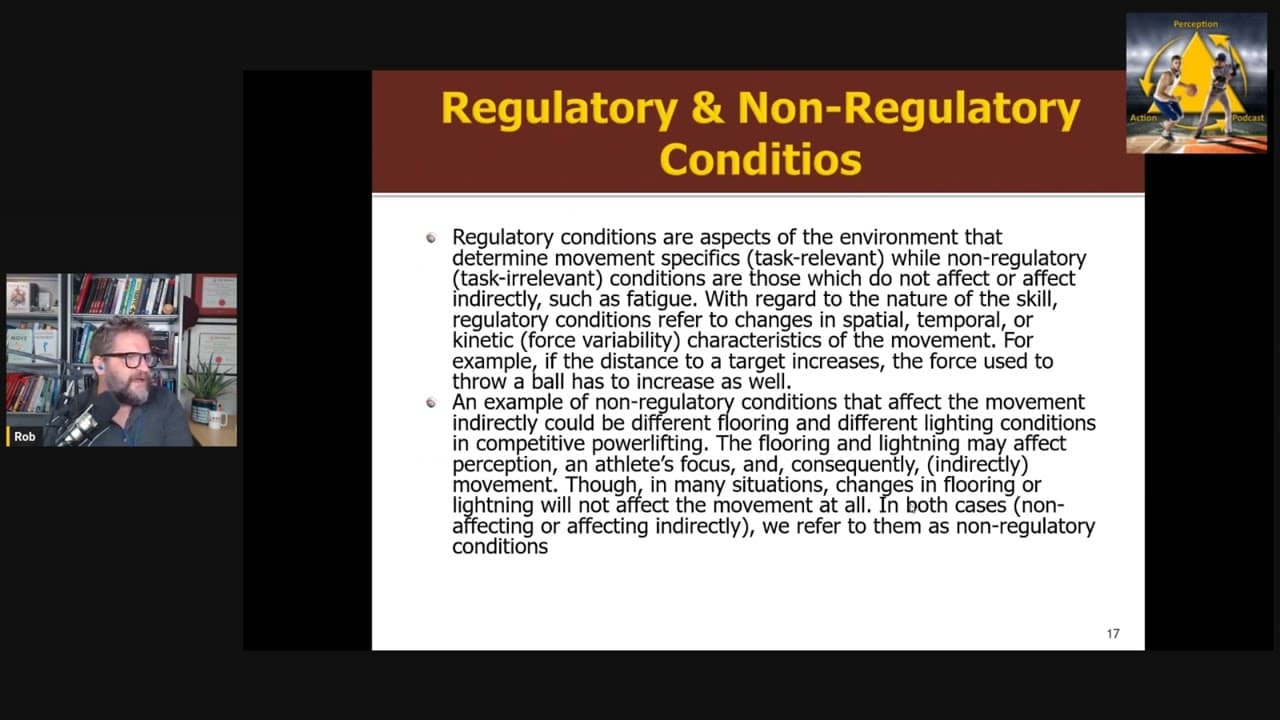
- The concept of regulatory and non-regulatory conditions is introduced, distinguishing between conditions that directly affect movement patterns and those that do not.
- The review concludes that the paper leans heavily on information processing ideas, lacking a contemporary model that considers ecological dynamics and self-organization.
Install to Summarize YouTube Videos and Get Transcripts
Explore YouTube Video Summarizer or Get YouTube Transcript Extractor
Questions & Answers
Q: What is the main focus of the paper reviewed in the video?
The main focus of the paper is to explore how variability in practice can be applied in real-world settings. It attempts to address questions such as when and how to incorporate variability, and what type of variability to use. The paper aims to provide a framework for applying research findings on variability to practical situations, with a focus on motor learning theories.
Q: What are the four types of variability discussed in the paper?
The four types of variability discussed in the paper are numerosity, heterogeneity, situational diversity, and scheduling. Numerosity refers to the number of examples or practice variations, heterogeneity relates to the similarity of movements across variants, situational diversity involves different environmental conditions, and scheduling pertains to the order and spacing of practice sessions.
Q: How does the paper relate variability to motor learning theories?
The paper attempts to map different types of variability onto various motor learning theories, suggesting that variability serves a purpose regardless of the theory subscribed to. It discusses theories such as Bernstein's repetition without repetition, schema theory, ecological dynamics, and others, highlighting that variability is beneficial across different theoretical frameworks.
Q: What critique does the review offer regarding the paper's theoretical stance?
The review critiques the paper's theoretical stance for leaning heavily on traditional information processing ideas, particularly the focus on fundamentals and adjustability. It contrasts this with ecological dynamics, which emphasizes adaptability and problem-solving. The review suggests that the paper does not incorporate contemporary models that consider self-organization and multiple solutions.
Q: What are the three key principles for implementing variability according to the paper?
The three key principles for implementing variability according to the paper are: 1) Level of difficulty - ensuring the difficulty is appropriate for the athlete's skill level; 2) Managing expectations - considering learner motivation and confidence; 3) Representative design - ensuring practice variations simulate competitive contexts. However, the review critiques the definition of representative design used in the paper.
Q: How does the review define the concept of representative design?
The review criticizes the paper's definition of representative design as being too focused on specificity, suggesting it should not aim to recreate competition exactly. Instead, representative design should retain essential elements like action fidelity and affordances, allowing for practice conditions that may not occur in competition but still enhance problem-solving and adaptability.
Q: What is the role of regulatory and non-regulatory conditions in practice variability?
Regulatory conditions are those that directly affect the movement pattern, such as the weight of a ball or distance to a target, requiring specific adjustments. Non-regulatory conditions, like different lighting or flooring, affect movement more indirectly. The paper discusses how these conditions can be manipulated to influence practice variability and learning outcomes.
Q: What conclusion does the review draw about the paper's contribution to motor learning?
The review concludes that while the paper provides an applied model for using variability, it is heavily rooted in traditional information processing theories and lacks a contemporary perspective that incorporates ecological dynamics and self-organization. The review emphasizes that the application of variability in practice depends on the motor learning theory one subscribes to, highlighting the diversity of approaches.
Summary & Key Takeaways
-
Rob Gray reviews a paper on applying variability in practice, critiquing its reliance on traditional information processing theories. The paper identifies four types of variability and maps them onto motor learning theories but is criticized for not incorporating ecological dynamics.
-
The paper suggests three principles for implementing variability: difficulty level, managing expectations, and representative design. However, the review challenges the paper's definition of representative design and its emphasis on fundamentals and adjustability over adaptability.
-
The review highlights the importance of theoretical perspective in determining how variability is applied, emphasizing that different motor learning theories offer distinct approaches to using variability in practice.
Read in Other Languages (beta)
Share This Summary 📚
Summarize YouTube Videos and Get Video Transcripts with 1-Click
Try YouTube Summary with ChatGPT & Claude or YouTube Transcript Generator
Explore More Summaries from Rob Gray 📚

Summarize YouTube Videos and Get Video Transcripts with 1-Click
Try YouTube Summary with ChatGPT & Claude or YouTube Transcript Generator