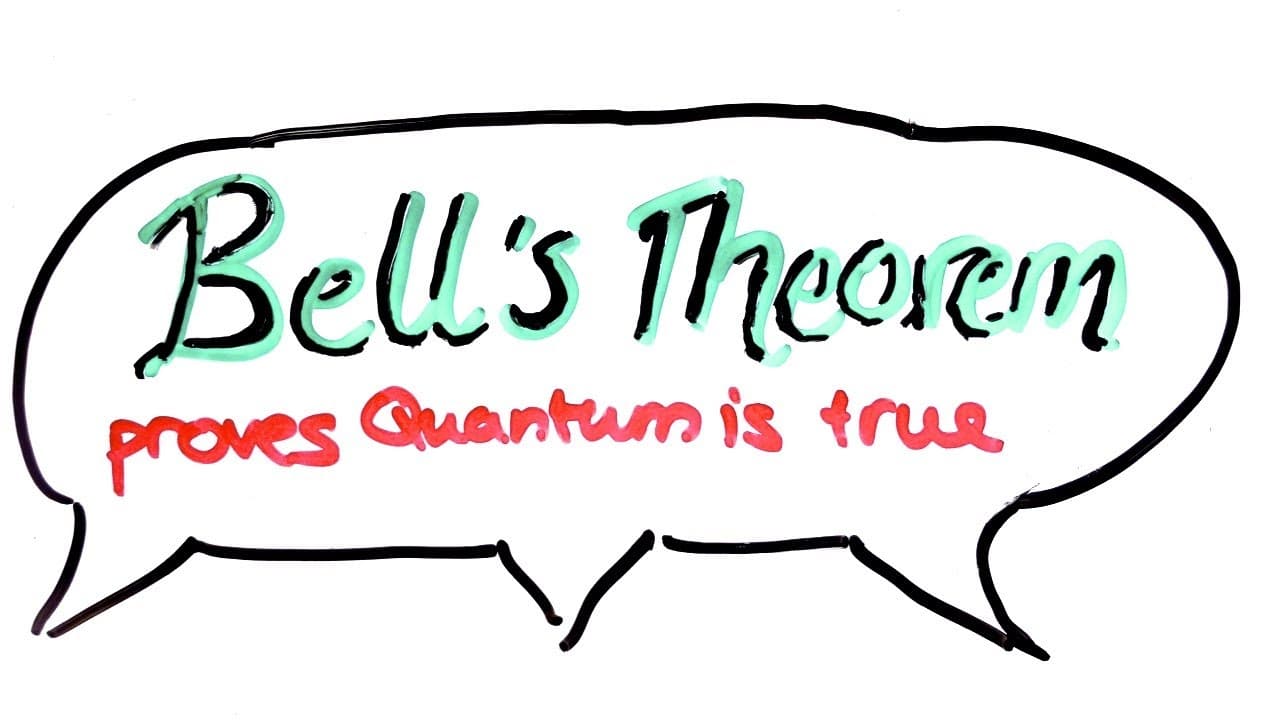
Does Bell's Theorem Prove Quantum Mechanics True?
TL;DR
Bell's theorem reveals that entangled particles can communicate faster than light, challenging conventional understanding of quantum mechanics. While it does not definitively prove quantum mechanics, it demonstrates that theories suggesting 'talking particles' cannot be entirely dismissed. This opens up further questions about the implications for relativity and alternative interpretations like Bohmian Mechanics.
Transcript
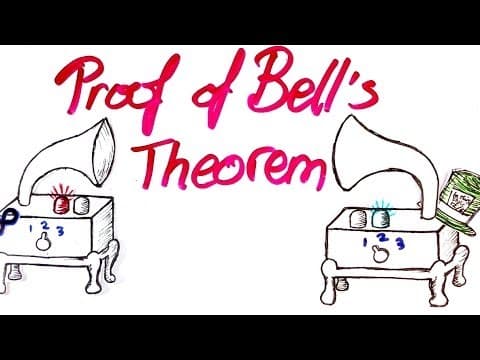
Today I am going to tell you about one of my favourite results, Bell's theorem, that answers the EPR paradox. But instead of proving the thing here, I've decided to push that to the next video, and instead just tell you the result and explain what it actually means. That's because this is the most misunderstood theorem of science that I know of. I ... Read More
Key Insights
- 🦾 Bell's theorem addresses the misunderstood concept of quantum mechanics and its superposition principle.
- ❓ The EPR paradox challenges superposition by suggesting that entangled particles must communicate, a notion that conflicts with the principles of relativity.
- 🙂 The results of Bell's experiment indicated that particles do communicate faster than light, aligning with quantum mechanics.
- 👍 Quantum mechanics is not proved to be correct by Bell's theorem, but it is not debunked either.
- ❓ The No Communication theorem suggests that manipulating entangled particles to send specific messages is impossible.
- 🦾 Bohmian Mechanics offers an alternative to quantum mechanics, involving talking particles but without superposition.
- ❓ Understanding Bell's theorem has implications for the theory of relativity and may require reevaluating certain assumptions.
Install to Summarize YouTube Videos and Get Transcripts
Explore YouTube Video Summarizer or Get YouTube Transcript Extractor
Questions & Answers
Q: How does the EPR paradox challenge the concept of superposition?
The EPR paradox argues that entangled particles must communicate, contradicting the superposition principle. According to EPR, if one particle is observed to have a certain property, the other particle must have a corresponding property without needing direct communication.
Q: Does Bell's theorem prove that quantum mechanics is correct?
No, Bell's theorem does not directly prove the accuracy of quantum mechanics. Instead, it demonstrates that quantum mechanics is not incorrect in terms of particles communicating faster than light.
Q: What implications does Bell's theorem have on the theory of relativity?
Bell's theorem challenges the assumption of the theory of relativity that nothing can surpass the speed of light. If particles can communicate faster than light, it could lead to logical inconsistencies in relativity, such as messages being received before they are sent.
Q: Is there an alternative theory to quantum mechanics that explains the observed phenomena without superposition?
Yes, Bohmian Mechanics is a promising alternative that involves talking particles but does not rely on superposition. It offers an intriguing perspective and may provide a deeper understanding of quantum phenomena.
Summary & Key Takeaways
-
Bell's theorem addresses the misunderstood concept of quantum mechanics and its superposition principle, where particles can exist in multiple states simultaneously.
-
The EPR paradox attempts to disprove superposition by suggesting that entangled particles must communicate with each other.
-
If nothing can travel faster than light, all theories with "talking particles" (including quantum mechanics) would be incorrect.
-
After conducting an experiment, it was discovered that particles do communicate faster than light, which aligns with quantum mechanics.
Read in Other Languages (beta)
Share This Summary 📚
Summarize YouTube Videos and Get Video Transcripts with 1-Click
Try YouTube Summary with ChatGPT & Claude or YouTube Transcript Generator
Explore More Summaries from Looking Glass Universe 📚

Summarize YouTube Videos and Get Video Transcripts with 1-Click
Try YouTube Summary with ChatGPT & Claude or YouTube Transcript Generator