Electrostatic Generator - Generation of High Voltage and High Current - High Voltage Engineering
TL;DR
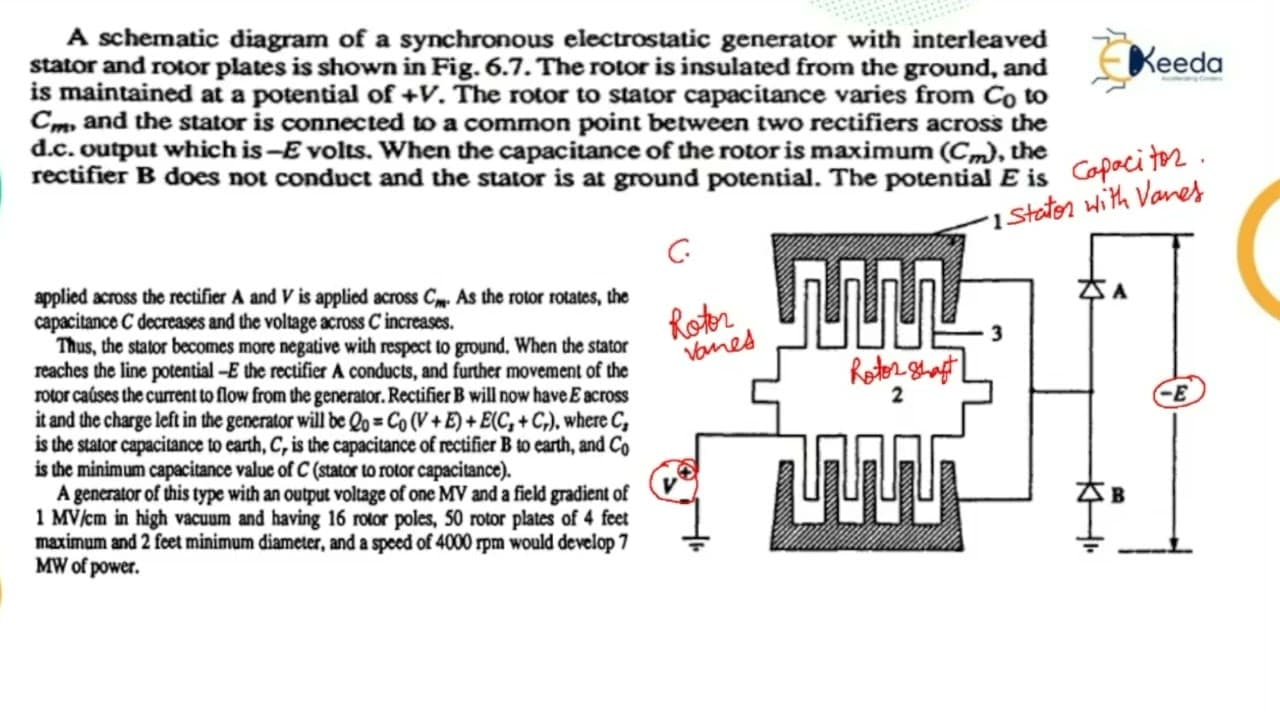
Electrostatic generators convert mechanical energy into electrical energy using variable capacitors in high vacuum.
Transcript
so hello friends let us discuss our second part of electrostatic machine after van der graaff generator is electrostatic generator what are the problems in electronic graph generator it is basically essentially have the high voltage but that can have low power devices and their power rating exceeds few tens of kilowatts as such in electrostatic mac... Read More
Key Insights
- ✋ Electrostatic generators convert mechanical energy into electrical energy using variable capacitors in high vacuum.
- ⚾ They are duals of electromagnetic machines and operate based on the principle of variable capacitance.
- 🦻 The stator and rotor form a variable capacitor, with rectifiers aiding in DC voltage development.
- 🖐️ Insulated rotor plates and stator capacitors play essential roles in the generator's operation.
- ✊ The generator can produce significant power outputs, such as seven megawatts, for testing insulation.
- ✊ Electrostatic generators are critical in providing DC power for testing specimens and insulation.
- 🥺 Capacitance variation in the generator leads to changes in voltage and current flow, aiding in power generation.
Install to Summarize YouTube Videos and Get Transcripts
Explore YouTube Video Summarizer or Get YouTube Transcript Extractor
Questions & Answers
Q: How do electrostatic generators convert mechanical energy into electrical energy?
Electrostatic generators convert mechanical energy into electrical energy using variable capacitors in high vacuum. The dual principle of electromagnetic machines is applied, generating DC power for various applications.
Q: What is the function of the stator and rotor in an electrostatic generator?
In an electrostatic generator, the stator and rotor work together to create a variable capacitor. The rotor is insulated and maintained at a potential, while the stator is connected to rectifiers for DC voltage development.
Q: What is the role of the rectifiers in an electrostatic generator?
The rectifiers in an electrostatic generator help develop DC output voltage by conducting current based on the capacitance variation. They ensure the generation of DC power from mechanical energy conversion.
Q: How is an electrostatic generator used in testing insulation?
Electrostatic generators are used to test insulation by generating DC power that can be utilized to test specimens. The high vacuum operation and variable capacitor principle make them ideal for such testing applications.
Summary & Key Takeaways
-
Electrostatic generators use variable capacitors to convert mechanical energy to electrical energy in high vacuum.
-
Duals of electromagnetic machines, they operate based on the variable capacitance principle, generating DC power for testing insulation.
-
The generators consist of a stator with an interleaved rotor, forming a variable capacitor that operates in a vacuum.
Read in Other Languages (beta)
Share This Summary 📚
Summarize YouTube Videos and Get Video Transcripts with 1-Click
Try YouTube Summary with ChatGPT & Claude or YouTube Transcript Generator
Explore More Summaries from Ekeeda 📚




Summarize YouTube Videos and Get Video Transcripts with 1-Click
Try YouTube Summary with ChatGPT & Claude or YouTube Transcript Generator