Explicitly defining a series
TL;DR
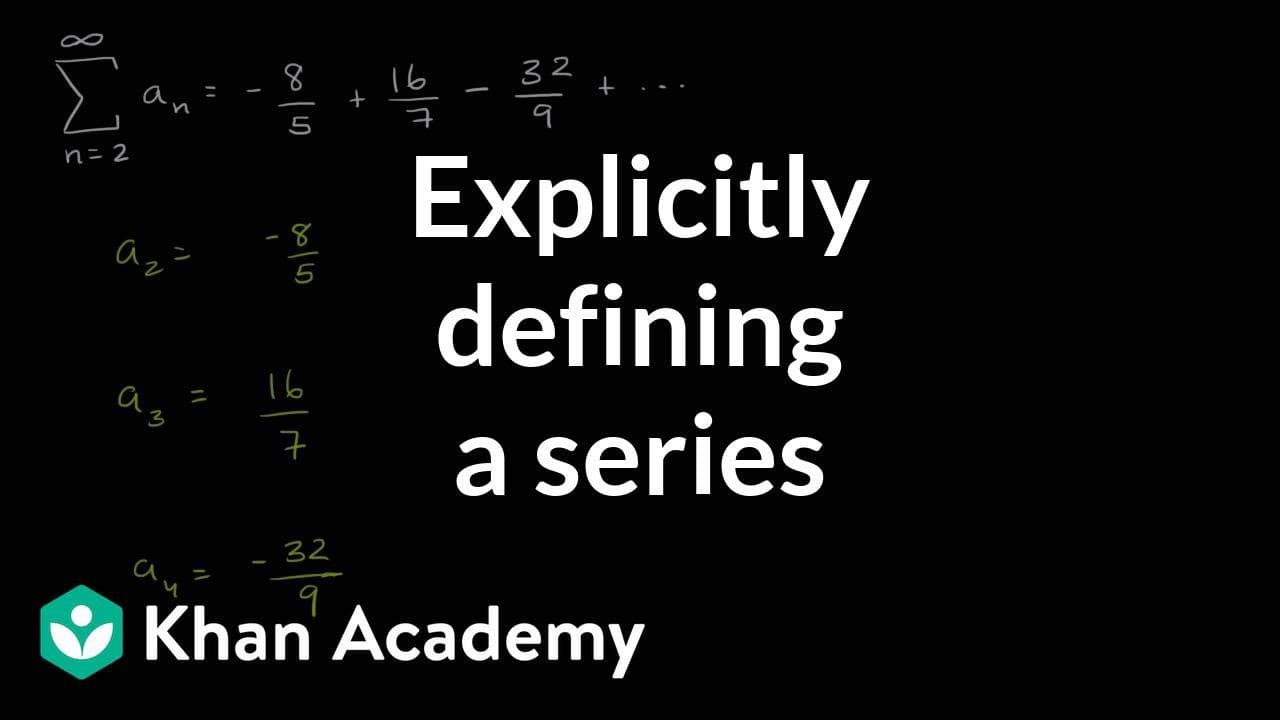
This video explains how to find the pattern in an infinite series and explicitly define the terms using sigma notation.
Transcript
Let's say that we're told that this sum right over here, where our index starts at 2 and we go all the way to infinity, that this infinite series is negative 8/5 plus 16/7 minus 32/9 plus-- and we just keep going on and on forever. And so what I want to do is to explicitly define what a sub n is here. So right now we just say, hey, if you take the ... Read More
Key Insights
- ❓ It is essential to identify patterns in both the numerator and denominator of an infinite series.
- 😑 The numerator can often be expressed as a power of a constant, where the exponent is related to the index.
- 🫰 The denominator may involve a linear pattern where each term is obtained by multiplying the index by a constant and adding another constant.
- 👻 Understanding these patterns allows for the explicit definition of terms in an infinite series.
- 💨 Sigma notation provides a concise way to represent and calculate the sum of an infinite series.
Install to Summarize YouTube Videos and Get Transcripts
Explore YouTube Video Summarizer or Get YouTube Transcript Extractor
Questions & Answers
Q: How can we define the terms of an infinite series explicitly in terms of n?
To define the terms explicitly in terms of n, we need to analyze the patterns in both the numerator and the denominator. In this example, the numerator follows a pattern of negative powers of -2, while the denominator follows a pattern of 2n + 1.
Q: What does the numerator of the series represent in this example?
The numerator represents the value obtained by raising -2 to the power of the index plus 1. It follows a pattern where the exponent of -2 is always one more than the index.
Q: How can we define the denominator of the series in terms of n?
The denominator follows a pattern of 2n + 1. Each term in the series has a denominator that is obtained by multiplying 2 by the index and adding 1.
Q: How can we express the series using sigma notation?
The series can be expressed as the sum from n equals 2 to infinity of (-2)^(n + 1) / (2n + 1). This sigma notation represents the infinite sum of all the terms in the series.
Summary & Key Takeaways
-
The video discusses how to define the terms of an infinite series explicitly in terms of n.
-
It shows an example of a series where the numerator follows a pattern of negative powers of -2, while the denominator follows a pattern of 2n + 1.
-
By understanding the patterns, the series can be expressed using sigma notation.
Read in Other Languages (beta)
Share This Summary 📚
Summarize YouTube Videos and Get Video Transcripts with 1-Click
Try YouTube Summary with ChatGPT & Claude or YouTube Transcript Generator
Explore More Summaries from Khan Academy 📚



Summarize YouTube Videos and Get Video Transcripts with 1-Click
Try YouTube Summary with ChatGPT & Claude or YouTube Transcript Generator