Sin Cos Tan - Trigonometry Table
TL;DR
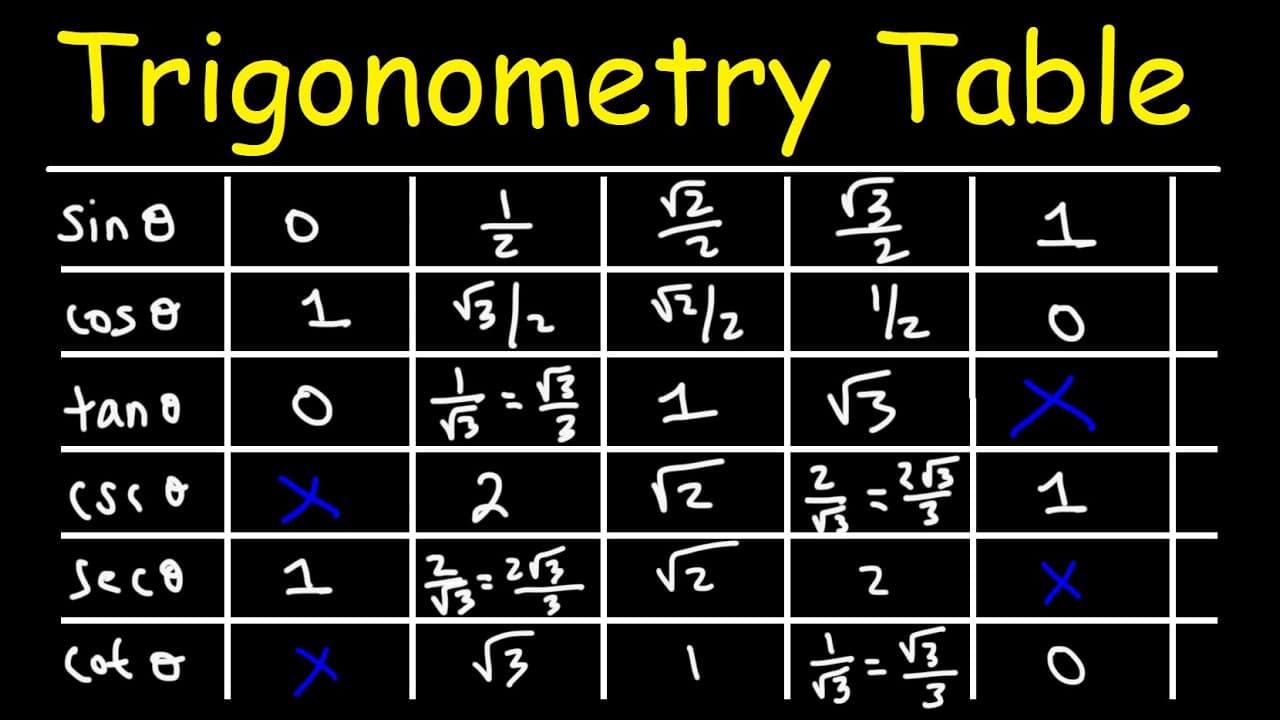
Learn how to calculate and understand the common trigonometric values for angles 0, 30, 45, 60, and 90 degrees.
Transcript
in this video we're going to construct a table of common trigonometric values that you'll typically see on an exam so the six common functions need to be familiar with are sine Theta cosine Theta tangent and then we have cosecant which is the reciprocal of sine and then secant Theta that's the reciprocal of cosine and cotangent Theta which is the r... Read More
Key Insights
- 👨💼 There are six common trigonometric functions: sine, cosine, tangent, cosecant, secant, and cotangent.
- 🔺 The angles 0, 30, 45, 60, and 90 degrees are frequently encountered in trigonometry.
- 🆘 Understanding the relationship between radians and degrees can help in converting between the two.
- 👨💼 The sine function follows a specific pattern as the angle increases, making it easier to memorize the values.
- 👨💼 The reciprocal of sine is cosecant, and the reciprocal of cosine is secant.
- ❓ Tangent is positive in quadrants 1 and 3, while cotangent is the reciprocal of tangent.
- ❓ Some trigonometric values, like secant 90 degrees and cotangent 0 degrees, are undefined.
Install to Summarize YouTube Videos and Get Transcripts
Explore YouTube Video Summarizer or Get YouTube Transcript Extractor
Questions & Answers
Q: What are the six common trigonometric functions?
The six common trigonometric functions are sine, cosine, tangent, cosecant, secant, and cotangent.
Q: What are the angles to be familiar with?
The angles to be familiar with are 0, 30, 45, 60, and 90 degrees.
Q: How can you calculate the trigonometric values for these angles?
By understanding the relationship between radians and degrees, and using the reciprocal and square root functions, you can calculate the trigonometric values for these angles.
Q: Why is sine positive in quadrants 1 and 2 but negative in quadrants 3 and 4?
Sine is positive in quadrants 1 and 2 because the y-values are above the x-axis. However, it becomes negative in quadrants 3 and 4 because the y-values are below the x-axis.
Q: How can you calculate the value of tangent 30 degrees?
To calculate the value of tangent 30 degrees, divide 1/2 by the square root of 3. This simplifies to the square root of 3 over 3.
Q: What is the reciprocal of cosecant 45 degrees?
The reciprocal of cosecant 45 degrees is 2 over the square root of 2, which can be simplified to the square root of 2.
Q: Why is secant 90 degrees undefined?
Secant is the reciprocal of cosine, and since cosine 90 degrees is 0, the reciprocal of 0 is undefined.
Q: What is the value of cotangent 60 degrees?
The value of cotangent 60 degrees is 1 over the square root of 3, which can be simplified to the square root of 3 over 3.
Summary & Key Takeaways
-
There are six common trigonometric functions: sine, cosine, tangent, cosecant, secant, and cotangent.
-
The angles to be familiar with are 0, 30, 45, 60, and 90 degrees.
-
By understanding the relationship between radians and degrees, and using the reciprocal and square root functions, you can easily calculate the trigonometric values for these angles.
Read in Other Languages (beta)
Share This Summary 📚
Summarize YouTube Videos and Get Video Transcripts with 1-Click
Try YouTube Summary with ChatGPT & Claude or YouTube Transcript Generator
Explore More Summaries from The Organic Chemistry Tutor 📚

Summarize YouTube Videos and Get Video Transcripts with 1-Click
Try YouTube Summary with ChatGPT & Claude or YouTube Transcript Generator