Clearing and Staining Fishes
TL;DR
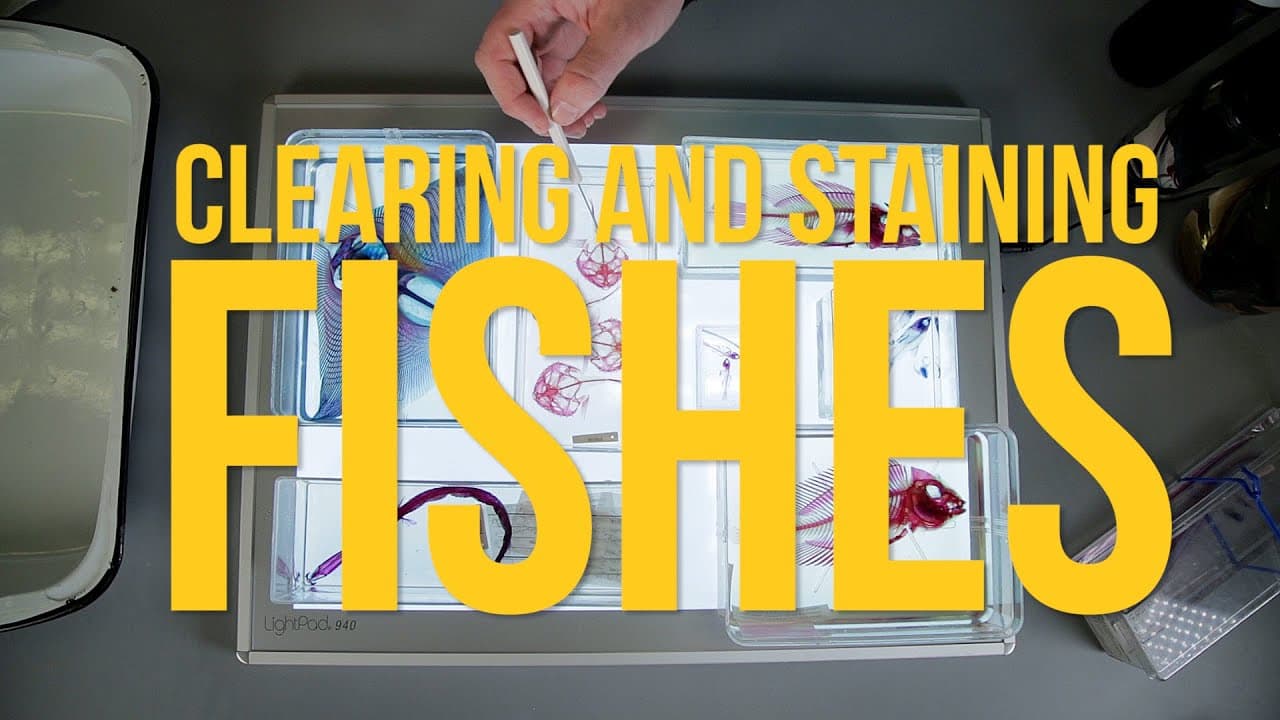
Clearing and staining process visualizes skeletons using dyes, enzymatic digestion, and glycerin, providing 3D insights.
Transcript
So we're here with Dr. Caleb McMahan, who is the collection manager of Fishes here at the Field Museum, and today we're going to be talking about clearing and staining. What is clearing and staining? Caleb: So, clearing and staining is a process where we take an entire specimen and we clear that specimen down and use different stains to stain diffe... Read More
Key Insights
- ❓ Clearing and staining involve tissue removal, staining, enzymatic digestion, and glycerin storage for 3D visualization.
- 🦻 The process aids in tracking growth, evolution, and morphology changes in species like fish, reptiles, and amphibians.
- 🦷 Cleared and stained specimens offer insights into biomechanics, teeth morphology, and jaw movement across different species.
- 🚱 The process is non-destructive, altering the appearance of specimens to answer diverse scientific questions.
- 🙂 Glycerin storage provides a refractive index that enhances visibility of skeletons on light trays.
- 🪪 Clearing and staining methods help in species identification through internal skeletal characteristics.
- 🥺 Research using cleared and stained specimens has led to novel discoveries in morphology, evolution, and biomechanics.
Install to Summarize YouTube Videos and Get Transcripts
Explore YouTube Video Summarizer or Get YouTube Transcript Extractor
Questions & Answers
Q: How is the clearing and staining process carried out on specimens?
The process involves tissue removal, dehydration, staining with specific dyes, clearing with trypsin, and storage in glycerin for 3D visibility.
Q: What benefits does clearing and staining offer over methods like x-rays?
Clearing and staining provide 3D visualization of skeletons essential in studying evolution, development, and anatomy in species, unlike x-rays.
Q: What discoveries have been made using cleared and stained specimens?
Researchers have uncovered insights into teeth morphology, biomechanics, and jaw movement across species and groups using cleared and stained specimens.
Q: Can the clearing and staining process be applied to humans?
While theoretically possible, clearing and staining a human would be expensive and extensive, primarily used in studying vertebrates like fish and reptiles.
Summary & Key Takeaways
-
Clearing and staining involve removing tissue, dehydrating, staining with alcian blue and alizarin red, and clearing with trypsin.
-
The process allows 3D visualization of skeletons and helps track growth and evolution in species.
-
It is used not only in fish but also in other vertebrates, offering insights into morphology and biomechanics.
Read in Other Languages (beta)
Share This Summary 📚
Summarize YouTube Videos and Get Video Transcripts with 1-Click
Try YouTube Summary with ChatGPT & Claude or YouTube Transcript Generator
Explore More Summaries from thebrainscoop 📚




Summarize YouTube Videos and Get Video Transcripts with 1-Click
Try YouTube Summary with ChatGPT & Claude or YouTube Transcript Generator